Alexander Revisited Blu-ray Movie
HomeAlexander Revisited Blu-ray Movie 
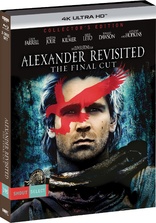
The Final Cut 4K / Collector's Edition / 4K Ultra HD + Blu-rayShout Factory | 2004 | 214 min | Unrated | Jul 01, 2025

Movie rating
5.9 | / 10 |
Blu-ray rating
| Users |  | 4.5 |
| Reviewer |  | 3.5 |
| Overall | | 3.5 |
Overview
Alexander Revisited (2004)
Oliver Stone's "Alexander" is based on the true story of one of history's most luminous and influential leaders – a man who had conquered 90% of the known world by the age of 25. The film chronicles Alexander's path to becoming a living legend, from a youth fuelled by dreams of myth, glory, and adventure, to his intense bonds with his closest companions, to his lonely death as a ruler of a vast empire.
Starring: Colin Farrell, Angelina Jolie, Val Kilmer, Christopher Plummer, Jared LetoDirector: Oliver Stone
| Action | Uncertain |
| Adventure | Uncertain |
| Epic | Uncertain |
| History | Uncertain |
| War | Uncertain |
| Drama | Uncertain |
| Biography | Uncertain |
Specifications
Video
Video codec: HEVC / H.265
Video resolution: 4K (2160p)
Aspect ratio: 2.39:1
Original aspect ratio: 2.35:1
Audio
English: Dolby Atmos
English: Dolby TrueHD 7.1 (48kHz, 24-bit)
English: DTS-HD Master Audio 5.1
English: DTS-HD Master Audio 2.0 (48kHz, 24-bit)
Subtitles
English SDH
Discs
Blu-ray Disc
Two-disc set (2 BDs)
4K Ultra HD
Packaging
Slipcover in original pressing
Playback
Region A (B, C untested)
Review
Rating summary
| Movie |  | 4.0 |
| Video |  | 0.0 |
| Audio | | 4.5 |
| Extras | | 3.5 |
| Overall | | 3.5 |
Alexander Revisited Blu-ray Movie Review
Reviewed by Dr. Stephen Larson July 19, 2025There are four versions of Oliver Stone's Alexander: a 175-minute Theatrical Cut (2004), a 166-minute Director's Cut (2005), a 213-minute Final Cut (2007), and a 206-minute Ultimate Cut (2014). Sir Terrence reviewed WB's 2007 Blu-rays of Alexander Revisited (the third cut) and Reviewer Emeritus Michael Reuben covered
WB's 2014 BD-50s of The Ultimate Cut and the Theatrical Cut. WB also issued an individual release of TUC the same year. The only stand-alone Blu-ray edition of the TC has been put out by Warner Bros. UK.
I am proud to acknowledge that I saw Alexander twice in theaters during its unexpectedly shortened run, including on opening day on the eve of Thanksgiving. While I feel then and now that the TC is pretty good, the initial version seemed crammed and tightly edited. When I recently re-watched Revisited, the focus on the internal divisions fomenting in Alexander's armies were clearer to me. The back-and-forth structure also illuminated the strong influence Alexander's parents had on him as an adult. Since the film has such a large ensemble, the added footage and restructuring of the narrative were beneficial in helping to explain the roles the same set of characters had in the different periods that are depicted. I also feel that Revisited expands significantly on Alexander's relationship with the eunuch, Bagoas (Francisco Bosch).
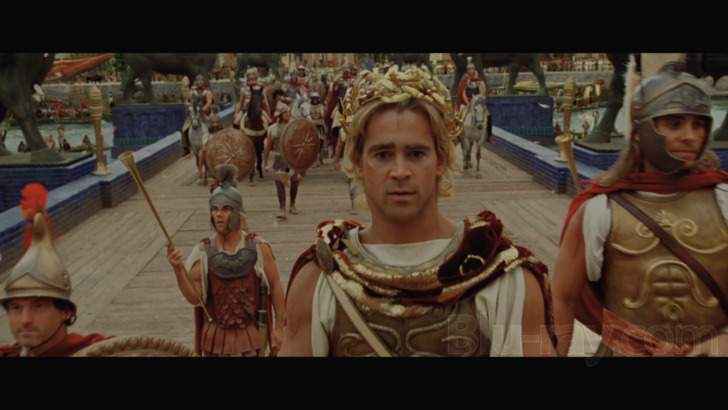
King Alexander gallops into the palace.
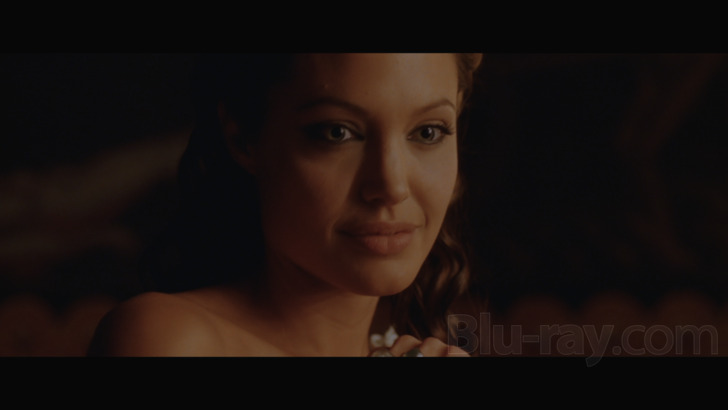
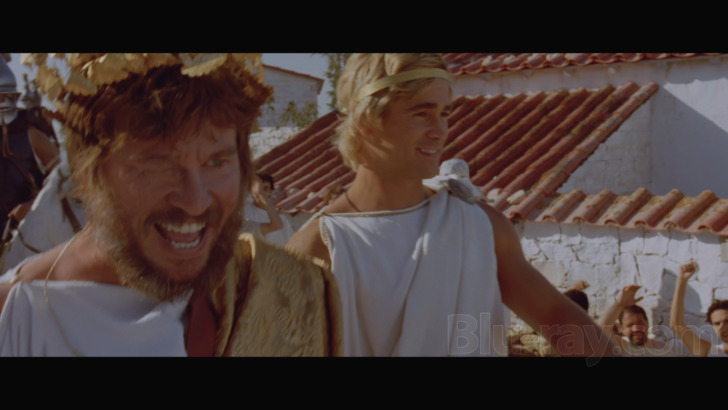
In terms of what he brings to the character of King Phillip and his interactions with other actors, dearly departed Val Kilmer delivers the strongest and best performance of all. I understand the criticism that Angelina Jolie and Colin Farrell were far too close in age to portray mother and son. (Jolie is only ten months older than Farrell.) It should be pointed out, though, that the makeup and shorter hair on Farrell make him look younger when he appears with Jolie in a scene on Queen Olympias's balcony in flashback. Farrell gives it his all in the crucial title role. But Farrell's performance pales in comparison to Richard Burton's in Robert Rossen's Alexander the Great (1956). A towering historical figure like Alexander requires an actor to portray him with the stature of a Burton, who is one of the giants of stage and screen. (Farrell has given superior performances before and since playing Alexander.) I want to be clear, though, that any cut of Stone's Alexander (even the TC) is unquestionably better than Rossen's movie, which suffers from an uneven narrative structure.
In retrospect, I don't think that American audiences responded well to the acting in the party scenes portrayed in Alexander. They were perhaps expecting more modern performances and dialogue, which may have elicited negative word of mouth. The sometime highfalutin modes of performing, coupled with the debauchery shown in the party scenes, imbue Alexander with a "camp" quality. But maybe what Stone is saying is that Macedonians could act in "campy" ways in daily life and the parts shown in the film.
With a big tent-pole project like Alexander, the then-new executives at Warner Bros. made a huge mistake by not testing the movie before wide release. Effects work and editing were rushed so the studio could have delayed the picture till 2005 when it premiered at Cannes or another marquee festival. But since they wanted to get it out in the late autumn of '04 to qualify for awards season, they could have booked preview screenings and used the exit surveys patrons filled out as focus research so Stone could make tweaks to the film possibly by Christmastime. (After all, he had a lot of extra footage to work from.) That way, Warners could have averted the critical and commercial debacle that awaited them.
Alexander Revisited Blu-ray Movie, Video Quality
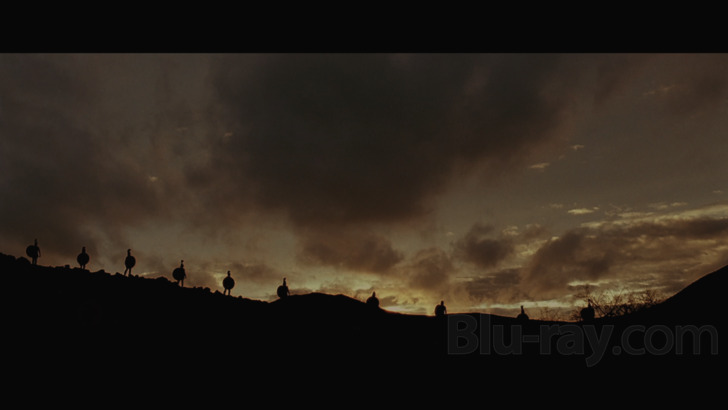
Shout Select's July "Collector's Edition" of Alexander Revisited comes with a slipcover with artwork unique to The Final Cut. (Warners' 2007 Two-Disc Special Edition DVDs also were housed with a slip.) The 4K Ultra HD Blu-ray is placed on a triple-layered disc (actual disc size: 91.2 GB) with the feature size occupying 88.5 GB of space. Please note that there isn't a separate 1080p Blu-ray for the extended feature. The UHD is based on a 4K scan of original elements supervised and approved by director/co-writer Oliver Stone. It is presented in Dolby Vision (HDR10 compatible). This is one of the weaker encodes from Shout due to the compression and lower bitrates. The feature boasts a mean video bitrate of only 45.6 Mbps and an overall bitrate of just 59.3 Mbps. Since Revisited runs for over three-and-a-half hours, it could have been spread to two BD-66s. Warners put Revisited on two discs for both its DVD and Blu-ray releases (though only on BD-25s for the latter). The first discs concluded after the intermission. Fortunately, the compression doesn't affect the quality on the UHD to a substantial degree. The scene in the caves with Philip (Val Kilmer) and the adolescent Alexander (Connor Paolo) is grainy and reveals some compression. But thankfully, there isn't any horrible banding. I viewed Revisited in HDR10 on a QLED and in Dolby Vision on an OLED. The DV appears to sport slightly warmer hues. There are some temperature fluctuations in different shots of the same scenes. For instance, I noticed a slight glaze over Old Ptolemy (Anthony Hopkins) and his Great Library in Alexandria compared to other shots where the glaze isn't apparent. It should be pointed out that the exterior shots have an artificial sunlight projected onto Ptolemy when he's looking across the horizon (which is more modulated as he stands over the balcony in Screenshot #8). There are also shots from within the library that have different lighting conditions (such as in frame grab #17). The color discrepancies can also be explained because there were two different color timers for the Theatrical Cut and The Final Cut, which I'll address later.
I am highly familiar with the look of Alexander having watched its various cuts several times and having read a November 2004 cover story in American Cinematographer as well as two books on the making of the film. I will rely on these primary sources for this section. According to AC, director of photography Rodrigo Prieto shot Alexander in Super 35 mm with an aspect ratio of about 2.35:1. Prieto incorporated six different film stocks for a majority of the shoot. One of the biggest sequences Prieto filmed was the Macedonian siege at Guagamela versus the Persians. Prieto shot it on Kodak Vision 250D 5246 and filtered each lens with Tobacco #1. The DP explained to unit publicist Michael Singer in the movie's program, Alexander (InterMedia, 2004), that he wanted the tobacco filter used for the Moroccan desert and sand to carry an orange-yellow look (see screen capture #22). Singer writes that Prieto deployed two full camera units and rolled as many as eight cameras shooting between them on occasion.
When filming shifted to the Atlas Mountains near Marrakesh, Prieto kept Kodak 5246 but went to chocolate filters so reds on the wardrobes could become more pronounced. You can see how red stands out in the beautiful shot from behind Alexander, who's standing atop the Hindu Kush (see #19). Prieto told AC senior editor Rachael K. Bosley that he also made use of 80C filters to give the Atlas Mountains scenes shot in November a "platinum quality."
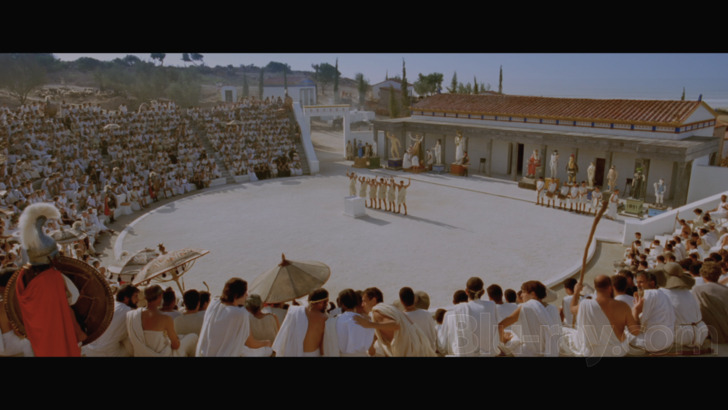
Prieto maintained the 5246 camera for day exteriors in the Babylon palace scenes. In his book, The Making of Alexander (R&L, 2004), ancient Greece historian Robin Lane Fox, who was on set for much of Stone's movie, wrote that Prieto employed golden filtrations and added a finer grain of film for this section compared to what was used for the Guagamela sequence. (See Screenshot #1.) Prieto told Singer that he gave the first Babylon sequences more saturated colors, which you can observe particularly on the 4K transfer.
Singer quoted Prieto as saying he went for a "very grainy film stock" when shooting the forest battle in India. In all of the transfers of Alexander that I have seen, this sequence has always appeared the grainiest, especially when Alexander rides Bucephalus rapidly through the thick and brush. For all of these scenes, Prieto applied ⅓ bleach-bypass on the negative. When he applied this amount at Éclair Laboratories in Paris, Prieto discovered that a fraction of bleach bypass applied in that lab is nearly the equivalent of a full bleach-bypass in the Los Angeles labs. ("Pretty intense," he confided to Bosley.)
When discussing the India scenes on a commentary track, Matt Zoller Seitz commits a technical error when he claims that the color infrared appearing on celluloid was an "accident" as the result of one of the reels getting "exposed" at an airport. Fox provides a detailed account his book about what actually happened. A "virus" materialized on the filmed footage as it was en-route to Thailand. Blue dots showed up on every eleventh frame of a batch which had returned from Éclair. Fox surmised that the spots could have something to do with the bleach-bypass process. But in the end, "enough of the footage was fine" and usable (Fox, p. 152–53).
Contrary to what Seitz says in his commentary, visual effects supervisor John Scheele states in a recent interview on Disc Two that it was Prieto's decision during filming to insert color infrared. This is corroborated by AC and Fox. Infrared was the seventh stock Prieto used, beginning when an injured Alexander falls from his horse in a daze (see Screenshot #s 38-40). According to Bosley, Prieto chose the stock Ektachrome 2443 EIR. The DP explained the color transformation to Bosley: "Green foliage turns magenta, the red of lips or blood turns yellow, and white skin turns pale white, almost translucent" (p. 39). Prieto viewed dailies of the infrared footage and was "exhilarated." I captured two additional shots showing the infrared (#s 24 and 25).
I want to return to my descriptions of the Alexandria sequences and supply some more details. Prieto told AC that he shot the library scenes on Eastman EXR 50D 5245 (day exteriors) and Vision 200T 5274 (day interiors). To capture a Mediterranean vibe, he placed a a Polarizer outside but didn't use any other filtration on the lens. Blue screen was set to the rear of the balcony. Prieto's crew shot VistaVision background plates in the island country of Malta. The camera team put two 100K SoftSuns on scissor-lifts just off the balcony to generate faux sunlight.
Following principal photography, Prieto went to Éclair to work on the 2K DI with digital timer Yvan Lucas. AC's Paris correspondent Benjamin Bergery interviewed Prieto and Lucas for the magazine's November '04 issue. Éclair is the facility where the production's footage was processed as both 35 mm dailies and HD video dailies throughout the whole shoot. Prieto supervised all the lab's work in August '04. He completed a color-correcting pass of an HD preview cut of Alexander on an Avid DS Nitris. The colors on this cut were a reference point during the DI process. Lucas said that Isabelle Julien assisted them in the grading. The reels were scanned using a Northlight film scanner. The film was printed on Kodak Vision Premier 2393 for 35 mm projection. When the time came for Stone to work on Revisited in 2007, Patrick C. Miller was brought in as color timer. The visual effects were completed by Diesel FX.
I have put together a graphical comparison between Warners' DVDs and Blu-rays with Shout's 4K. Notice how the sunlight on the face of Persian King Darius (Raz Degan) is considerably brighter in #s 26 and 27 than it is on the Shout transfer in #28. The same pattern applies in the two-shot featured in capture #s 29-31. The UHD separates itself from its format predecessors when there are wide shots with lots of actors crowded in a single frame. For instance, when I watched the 4K on a large screen, I could see Alexander (Colin Farrell) holding a cup in the center of an extreme long shot (#34). My downscaled screenshot isn't representative of the crisp clarity and detail you'll be able to pick out on a big screen. Similarly, features on Cleitus (Gary Stretch, seated with a black robe) are sharp and clear in a long shot (e.g., #37). I played the UHD back shot by shot on a 4K monitor and only detected one speckle (on a grassy plain). My video score for the UHD is 3.75/5.00. (It would have been higher had it not been for the subpar encode, which affects the image in darker shots.)
Screenshot #s 1-25, 28, 31, 34, 37, & 40 = Shout Select 2025 4K Ultra HD BD-100 (downsampled to 1080p)
Screenshot #s 26, 29, 32, 35, & 38 = Warner Bros. 2007 Two-Disc Special Edition DVDs
Screenshot #s 27, 30, 33, 36, & 39 = Warner Bros. 2007 Two-Disc Special Edition Blu-rays
The 213-minute feature contains a mere twelve chapter breaks on the UHD.
Alexander Revisited Blu-ray Movie, Audio Quality
Shout has supplied three audio track options to watch Alexander with on UHD (in addition to an archival commentary and a recent commentary): a new Dolby Atmos mix (Dolby TrueHD 7.1 compatible) encoded at an average bitrate of 3715 kbps and a maximum bitrate of 5949 kbps; a DTS-HD Master Audio 5.1 Surround mix (3873 kbps, 24-bit); and a DTS-HD Master Audio 2.0 Stereo downmix (2039 kbps, 24-bit). I focused on the Atmos track for this review. There are a lot of Irish actors performing Greek accents (in English). I could generally discern the words well without the optional English SDH turned on but that could be because I've seen Alexander so many times. I feel that the dialogue sounds a bit too soft at times, though. The thunderclap in some scenes provides some real ambiance on the height channels. The Atmos also delivers some fine low-end sounds (e.g., the pipes and whistles from the black eagle). When the soldiers march in unison and stomp their feet prior to the Battle of Guagamela, high bass is heard on the .LFE. The majestic music by Vangelis is also a big part of the sound design. I could hear my sub boom when the electronic instruments reach a crescendo. The vocals performed by Konstantinos Paliatsaras, Irina Valentinova-Karpouchina and the Epirus Polyphonic Ensemble have a viable presence in the front soundstage.
Note: Alexander is one of Vangelis's greatest scores and deserves to have a much expanded album than the sole CD Sony Classical gave us more than two decades ago. In fact, there's likely enough music to possibly fill three CDs. A release is up to Vangelis's estate, Oliver Stone, and Warner Bros. I am hoping for a complete score set à la the volume Intrada released of Horner's score for Troy.
Alexander Revisited Blu-ray Movie, Special Features and Extras
Shout has recorded a recent commentary from a critic/author and included three new interviews conducted by Justin Beahm. The boutique label has ported over Stone's Revisited commentary, a production documentary his son Son completed (as well as two BTS featurettes), trailers, and an extensive photo gallery. Absent are a previously recorded commentary track by historical advisor Robin Lane Fox, the DVD featurette "The Death of Alexander," the short doc "The Real Alexander and the World He Made" (included on the Ultimate Cut), and a video intro to Revisited by Stone (which is on the DVD and Blu-ray). My DVD also has an insert with a message written by Stone to the viewer about why he assembled The Final Cut. I also own Pathé's 2005 two-disc Édition Collector, which is housed in an attractive slipbox with a digipack. The second disc contains interviews with Stone, Farrell, Jolie, and Kilmer. There's also a 50-minute National Geographic documentary about Alexander the Great.
DISC ONE: 4K ULTRA HD – FEATURE FILM
- Audio Commentary with Director and Co-Writer Oliver Stone - this feature-length track was recorded for the 2007 WB DVDs. On the one hand, Stone made then-new comments for previously unreleased material that were integrated into The Final Cut. But on the other hand, while re-listening to this commentary, it appears that remarks Stone made over scenes featured on the Theatrical Cut DVD have been reinserted on to this one as well. In English, not subtitled.
- Audio Commentary with Film Critic Matt Zoller Seitz - Seitz states upfront that this will not be a historically focused track on Alexander's life and times. He declares Alexander a great film and "one of Stone's masterpieces." Seitz's track is mostly screen specific. The first section of the commentary is the strongest. He points out similarities he sees in Alexander with Citizen Kane (1941) and Lawrence of Arabia (1962). Seitz also compares Stone's movie with Henry V and Julius Caesar (play and film versions). In addition, Seitz examines the character of Ptolemy, especially as a framing device. He unpacks the dueling forces of myth as fact versus myth as metaphor. More, he analyzes the sound design as well as the literal and figurative representations of snakes in the film. Seitz reads interview excerpts Stone delivered about Alexander from the book, The Oliver Stone Experience. This track contains several extended pauses. Seitz makes some important factual errors. As noted in the Video section, he has a misunderstanding about the use of color infrared in the closing scene of the battle in India, which was intentional. Seitz mistakenly claims that Revisited is the most recent version and neglects 2014's Ultimate Cut. When he digresses to drawing a comparison with Platoon, he erroneously says that Barnes holds the rank of Major. All in all, Seitz's commentary has numerous moments of quality info nuggets, but it's not as good as the recent track he recorded on Shout's discs of Born on the Fourth of July. In English, not subtitled.
DISC TWO: BLU-RAY – SPECIAL FEATURES
- NEW Interview with Director and Co-Writer Oliver Stone (14:52, 1080p) - this relatively brief interview is broken up into four sections following Stone's detailed introduction about Alexander the Great: "Writing Alexander," "Financing & Reception," "The Final Cut," and "My Relationship with Alexander." Stone effuses about the historical Alexander and presents the Macedonian King's achievements. He lays out the sociopolitical context in which he wrote about the Alexander screenplay. Stone addresses his film's critical reception in the US and Mediterranean countries. The most illuminating moments of the interview are when Stone delves into the contractual details he had with Warner Bros. and the changes of leadership the studio underwent in 2003–04. He looks back at the different editing phases the film went through in Europe and differences between the various cuts. In English, not subtitled.
- NEW Interview with Editor Alex Márquez (10:00, 1080p) - Márquez describes his working relationship with Stone and having to cut Alexander after two editors left the project. Additionally, he discusses the map he worked from while cutting Alexander. Márquez delves into the process of editing the movie's sections and sequences. He also talks about assembling the Director's Cut and Revisited. More, Márquez addresses the challenge of editing the later cuts without the aid of ADR and having to rely on existing audio stems. In English, not subtitled.
- NEW Interview with Visual Effects Supervisor John Scheele (8:31, 1080p) - Scheele discloses how he came to work on Alexander and his contributions as a V.E. Supervisor. He spends the most time of this interview discussing the elephant battle in India (actually filmed in Thailand). Specifically, how his crew used motion capture, CGI, blending dust, and putting the final shots together. Scheele reveals his one regret in post-production. He describes his collaborative experiences with Stone at the end. In English, not subtitled.
- Fight Against Time: Oliver Stone's ALEXANDER (1:16:12, 480i) - This near-feature-length documentary was produced by Stone's eldest son, Sean Stone, who took over a semester away from college to travel with his father during the filming of Alexander. It features tons of behind-the-scenes footage on the continents the picture was shot and during breaks from filming. There are revealing moments of Oliver meeting wsith producer Moritz Borman as they plot a release strategy for the film. Fight Against Time is also a highly personal doc as we see candid conversations between father and son. There are excerpts shown from Stone's NYU short films. The entire program is in English, not subtitled.
- Resurrecting Alexander (26:41, 480i) - Sean Stone conducted on-set interviews with producers Moritz Borman, Thomas Schühly, and Jon Kilik. He also spoke with costume designer Jenny Beavan, production designer Jan Roelfs, 2nd unit director Dale Dye, and cinematographer Rodrigo Prieto. A screen test that Farrell did for the title role, which is also shown in Fight Against Time, is extracted here. There's lots of BTS footage with Oliver Stone and members of his cast and crew. Sean also shot footage inside the visual effects facility in Paris. In English, not subtitled.
- Perfect Is the Enemy of Good (28:51, 480i) - Sean shows BTS filming for scenes in Marrakesh and where green screen work was done for the scenes in Babylon. Other scenes are shown in Shepperton Studios. We hear brief remarks from Christopher Plummer and many others. In English, not subtitled.
- Vangelis Scores ALEXANDER (4:31, 480i) - this piece includes some comments from the composer about his score. It presents a few clips from the film and musical accompaniment.
- NEW Behind-the-Scenes Still Gallery (9:02, 1080p) - this slide show presents 107 distinct images from the production of Alexander. There are many photos of Stone with his DP Rodrigo Prieto as well as other crew and cast members. The stills show the filmmakers on location shooting the Battle of Gaugamela and others captured while filming the palace scenes in Babylon. There are a lot of stills here that I have never seen before. They may have come from Stone's own collection and are stunning to behold!
- Theatrical Trailers (3:40 altogether, 480i) - Warners' teaser (1:45) and theatrical trailer (1:53) initially appeared on the second disc of the Director's Cut set.
Alexander Revisited Blu-ray Movie, Overall Score and Recommendation
I really wanted Alexander to be a critical and box-office success so I sympathize with Oliver Stone's anguish over the initial reception in the US and UK. But the film has certainly grown in appreciation since. Alexander Revisited seems to be Stone's preferred version. Shout Select's two-disc set is a budget release, though. A dream definitive package would encompass all four cuts in 4K. (The Director's Cut remains unreleased on Blu-ray so hold on to your DVDs!) Shout's encoding is weak and video bitrates are low so compression is very mediocre. Still, the picture generally looks very good. Pathé will be releasing a 4K Ultra HD Blu-ray of Revisited in France this November. This will also include a separate standard Blu-ray of The Final Cut and a "bonus Blu-ray" with extra features still to be announced. I will be keenly interested to see how Pathé's encode compares with Shout's! The new interviews are very good, if a little too short. The expansive photo gallery is absolutely wonderful to have. Be sure to hang on to earlier discs as some supplements haven't been carried over. A SOLID RECOMMENDATION.
Other editions
Alexander: Other Editions

Alexander Revisited
The Final Cut
2004

Alexander Revisited
2004

Alexander Revisited
The Final Cut | Two-Disc Set
2004

Alexander
The Ultimate Cut
2004
Alexander
Theatrical Cut
2004
Similar titles
Similar titles you might also like

Troy
Director's Cut
2004

Kingdom of Heaven 4K
Director's Cut
2005

Spartacus: The Complete Series
2010-2013

Braveheart 4K
1995

Band of Brothers
2001

The Pacific
with Bonus Disc
2010

King Arthur
Director's Cut
2004

Centurion
2010

300 4K
2007

300: Rise of an Empire
2014

The Eagle
2011

Hacksaw Ridge 4K
2016

Flyboys
2006

Master and Commander: The Far Side of the World 4K
2003

Red Tails
2012

Gladiator 4K
2000

The Messenger: The Story of Joan of Arc
1999

The Patriot
Extended Cut
2000

We Were Soldiers 4K
2002

Spartacus: Gods of the Arena
2011