Airport: The Complete Collection Blu-ray Movie
HomeAirport: The Complete Collection Blu-ray Movie 
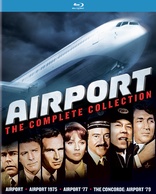
Airport / Airport 1975 / Airport '77 / The Concorde... Airport '79Universal Studios | 1970-1979 | 4 Movies | 469 min | Rated PG | Jun 14, 2016


Movie rating
Movie has not been rated yetBlu-ray rating
| Users |  | 3.6 |
| Reviewer |  | 2.5 |
| Overall | | 2.5 |
Overview
Airport: The Complete Collection (1970-1979)
See individual titles for their synopses.
| Drama | 100% |
| Thriller | 46% |
| Action | Insignificant |
Specifications
Video
Video codec: MPEG-4 AVC
Video resolution: 1080p
Aspect ratio: 1.85:1, 2.35:1
Original aspect ratio: 2.39:1, 1.85:1
Audio
See individual releases
Subtitles
None
Discs
50GB Blu-ray Disc
Four-disc set (4 BDs)
Playback
Region A, B (C untested)
Review
Rating summary
| Movie |  | 3.0 |
| Video | | 3.5 |
| Audio |  | 2.0 |
| Extras |  | 0.5 |
| Overall | | 2.5 |
Airport: The Complete Collection Blu-ray Movie Review
Reviewed by Martin Liebman August 5, 2016Note: This boxed set is currently the only way to own three of the four 'Airport' films: Airport 1975, Airport '77, and The Concorde: Airport '79. The original film was previously released; I cannot verify that the copy included is the same as the original release from 2012, but I can confirm that it is identical to the second release from 2014. Separate reviews for each film are available through the links above, which includes 25 additional screenshots for each film new to Blu-ray. Since this package is home to three unique releases, this review will only cover the films new to Blu-ray.
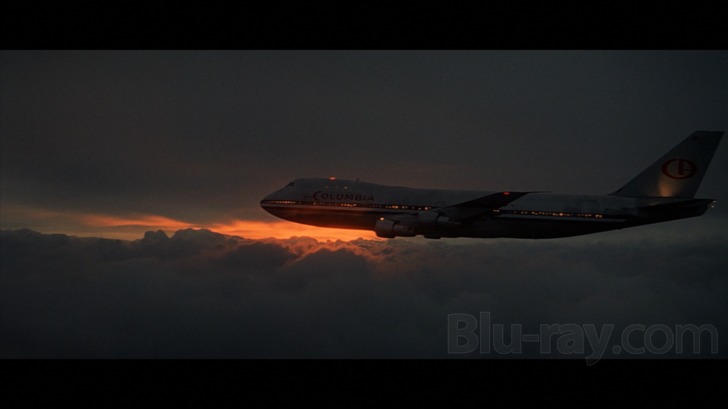
Airport 1975
Score: 4.0/5.0
1970's Airport clustered a bunch of characters into a plane and on the ground, taking its time -- an entire flight, it seemed -- to get the action rolling and put the passengers in harm's way. The follow-up hints at following the same structure, but it sacrifices the in-depth characterization of the first for a faster, more immediately presented peril. The movie isn't any worse for its lesser characterization. If anything, it's leaner, and while the first film found a magical combination of charm and interpersonal intensity matched with dramatic danger, the follow-up prefers a simpler, but no less exciting and engaging, pure Disaster styling. It's simplistic, yes, but it's highly enjoyable, basic cinema that doesn't hide its cards and makes the perilous journey an enjoyable ride through the skies.
Columbia Airlines Flight 409 is departing from Washington, D.C. and headed to Los Angeles. Scott Freeman (Dana Andrews) is piloting a small private plane also bound for L.A. The commercial flight is carrying over 100 passengers, including a young girl (Linda Blair) in desperate need of an organ transplant. Freeman's flying the friendly skies solo. The larger flight and the smaller plane take off, unremarkably. Prior to arrival, both flights are diverted to Salt Lake City; dense fog is covering the entire West Coast, making landing anywhere near the flights' destination an impossibility. Over the skies of Utah, Freeman suffers a heart attack and, unfortunately, crashes his plane into the 747's cockpit. The co-pilot and navigator are killed. The pilot is incapacitated. With nobody available to fly the plane, it's up to head stewardess Nancy Pryor (Karen Black) to sit in the big seat and take charge of the flight. Fortunately, she's in radio contact with the tower, which is scrambling to help her in any way possible. With little hope of her capably landing the plane -- it's all she can do to gently correct course or gain a little altitude -- Nancy's boyfriend Alan Murdock (Charlton Heston) and one of the heroes of Airport, Joe Patroni (George Kennedy), hatch a daring plan to save the flight before it ends very badly for everyone on board.
The film's more pronounced focus on in-air disaster rather than the interconnected relationships of those together on the plane or separated by air and land gives this sequel a different feeling. Rather than a lengthy exploration of who's who well prior to boarding the plan, the 747 in Airport 1975 takes off less than twenty minutes into the movie, and disaster strikes not much longer after that. Even with the less detailed roster -- only a few passengers have any real connection to those on the ground, people who just so happen to, conveniently, be two of the main figures who will do their best to help the plane land safely -- there's enough tension in the cockpit to maintain interest. Support characters -- a sick girl, a nun, a celebrity, a loudmouth, and a few heavy drinkers -- don't add much to the movie other than multiple faces to cut away to during the tragedy to remind the audience of what's at stake. The original film was much smarter in its character details, weaving the passengers neatly into the story and making them critical pieces to the narrative. Here, only Nancy really, truly matters on the plane. Even the on-flight presence of Patroni's wife and son only make his character a little more emotionally involved. It's a generic roster, but fortunately the movie capably soars beyond the lack of interesting characterization.
The film more than makes up for its lack of care and concern for many on the flight with a tight and thrilling journey from chaos in the skies to, everyone hopes, safety on the ground. There's not much in the way of physical action. An explosion and a couple of stunts are pretty much it. Yet the film maintains white-knuckle tension with the smallest of things -- checking a setting on the plane, steering her just a little to the right or left -- becoming monumental hurdles. The key characters don't even need much shape. The relationship between Nancy and Murdock helps to heighten the urgency, but the down side is that there's never any question how the rescue operation will play out, all but erasing the surprise and dramatic impact from one of the movie's key scenes. Ultimately, Airport 1975 simply boils down to one thing: fun. It's not a classic Disaster movie with the large character roster and multi-positional goings-on. It's very focused and enjoyably so, relegating most everything beyond the core action to background support at best and noise at worst.
Airport '77
Score: 2.5/5.0
Another star-studded cast populates Airport '77, the franchise's third film and a far cry from the excellence of the first and sheer entertainment value of the second. The film once again cobbles together a rather eccentric collection of characters and, unlike the first and very much like the second, most only serve to suffer in peril and fear rather than play an integral part in the movie. Director Jerry Jameson's picture struggles to find, or maintain, tightly woven thrills. It's a basic cause-and-effect film with little sense of real peril despite a rather strong starting premise and the promise of both a popular franchise and a top-flight cast operating in support, resulting in a classic case of franchise fatigue: the expectedly lesser results when a series surges onward without the same focus as before, even with a good idea at its core.
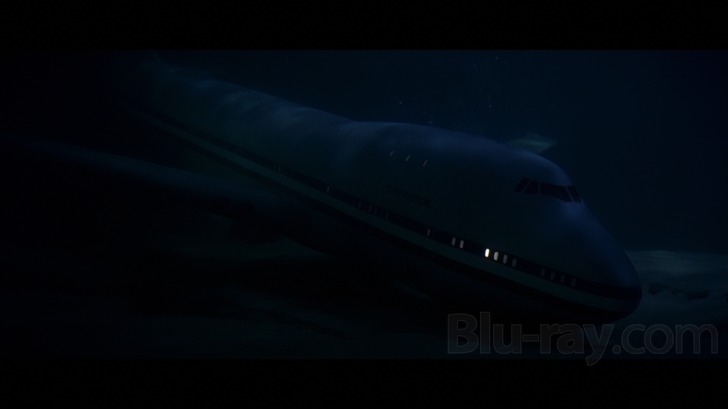
Philip Stevens (Jimmy Stewart) is a man of fine tastes and endless wealth. He's constructed a luxury jumbo jet that, on her maiden voyage, is scheduled to carry an assortment of VIPs, as well as his priceless art collection and his most prized possession, his daughter and grandson. But a few bad guys have other plans. Several men manage to pose as maintenance and staff and, with the cooperation of the flight's co-pilot, Bob Chambers (Robert Foxworth), gas the crew and guests and steer the plane towards a remote, long-abnadoned island and runway in the Bermuda Triangle. Their plan is to land the craft, steal the art, and leave the passengers to awaken and piece together what's happened, long after the criminals are gone. But the plan goes awry when the jet, flying low to avoid radar detection, clips an oil platform and crashes into the sea. The plane sinks but lands on a shallow bit of submerged land not too far from the surface. As the passengers and crew awaken, including Captain Don Gallagher (Jack Lemmon), they are forced to race against time to figure out a way to get word to the surface and be rescued before they drown in the world's most expensive tomb.
Airport '77 gets out of the gate rather slowly and lethargically. It takes a good thirty minutes to set the story in motion, for both the bad guys to do their thing in preparation of taking the plane and for the passengers to assemble on board and establish their relationships and personalities. Their Soap Opera-inspired antics and associations only result in a slow-drip reveal of what's to come and what to expect of them once tragedy strikes. The filmmakers clearly hoped that that slow drip would, as happens in the movie as a leak in the plane eventually becomes a full-fledged saturation and flood, prime the film for the explosion of dramatic interest to follow alongside the action, but that never materializes. Characters beyond the core -- Captain Gallagher and Stan Buchek (Darren McGavin) on the plane -- don't do much more than annoy, writhe in pain, scream, take up space, and offer up more bodies to put in danger as the situation grows ever more bleak, and wet. Even the returning George Kennedy, playing the fan-favorite Joe Patroni, is completely wrenched into the plot to get him in the movie. Only a handful of the characters are critical or somehow important to the movie, and some of the more detailed insight into the lesser ones at film's start, and without any real purpose to their comings and goings -- one of the keys that made the first film so memorable -- mean that they only add numbers to what everyone wants to see: a plane trapped underwater with precious little hope that the people on board escape alive.
Airport '77's single best asset, even beyond its assembled all-star cast, is the rather enticing and somewhat unique idea behind it. The movie is, essentially, a shrunk-down version of The Poseidon Adventure, the classic maritime Disaster flick released several years prior, and taking place on a sunken airplane rather than a sinking cruise ship. It's uniquely compelling. The execution just doesn't live up to either that film's standards or the Airport franchise's excellence. The movie seeps a bit of tension in its final act when hope literally hangs in the balance and work is furiously underway to rescue the survivors, but even then it's largely minimal. Airport '77 is a great lazy weekend afternoon movie, but even considering the interesting concept that's oozing with potential, it doesn't execute satisfactorily and pales compared to the vastly superior original and the highly entertaining, if not rather simplistic, sequel.
The Concorde: Airport '79
Score: 1.5/5.0
It's probably wise that Universal put the brakes on the Airport franchise after The Concorde: Airport '79 slogged its way to critical and box office failure. Coming off the high of the original's character-driven excellence, the sequel's high-flying excitement (a movie that spawned a genre parody film), and a third picture that wasn't exactly sunken treasure but decent enough entertainment, the studio green-lit the fourth film, this one focusing on an intercontinental flight on board the then relatively new and shiny Concorde jet, which has since been scrapped and left to live in the annals of aviation history. It's too bad that its cinematic namesake can't live up to the legacy of either the jet or the Airport franchise. Airport '79 struggles its way through a bland story, a disinterested cast, lousy visual effects, and poor pacing, easily the worst of an otherwise fun franchise.
Captain Joe Patroni (George Kennedy) is co-piloting the Concorde with Paul Metrand (Alain Delon) on a trans-Atlantic flight from D.C. to Paris and then, on to Moscow where the Olympic games are taking place. On board the flight is Maggie Whelan (Susan Blakely), a TV news reporter who comes into possession of red-hot information: the head of a weapons manufacturing firm, Kevin Harrison (Robert Wagner), has been illegally selling arms to every bad actor on the planet. His company is about to test-fire a brand-new military-grade drone which he and a cohort secretly reprogram to destroy the Concorde. Can Patroni save his passengers and crew and make it safely to Paris and Moscow, or will disaster yet again strike a flight in which he is personally involved?
The Concorde: Airport '79 plays with the look, feel, and flow of a TV movie, not a major motion picture. A far cry from the more involved production values, crisper writing, and smoother filmmaking of the originals, and the first two in particular, the film flounders without much of a sense of purpose, content to simply throw various in-air obstacles at the Concorde, the only question being which, if any, will finally put the plane in serious peril that a couple of barrel rolls and a flare gun can't solve. The action scenes, which are little more than the plane's cabin spinning in circles and crude visual effects that are worthy only of a cut-rate late 70s/early 80s TV show, are the only source of tension or dramatic interest in the movie. The core story -- a weapons manufacturer trying to kill someone on board the plane before she can spill the beans -- isn't particularly compelling, at least not with this level of characterization and with the rather forced-in story lines around the other passengers who, again, don't amount to a thing other than bodies to fill up space. The story would have probably worked better reworked and condensed as an episode of Airwolf rather than a feature-length picture in a franchise that had already run its course.
George Kennedy. Poor George. He gets his biggest role in an Airport film yet -- he's the main character, the Concorde's pilot, the man around whom most everything that has to do with aviation and saving the day revolves -- and his performance comes across as so hammy that it wouldn't come as a surprise to discover he was putting back some adult beverages during the shoot. The performance is insanely loose and the character is poorly defined. "My wife died in a car wreck a year ago!" he proclaims almost giddily in one scene. How his Joe Patroni devolved from critical mainstay in the original to well defined support in the second to wrenched-in familiar face in the third to pushed to the top of the credits list yet, at the same time, shoved to the bottom of character development hell in the fourth is probably the single most interesting thread throughout the entire Airport franchise. He's surrounded by the typical mainstay sort of characters who, beyond a few cutaway shots and lines of dialogue meant to keep the audience on-edge for their well-being, add nothing of value to the movie. There's the mother hurrying a new heart to her sickly son, a singer and a Saxophone player, and some Russian olympians, one of whom has a mute daughter with him. That's just about it. Even the venerable Robert Wagner can't summon a solid performance. He scowls well enough when necessary, but the part is so devoid of content beyond "bad guy" that even he cannot find much charge for the character.
Airport: The Complete Collection Blu-ray Movie, Video Quality
Airport 1975
Score: 4.0/5.0
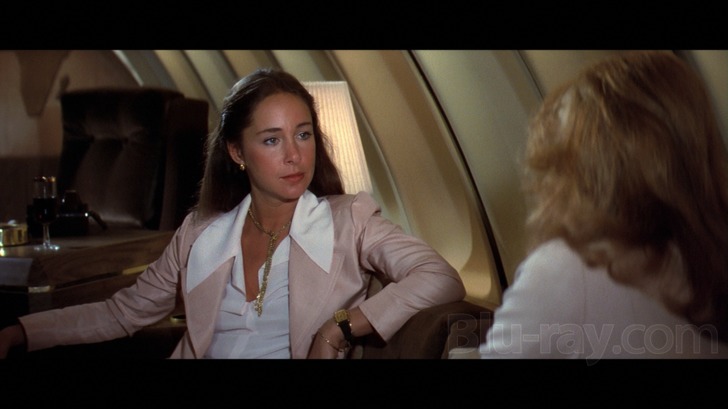
Airport 1975's 1080p transfer delivers the sort of catalogue image that should make most viewers, even harder-to-please videophiles, rather
happy.
Universal's presentation is a fair step up from the studio's effort on the original Airport Blu-ray. Grain retention is clear and even, if not
thick.
The image
enjoys a consistently high-yield film-quality presentation with precious little in the way of print deterioration. Most flaws seem inherent to the
source,
mostly seen in broad exterior shots of the plane flying over Utah in the daytime (it appears a bug splattered on the camera lens at one point). Detail
is
excellent. Fabric on the seats in the plane is particularly impressive, and tangibly so. Instrument clusters, buttons, and gauges in the cockpit all
impress, and after the damage there's more in the way of exposed innards and twisted, sharp metal that also reveals a satisfying level of lifelike
detail.
General attire is quite impressive, too, and facial features are adequately complex throughout the film. Colors are rich and pleasing and many.
Purples, pinks, reds, and blues throughout the plane are always vibrant, but naturally balanced. Murdoch's yellow sweater is probably the most
dominant clothing color in the movie. Fake blood looks more orange than red, and the Blu-ray allows viewers to get a good look at its unnaturally
thick
consistency. Flesh tones appear spot-on, though black levels are prone to fluctuation between nicely dark, if not pushing slightly to crush, and a bit
washed out. On the whole, this is a very impressive effort from Universal.
Airport '77
Score: 4.0/5.0
Airport '77's 1080p transfer isn't quite perfect, but it's rather nice-looking, all things considered. Grain structure is very fine, and regular, if
not
a bit
volatile in a few places. The
image sometimes looks a bit too smooth, but loss of detail is never an issue and the picture never takes on that waxy, plastic look. It's just very
clean.
Indeed, detail is very nice to, at times, striking. Many of the fancier appointments inside the plane, particularly woods, carpeting, and upholstery,
are
strongly revealing. Clothing is likewise complexly presented, and faces rarely miss a beat. Colors are well saturated and vibrant both inside the
plane
and up on the surface, particularly late in the movie out in the very bright daytime sunshine. Black levels are very deep but prone to mild crush.
Flesh
tones appear accurate. A stray hair is visible on the lower-left portion of the screen right after the opening titles, lingering for one shot. Small little
specks and flecks pop up throughout, but never to any sort of detrimental level.
The Concorde: Airport '79
Score: 2.0/5.0
The Concorde: Airport '79's 1080p transfer is a far cry from the other presentations in the series. It's rather soft, with unassuming, poorly
defined details. Textures rarely excite, not clothes, not upholstery on the plane, not instrument clusters in the cockpit. Fine detail rarely pushes all
that hard at all, leaving viewers with only a little more than basic definition. Colors are a little more flush and healthy. Reds and blues are
particularly
stout, standing nicely apart from the late 70s-era browns, beiges, and oranges that feature rather prominently throughout. Noise is thick and clumpy
throughout, rarely relenting in density. Grain often appears frozen in place. Print wear is obvious, heavier at some junctures than others. The image
does tighten up a little bit about an hour into the movie. There's a noticeable uptick in resolution and clarity. Grain sometimes almost appears free
from its solid state. While its best scenes never approach the quality of the previous films, they're more than welcome, though short-lived, in a
rather
unimpressive presentation.
Airport: The Complete Collection Blu-ray Movie, Audio Quality
Airport 1975
Score: 2.0/5.0
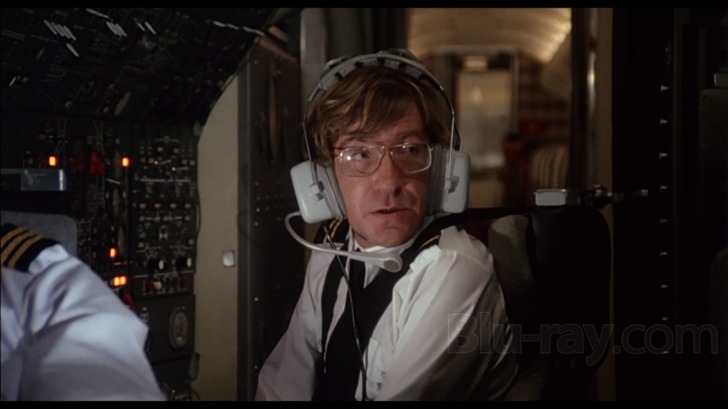
Airport 1975's DTS-HD Master Audio Mono soundtrack barely gets off the ground. Music to start fails to impress. It's mushy and undefined
with very little sense of space. Jet engine noise is pedestrian and lumpy. Falling rain is unkempt and lacking realistic distinction. A few larger effects
--
the plane crash, helicopters taking off and landing -- are likewise more a cluster of clumpy sounds rather than elements with any sort of authentic
clarity. Dialogue at
least comes through very clearly and accurately, with good center placement and, for the most part, fair prioritization.
Airport '77
Score: 2.0/5.0
Airport '77's DTS-HD Master Audio Mono soundtrack delivers a passable listen that relates the basics, but beyond dialogue without any sort
of
richly realized detail. Music sputters into the stage with little range. It's cramped, unkempt, and absent anything more than crude definition. "Live"
background music on the plane -- singing and guitar strumming -- is a little more open and well defined. Ambient details in the plane, at the airport,
or
up on the surface of the ocean fail to realize any kind of accurate, immersive sensation. Heavier elements -- particularly rushing water -- are more
globular and jumbled than they are accurate. Dialogue is generally fine, nicely clear and articulate, though screams and shrieks and cries come
across
as piercing and muddled.
The Concorde: Airport '79
Score: 2.0/5.0
The Concorde: Airport '79's DTS-HD Master Audio Mono soundtrack feels ever-so-slightly more open and fluid than the tracks accompanying
its
most recent two predecessors. That said, there's precious little sense of spread to the ends of the stage or definition to music. The most raw, basic
notes are all that are available. There's a fair, certainly not enticing or engrossing, sense of weight and depth to heavier effects, like jet engine
rumbles
and explosions. Chaos on the flight -- screams, falling suitcases, and the like -- never stretch the stage nor come across as all that realistically
detailed. Basic dialogue is fine, pushing far enough to the center and playing with appreciable clarity.
Airport: The Complete Collection Blu-ray Movie, Special Features and Extras

Of the three films new to Blu-ray, each contains only a 480i trailer.
Airport: The Complete Collection Blu-ray Movie, Overall Score and Recommendation
The Airport franchise might be the best existing example of the law of diminishing returns. A classic first film is followed by a lesser, but very enjoyable sequel, followed by a decent but middling third entry and an awful capper to the franchise in Airport '79. Universal's Blu-ray package is disappointingly devoid of meaningful bonus content. Video is rather good for the first three films. Sound doesn't impress in the sequels' mono tracks. Recommended.