Ai Weiwei: Never Sorry Blu-ray Movie
HomeAi Weiwei: Never Sorry Blu-ray Movie 
Artificial Eye | 2012 | 95 min | Rated BBFC: 15 | Oct 08, 2012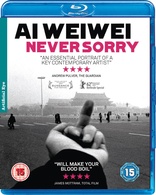

Movie rating
6.9 | / 10 |
Blu-ray rating
| Users |  | 3.0 |
| Reviewer |  | 4.5 |
| Overall | | 4.5 |
Overview
Ai Weiwei: Never Sorry (2012)
Ai Weiwei is known for many things—great architecture, subversive in-your-face art, and political activism. He has also called for greater transparency on the part of the Chinese state. Director Alison Klayman chronicles the complexities of Ai’s life for three years, beginning with his rise to public prominence via blog and Twitter after he questioned the deaths of more than 5,000 students in the 2008 Sichuan earthquake. The record continues through his widely publicized arrest in Beijing in April of 2011. As Ai prepares various works of art for major international exhibitions, his activism heats up, and his run-ins with China’s authorities become more and more frequent.
Starring: Ai Weiwei, Changwei Gu, Danqing ChenDirector: Alison Klayman
| Foreign | Uncertain |
| Documentary | Uncertain |
Specifications
Video
Video codec: MPEG-4 AVC
Video resolution: 1080p
Aspect ratio: 1.78:1
Original aspect ratio: 1.78:1
Audio
Mandarin: DTS-HD Master Audio 5.1
Mandarin: LPCM 2.0
Subtitles
English
Discs
50GB Blu-ray Disc
Single disc (1 BD)
Playback
Region B (locked)
Review
Rating summary
| Movie |  | 5.0 |
| Video | | 4.5 |
| Audio | | 4.5 |
| Extras |  | 2.5 |
| Overall | | 4.5 |
Ai Weiwei: Never Sorry Blu-ray Movie Review
Reviewed by Dr. Svet Atanasov October 10, 2012Screened at the Berlin International Film Festival and winner of the Special Jury Prize at the Sundance Film Festival, Alison Klayman's "Ai Weiwei: Never Sorry" (2012) arrives on Blu-ray courtesy of British distributors Artificial Eye. The supplemental features on the disc include the film's original theatrical trailer and a video interview with director Alison Klayman. In Mandarin and English, with optional English subtitles for the main feature. Region-B "locked".
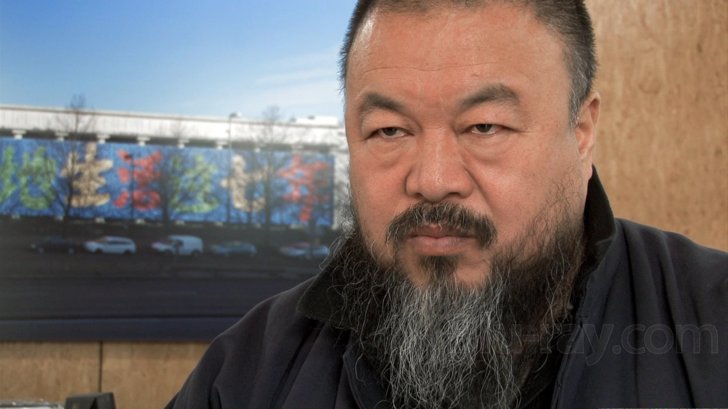
Don't retreat, retweet!
There was a time when Ai Weiwei believed the red leaders of his country – though not as much as his father, Chinese poet Ai Qing, did. But the more he read and the more he listened to what they had to say, the more he started to realize that they did not care about his countrymen. Eventually, like his father, once a passionate communist who was denounced and sent to a labor camp, Ai Weiwei saw how rotten the entire system was.
In 1983, he got lucky and left China.
Ai Weiwei settled in New York, ready to experience everything the city had to offer and study art. Though he had come to America through a program sponsored by the Chinese government, Ai Weiwei immediately cut all ties with it. It was his way of showing the red leaders in Beijing the middle finger. He felt good and inspired. It did not matter that at the time he was poor and often had nothing to eat. He had tasted freedom and instantly fallen in love with it.
In 1993, Ai Weiwei returned to China. His father was seriously ill and he wanted to spend as much time with him as possible. As an artist he had earned a reputation in New York, which also allowed him to meet and spend time with Chinese officials that would have simply ignored him ten years earlier.
By 2008, one could easily see that China was changing. Ai Weiwei’s life was also about to change because he was invited to assist with the design of the ‘Bird Nest’ stadium for the Beijing Olympics. He was proud of his work but was convinced that the Olympics, as organized and promoted, were nothing more than a giant propaganda piece staged by the red leaders in Beijing. When they invited him to the opening ceremony, he refused to attend. It was his way of showing them the middle finger yet again.
Also in 2008, China suffered a massive earthquake. Thousands of people died, many of them in laughably poor government buildings and schools. Fearing that an accurate assessment of the aftermath and the government’s efforts to deal with the needs of its people would tarnish the image of the Party, the red leaders in Beijing decided to cover up as much as they could. Ai Weiwei decided to launch a citizen’s investigation on his blog and collect the names of the victims.
He started digging – and tweeting.
The red leaders did not like what Ai Weiwei was doing on the Internet and tried to silence him. But it was a little too late. People had already started talking and asking questions, and Ai Weiwei had emerged as the spiritual leader of a strange virtual movement. Like him, other young people, some curious, some angry, had also started tweeting and blogging. In May 2009, Ai Weiwei, assisted by volunteers, posted the names and birthdays of 5,212 victims on his blog. The red leaders immediately shut down the blog and installed surveillance cameras at his home studio. But once again Ai Weiwei did not care, he kept tweeting. And when he traveled abroad to present his latest art collection, he never missed an opportunity to critique Beijing.
On April 3, 2011, Ai Weiwei disappeared. He was last seen on the airport in Beijing, where he was trying to board a flight to Hong Kong. Minutes after the news broke out, hundreds of thousands of bloggers around the world started typing. The outrage was so big that the U.S. government issued an official statement.
Exactly 81 days later, Ai Weiwei re-emerged. According to Chinese state media, the artist was released on bail after confessing to tax evasion. That was the official story. The 'other' story is that he had become one of many artists and intellectuals the Chinese government could no longer tolerate, which is why they had him arrested and sent to an undisclosed location, where he was likely going to end up in a plastic bag had it not been for the Internet outrage.
Alison Klayman’s documentary chronicles Ai Weiwei’s unusual story and offers a good analysis of the current socio-political climate in China. It is comprised of excellent interviews with the artist and many of the men and women that know him best, as well as archival footage from the still largely devastated Sichuan Province and the news networks covering Ai Weiwei’s clashes with the Chinese authorities. Despite the abundance of political content here, Klayman and her camera are only casual observers, asking the right questions and, when possible, looking in the right direction.
Ai Weiwei: Never Sorry Blu-ray Movie, Video Quality
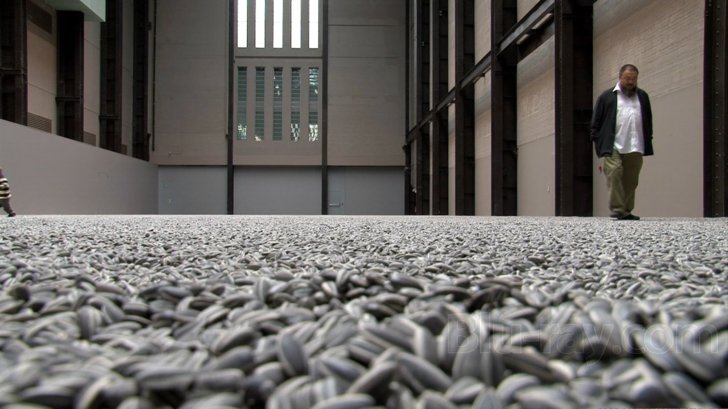
Presented in its original aspect ratio of 1.78:1, encoded with MPEG-4 AVC and granted a 1080p transfer, Alison Klayman's Ai Weiwei: Never Sorry arrives on Blu-ray courtesy of British distributors Artificial Eye.
Shot digitally and featuring plenty of raw and archival footage, the film has that traditional documentary look - portions of it look outstanding, while some of the older content looks a bit rough. Nevertheless, the overwhelming majority of the film has clearly benefited from the transition to Blu-ray; depth and clarity are often very strong. Excluding some of the archival footage, contrast and colors are also stable. There is some extremely light motion judder but it is clearly source related. Compression is excellent. All in all, considering the various source limitations, I think that the film looks quite remarkable in high-definition. (Note: This is a Region-B "locked" Blu-ray disc. Therefore, you must have a native Region-B or Region-Free PS3 or SA in order to access its content).
Ai Weiwei: Never Sorry Blu-ray Movie, Audio Quality

There are two audio tracks on this Blu-ray disc: Mandarin DTS-HD Master Audio 5.1 and Mandarin LPCM 2.0 (with portions of English). For the record, Artificial Eye have provided optional English subtitles for the main feature.
Ai Weiwei: Never Sorry is primarily a dialog-driven feature. Naturally, dynamic movement is quite limited. There are areas of the film, however where Ilan Isakov's soundtrack adds up to the often tense atmosphere. The dialog is crisp, stable, and easy to follow. The English translation is also excellent.
Ai Weiwei: Never Sorry Blu-ray Movie, Special Features and Extras

- Trailer - original trailer for Ai Weiwei: Never Sorry. In Mandarin and English, with imposed English subtitles. (3 min, 1080p).
- Interview - in this video interview, director Alison Klayman explains what inspired her to visit China and tell Ai Weiwei's story, and shares her impressions of the artist and his work as well as the socio-political climate in contemporary China. In English, not subtitled. (22 min, 1080).
Ai Weiwei: Never Sorry Blu-ray Movie, Overall Score and Recommendation
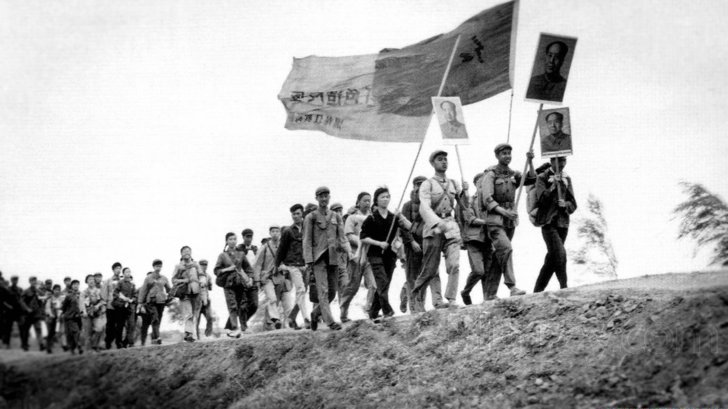
It is painfully obvious now that the more things change in China, the more they stay the same. The Communist government may have opened up the country for business - and I am convinced that, similar to Russia, most prominent businessmen there are either former apparatchiks or parachutists directly servicing the top men in the Party - but its leaders would do anything to get rid of those who dare to speak against their policies. Ai Weiwei's story proves it. I hope people will find the time to see Alison Klayman's film because it has a lot to say about a part of the world which, regardless of whether we want to admit it, affects our lives daily. VERY HIGHLY RECOMMENDED.
Similar titles
Similar titles you might also like
(Still not reliable for this title)

Man Marked for Death, 20 Years Later
Cabra Marcado para Morrer | Limited Edition
1984

The Mystery of Picasso
Le mystère Picasso / Arrow Academy
1956

Man with a Movie Camera
Человек с киноаппаратом / Chelovek s kino-apparatom
1929

Hitler's Hollywood
Includes From Caligari to Hitler
2017

More Than Honey
2012

Anselm
Das Rauschen Der Zeit
2023

To Be and to Have
Être et avoir
2002

24 City
二十四城记 / Èr shí sì chéng jì
2008

Faces Places
Visages villages
2017

America as Seen by a Frenchman
L'Amérique insolite / Arrow Academy
1960

The Gleaners & I
Les glaneurs et la glaneuse
2000

Chronicle of a Summer
Chronique d'un été
1961

Pina
2011

Harlan County USA
1976

De l'autre côté
From the Other Side
2002

Land of Silence and Darkness
Land des Schweigens und der Dunkelheit
1971

The Act of Killing
2012
Sud
South
1999
D'est
From the East
1993

Antonio Gaudí
1984