Afterimage Blu-ray Movie
HomeAfterimage Blu-ray Movie 
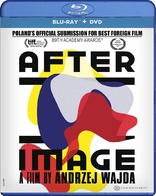
Powidoki / Blu-ray + DVDFilm Movement | 2016 | 100 min | Not rated | Nov 07, 2017
Price
List price:Listed on Amazon marketplace

Movie rating
6.5 | / 10 |
Blu-ray rating
| Users |  | 0.0 |
| Reviewer |  | 3.5 |
| Overall | | 3.5 |
Overview
Afterimage (2016)
The story of charismatic painter Wladyslaw Strzeminski, who opposed social realism and maintained his own artistic freedom in spite of political obstacles.
Starring: Boguslaw Linda, Aleksandra Justa, Bronislawa Zamachowska, Zofia Wichlacz, Krzysztof PieczynskiDirector: Andrzej Wajda
| Foreign | Insignificant |
| Drama | Insignificant |
| Biography | Insignificant |
| History | Insignificant |
Specifications
Video
Video codec: MPEG-4 AVC
Video resolution: 1080p
Aspect ratio: 2.38:1
Original aspect ratio: 2.39:1
Audio
Polish: DTS-HD Master Audio 5.1
Polish: Dolby Digital 5.1
Subtitles
English
Discs
Blu-ray Disc
Two-disc set (1 BD, 1 DVD)
DVD copy
Playback
Region A (B, C untested)
Review
Rating summary
| Movie | | 3.5 |
| Video |  | 4.5 |
| Audio |  | 4.0 |
| Extras |  | 2.0 |
| Overall | | 3.5 |
Afterimage Blu-ray Movie Review
Reviewed by Jeffrey Kauffman November 3, 2017Can a work of abstract art, or a piece of music that doesn’t have “programmatic” tendencies, ever be “political”? There’s a difference between, say, one of Mondrian’s geometric enterprises and Picasso’s immortal Guernica, with the latter’s political leanings hardly covert despite Picasso’s presentational eccentricities. But is there a political aspect to a generic Mondrian work, aside from the perhaps subliminally anarchic way Mondrian refused to abide by the “rules” of representational art? Similarly, it’s easy to divine the political subtext of a “rah rah” piece like Tchaikovsky’s 1812 Overture, something that may not be quite as easy with another classical masterpiece that came out at around the same time, Brahms’ Symphony Number 3 in F major. I ask these questions because I’ve frankly been flabbergasted for years over how the then nascent Soviet regime sought to impose strictures on artists in virtually any medium imaginable, regulations that sought to enforce a certain “orthodoxy” which is almost inevitably subjective. As I discussed quite some time ago in our Keeping Score: Shostakovich's Symphony No. 5 Blu-ray review, I’ve found it frankly incredible how a composer like Shostakovich managed to flourish (more or less, anyway) in a society that regularly branded him an outcast simply for the way he organized tones. How does one even decide what is “acceptable” or not when dealing with Art (in any medium) that is not overtly representational, other than the fact that art (as in painting) that was not "Socialist realist" was automatically deemed forbidden? That very question lurks beneath some of the screeds voiced by Stalinist officials in Afterimage, the last film of Polish master Andrzej Wajda, who himself fought against “commandments” handed down from on high. The film is a biography of a Polish painter who is probably not that well known to many outside of Poland, Władysław Strzemiński (Bogusław Linda). This is a dour and frankly pretty depressing account of a life torn asunder by Stalinist impulses, and it is therefore a bit of a trial to get through, since there is a decided lack of “feel good” elements offsetting the relentless trudge of imposed conformity that runs through the story.
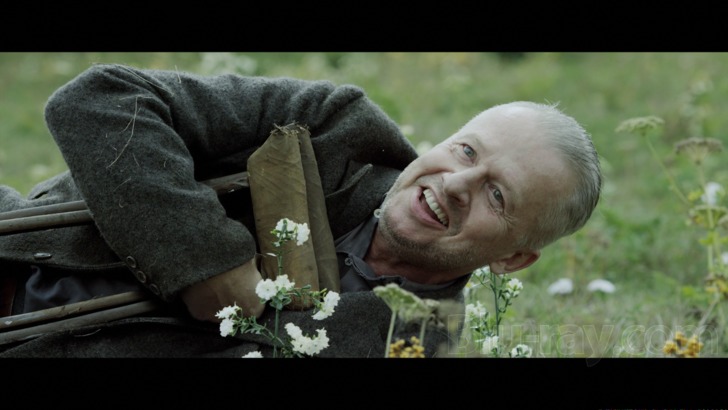
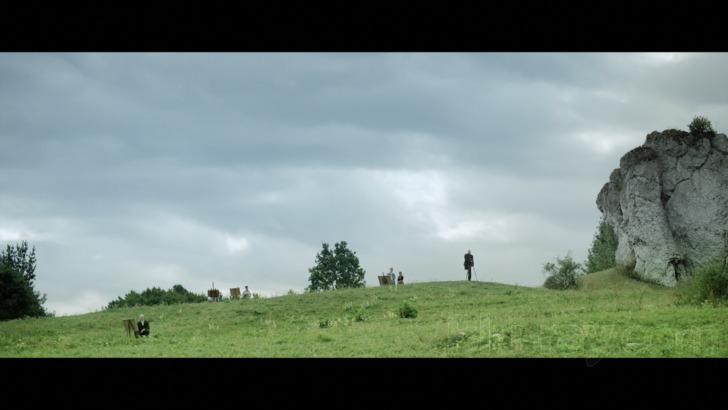
The first glimpse Wadja offers of Strzemiński in Afterimage is one of the few even momentarily joyful incidents in the film. A young student named Hanna (Zofia Wichlacz) arrives to join a gaggle of other Strzemiński acolytes who have gathered together on a gorgeous hillside. When Hanna asks where Strzemiński is, another student points to an isolated figure at the top of a faraway hill, and it’s somewhat hard to make out that the venerable artist and teacher is missing a leg and an arm courtesy of some long ago World War I injuries. When Strzemiński suddenly (intentionally) careens over, folding up his crutch and then rolling down the hill, it would seem to be a vignette documenting a free spirit enjoying a certain silliness despite some harrowing personal handicaps. Unfortunately, it’s about the last time anyone has any “fun” in Afterimage.
The next vignette probably more properly prepares the viewer for the slog that awaits Strzemiński as a post World War II Poland falls increasingly under the sway of the Soviets and Stalinism. Strzemiński is in his apartment preparing to paint, when suddenly his entire flat becomes bathed in a deep red tone. Is this magical realism a la Alejandro González Iñárritu creeping into the work of a Polish master who himself mentions the Italian neorealists as one of his formative influences? Hardly — it’s a somewhat cheeky and maybe even hyberbolic depiction of the effects of the hoisting of a huge maroon banner in honor of Stalin outside of Strzemiński’s window. It’s perhaps a too convenient visual metaphor for the fact that Strzemiński is about to “drown” in Stalinism in some unexpected (if sadly predictable) ways, but it quickly defines the artist as a man not about to let outside events hinder his production of art (at least not right off the bat, anyway).
Strzemiński’s attempts to cut through the banner to let some natural light into his workplace of course leads to a showdown with local Stalinist officials, and soon enough Strzemiński’s actual career as a professor is hampered. One particularly chilling vignette documents the attempts of a school board to censure Strzemiński for his unorthodox opinions, an attempt which requires the adherence of several of Strzemiński’s students, many of whom worship their teacher as a veritable god. The fact that a monologue by the main Socialist nemesis in this group supposedly taking Strzemiński to task is in fact little more than a meaningless word salad is perhaps Wajda’s subtly inflammatory way of suggesting that these arbiters of “orthodoxy” may not exactly be clear on what constitutes acceptable Art.
That whole “word salad” issue in fact tends to hamper Afterimage generally, since there’s a notable lack of context and clear explication in terms of several elements presented or at least alluded to throughout the film. It’s never totally clear what exactly is the problem with Strzemiński’s art and/or philosophy, other than that it chafes against Stalinist principles (principles which are similarly left largely unexplored, other than their overwhelming insistence on conformity). But even on a more personal level, Wadja doesn’t seem to want to delve beneath the surface of Strzemiński’s obviously incredibly difficult life. Therefore, his estrangement from his wife (who’s largely only referred to) is never really adequately explained, something that leaves his relationship with his daughter Nika (Bronislawa Zamachowska) kind of floating in a cinematic netherworld, which in turns makes an apparently heartless decision Strzemiński makes regarding the girl seem almost pointless. Another potentially emotional flashpoint, Strzemiński’s burgeoning relationship with Hanna, also is largely devoid of any clear development, and so never provides any truly cathartic content.
Afterimage Blu-ray Movie, Video Quality
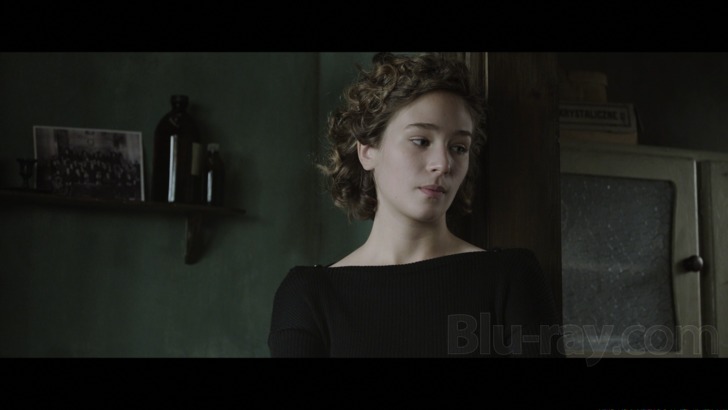
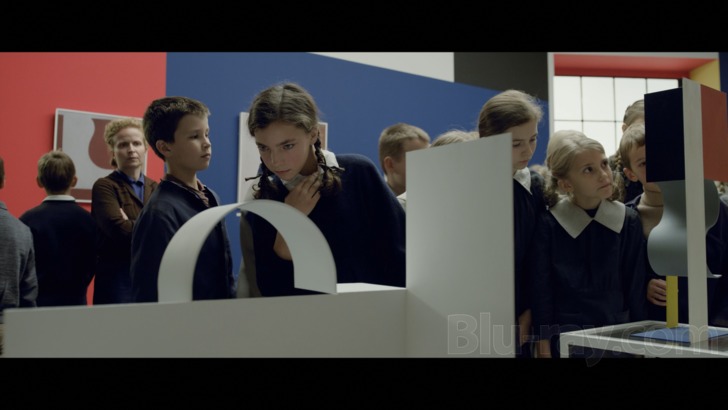
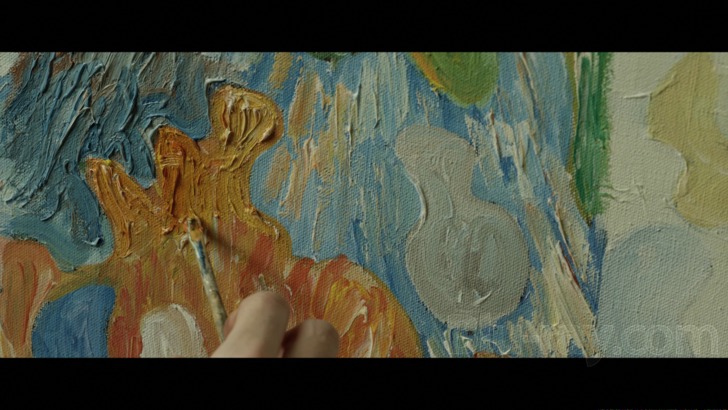
Afterimage is presented on Blu-ray courtesy of Film Movement with an AVC encoded 1080p transfer in 2.38:1. While the IMDb doesn't list the camera utilized, it does state the film was finished at a 4K DI, and this transfer does boast superior detail levels almost all of the time, despite an intentionally tamped down palette that tends to exploit a lot of dreary grays, browns and beiges. Fine detail pops quite winningly across expected elements like some of the heavily tufted fabrics on display, or even the nicely textured canvases that Strzemiński works on. The general lack of vivid hues only tends to make pops of Soviet red stand out all the more, probably an intentional production design decision. The only minor issue spotted here is some recurrent banding, typically in fades at the end of scenes (one of the more noticeable examples is on the right side of the frame during the final fade out).
Afterimage Blu-ray Movie, Audio Quality
Afterimage's DTS-HD Master Audio 5.1 track in the original Polish tends to derive some of its most memorable surround activity from the astringent score by Andrzej Panufnik, with strident and even screechy sounding minor seconds dotting the soundstage regularly. Some of the outdoor material provides good placement of ambient environmental effects as well, but a lot of this film is intentionally smaller scale in its sound design ambitions, offering quiet if intense dialogue scenes that typically play out in either duos or at most small groups. Fidelity is fine throughout the presentation, with no problems of any kind to report.
Afterimage Blu-ray Movie, Special Features and Extras
- Commentary by Professor Emeritus Stuart Liebman, CUNY Graduate Center
- Wadja by Wadja (1080p; 1:34:57) is a superb overview of Wadja's long and noted career, and includes a lot of excellent interview segments with Wadja discussing his films.
- Afterimage Trailer (1080p; 1:44)
Afterimage Blu-ray Movie, Overall Score and Recommendation
For a film ostensibly dealing in the untameable passions of a committed artist hell bent of preserving his integrity, Afterimage is a curiously dispassionate film, seemingly divorced from any of the emotions one might expect to well up courtesy of the indignities Strzemiński is forced to endure. Wadja is the consummate professional in Afterimage, as he has always tended to be throughout his long and storied career, but an already inherently elegiac piece like this tends to start playing more and more like a funeral dirge when there's no let up to the suffering and when no clear emotional tether to the characters has been established. Even without that emotional underpinning, which certainly could have helped elevate Wadja's message, Afterimage is a bristling critique of enforced conformity stifling artistic freedom. Technical merits are generally strong, the supplementary package has a lot to recommend it, and with caveats noted Afterimage comes Recommended.
Similar titles
Similar titles you might also like
(Still not reliable for this title)

Jimmy's Hall
2014

Labyrinth of Lies
Im Labyrinth des Schweigens
2014

Mr. Jones
2019

The Roosevelts: An Intimate History
2014

The Looming Tower
2018

Darkest Hour
2017

Churchill
2017

The Innocents
Les Innocentes
2016

The Mortal Storm
Warner Archive Collection
1940

Hillary's America
2016

Cradle Will Rock
1999

Confucius
孔子 / Kong zi
2010

Prick Up Your Ears
1987

Cesar Chavez
2014

Dawson City: Frozen Time
2016

Red Joan
2018

Won't You Be My Neighbor?
2018

Untold History of the United States Part 3: Reagan/Bush/Clinton/Obama
Oliver Stone's
2012-2013

Bombshell: The Hedy Lamarr Story
2017

RBG
2018