Aesthetics of a Bullet Blu-ray Movie
HomeAesthetics of a Bullet Blu-ray Movie 
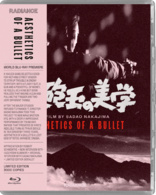
Teppôdama no bigaku | Limited EditionRadiance Films | 1973 | 97 min | Not rated | Jun 02, 2026

Movie rating
7.2 | / 10 |
Blu-ray rating
| Users |  | 0.0 |
| Reviewer |  | 4.0 |
| Overall | | 4.0 |
Overview
Aesthetics of a Bullet (1973)
A small time crook who sells rabbits for a living frequently gets himself into trouble with loan sharks and the yakuza. He dreams of becoming a successful big-shot and embarks on the life of a yakuza hitman.
Starring: Miki Sugimoto, Tsunehiko Watase, Mitsuru Mori, Asao Koike, Ichirô ArakiDirector: Sadao Nakajima
| Foreign | Uncertain |
| Drama | Uncertain |
| Crime | Uncertain |
| Action | Uncertain |
Specifications
Video
Video codec: MPEG-4 AVC
Video resolution: 1080p
Aspect ratio: 2.35:1
Original aspect ratio: 2.39:1
Audio
Japanese: LPCM Mono (48kHz, 24-bit)
Subtitles
English
Discs
Blu-ray Disc
Single disc (1 BD)
Playback
Region A (B, C untested)
Review
Rating summary
| Movie | | 4.0 |
| Video | | 4.0 |
| Audio |  | 3.5 |
| Extras |  | 3.0 |
| Overall | | 4.0 |
Aesthetics of a Bullet Blu-ray Movie Review
Reviewed by Jeffrey Kauffman June 2, 2026Robert Schwentke contributes an interesting supplement included on this disc where among other tidbits of information he deconstructs the title of the film in terms of the original Japanese version and subsequent English translation. While Schwentke offers several intriguing translations of Japanese with unexpected connotations (more about that in a moment), the bottom line is whether or not Japanese has an idiom to match English, Aesthetics of a Bullet could have easily been called Useful Idiot and/or Clothes Don't Make the Man. Deconstruction of one sort or another seems to be endemic to Aesthetics of a Bullet, though as Schwentke also elaborates, that tendency may be evident in the entire filmography of director Sadao Nakajima. Kiyoshi Koike (Tsunehiko Watase) is a wannabe yakuza who is in reality something of a schlub, if Japanese has an equivalent for that term. As Schwentke gets into in his analysis, the very first word of the film's original Japanese title, teppōdama, may literally refer to a bullet, but it also has a fascinating subtextual meaning, at least for yakuza, as a veritable "sacrificial lamb", or perhaps more accurately, "sacrificial hitman". And that, of course, is where Koike comes in, used as an unwitting pawn by higher ups in the criminal world in order to basically incite, well, Battles Without Honor and Humanity.
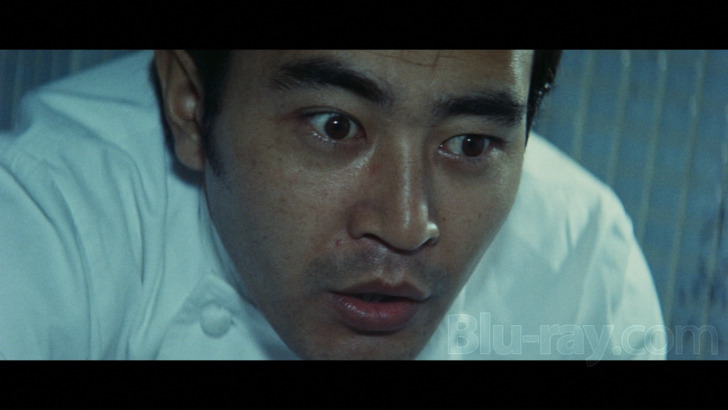
It's obvious from the get go that Kioke is in over his head, to say the least, though he's so self absorbed that he thinks the flashy new clothes and gun he's given to complete his "assignment" basically announce him as the new yakuza in town. Several almost comical interludes prove rather quickly that Koike is probably delusional, and suffice it to say his mission goes spectacularly wrong, leaving Koike not just a pawn, but a pawn now in serious trouble with people who want him eliminated to prevent any further unraveling of plans. Koike himself probably unsurprisingly begins to unravel, and in that aforementioned "deconstructionist" mode, Nakajima and screenwriter Tatsuo Nogami complete upend expectations by ultimately having Koike take a family hostage before everything devolves in what Schwentke refers to as almost a Classical Greek Tragedy finale (Schwentke mentions how Nakajima spent much of his college life studying Sophocles).
There's a lot of subtext in this story, with the "economic miracle" of Japan post World War II also getting its fair share of "deconstruction", and with a clear if subtle emphasis on the "westernization" of the nation after the debacle of that war. In that regard, while quite distinctive in its own presentation, Aesthetics of a Bullet may remind fans of Japanese films in particular of any number of iconic outings where a marginalized character is unable to participate in a celebrated economic revival.
Aesthetics of a Bullet Blu-ray Movie, Video Quality
Aesthetics of a Bullet is presented on Blu-ray courtesy of Radiance Films with an AVC encoded 1080p transfer in 2.35:1. Radiance's insert booklet offers only a bit of generic information on the transfer:
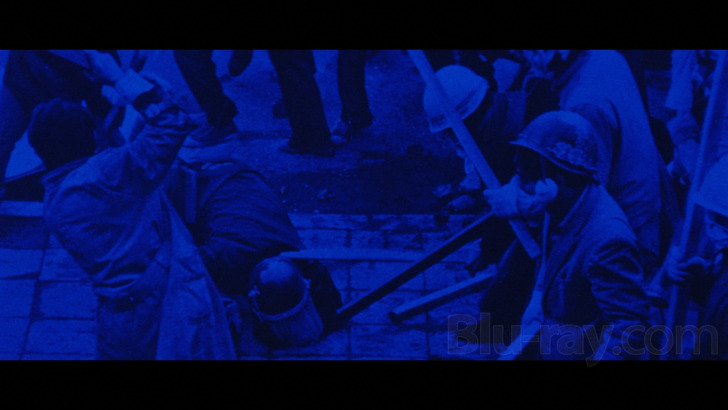
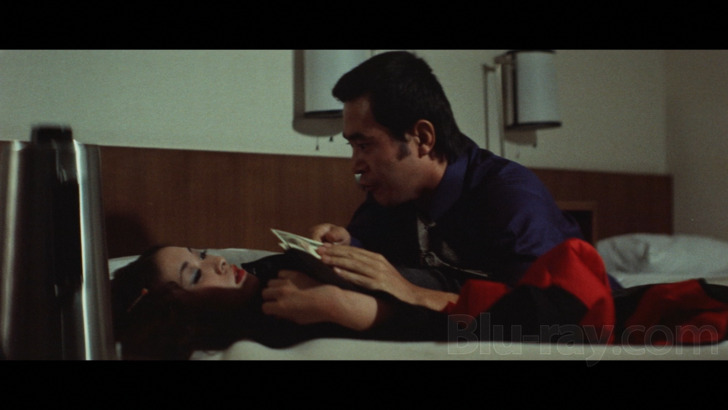
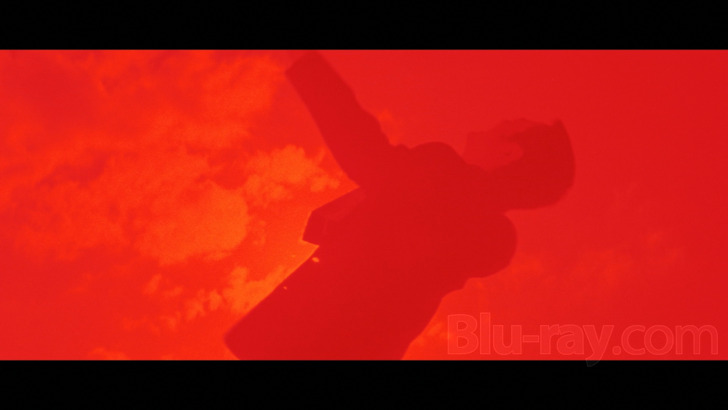
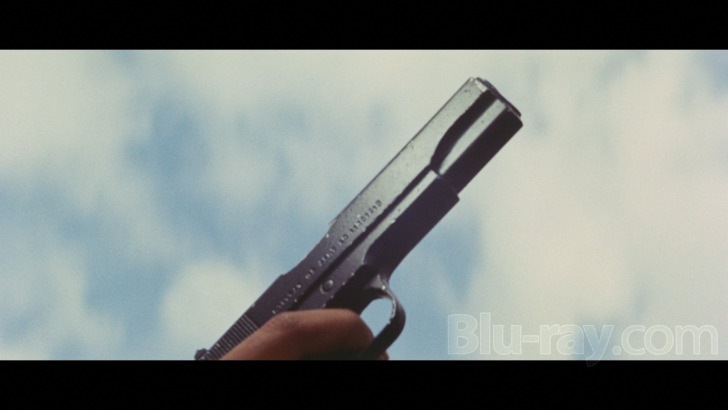
Aesthetics of a Bullet was transferred in high definition by Toei Company and supplied to Radiance Films as a high definition digital file. It is presented in the original aspect ratio with original mono audio.This is an appropriately gritty and dark (in both senses of that term) presentation, with some commendable detail levels in close-ups in particular, and a generally very nicely suffused palette. There are a number of pretty fuzzy and even blurry moments, some of which I attribute to the kinds of anamorphic oddities that can often be spotted in Asian films in particular, notably where Nakajima and cinematographer Toshio Masuda tend to try to draw attention to something deeper in the frame, leaving the edges looking frankly unfocused. As can be seen in screenshots 2 and 4, a couple of interstitial sequences offer some almost astounding colors slathered on the proceedings. Much of the film takes place in dimly lit or downright dark settings, and there can be passing moments of crush, as when Koike in his fancy new black duds walks in front of black walls at night. Grain can occasionally look slightly mottled, but resolves without any major issues.
Aesthetics of a Bullet Blu-ray Movie, Audio Quality
Aesthetics of a Bullet features LPCM Mono audio in the original Japanese, though any spoken material may take a back seat for some to a really riveting score by Ichirô Araki and The Brain Police. There's a nascent punk energy to much of the music which gives the film even more of an anarchic ambience than the narrative alone, though at extreme amplitudes some minor distortion can be detected. Urban material and even some relatively rural moments can also offer good ambient environmental effects. Dialogue is rendered without any issues. Optional English subtitles are available.
Aesthetics of a Bullet Blu-ray Movie, Special Features and Extras
- Robert Schwentke (HD: 29:52) offers his thoughts on Nakajima and the film.
- Kazuyoshi Kumakiri (HD; 16:17) features the film's assistant director. Subtitled in English.
- Sadao Nakajima (HD; 19:28) is featured in a 2023 interview. Subtitled in English.
- Trailer (HD; 2:57)
Aesthetics of a Bullet Blu-ray Movie, Overall Score and Recommendation
The aforementioned Battles Without Honor or Humanity debuted just a couple of weeks before Aesthetics of a Bullet in early 1973, and it may be a compelling exercise for "discerning cineastes" to compare and contrast how these two films completely revolutionized so-called ninkyo eiga. As is mentioned on the cover of this release and addressed in some of the supplements, Nakajima had a much harder time getting this piece financed than Kinji Fukasaku did with his film, but that may have ultimately redounded to this production's benefit, with "indie" co-producer Art Theater Guild allowing Nakajima considerable stylistic freedom, arguably even more so than Fukasaku experienced. It probably goes without saying that the Battles franchise probably subsumed this film, at least for a while, but this Radiance release should help Aesthetics of a Bullet find a new and appreciative audience. Technical merits are generally, and all of the interviews on the disc are very interesting. Recommended.
Other editions
Aesthetics of a Bullet: Other Editions

Similar titles
Similar titles you might also like

Japan Organized Crime Boss
日本暴力団 組長 | Nihon boryoku-dan: Kumicho | Standard Edition
1969

Rulers of the City
I padroni della città
1976

Battles Without Honor and Humanity
1973

Triad Underworld
Gong wu
2004

Yakuza Graveyard
Standard Edition
1976

Proxy War
Battles Without Honor and Humanity
1973

Police Tactics
Battles Without Honor and Humanity
1974

Final Episode
Battles Without Honor and Humanity
1974

Three Men to Kill
Trois hommes à abattre
1980

Wandering Ginza Butterfly
銀蝶渡り鳥 / Ginchô wataridori
1972
The Execution Game
Shokei yugi / 処刑遊戯
1979

Beyond Outrage
アウトレイジ ビヨンド / Outrage Beyond
2012

The Wind-of-Youth Group Crosses the Mountain Pass
峠を渡る若い風 / Tôge o wataru wakai kaze
1961

Connected
保持通話 / Bo chi tung wah
2008

A Bittersweet Life
2005

Teenage Yakuza
ハイティーンやくざ / Hai tiin yakuza
1962

Retaliation
縄張はもらった / Shima wa moratta
1968

Running Out of Time
暗戰 / Am zin
1999
Red Peony Gambler III: The Flower Cards Game
緋牡丹博徒 花札勝負 / Hibotan bakuto: Hanafuda shōbu
1969

Supermarkt 4K
Vinegar Syndrome Exclusive / Limited Collector's Edition / Slipcover in Original Pressing
1974