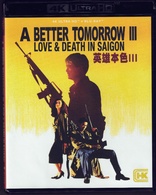
A Better Tomorrow III: Love and Death in Saigon 4K Blu-ray Movie
HomeA Better Tomorrow III: Love and Death in Saigon 4K Blu-ray Movie 
Ying hung boon sik III zik yeung ji gor / Ying xiong ben se III xi yang zhi ge / 英雄本色III夕陽之歌 / Hong Kong Cinema Classics #21 / 4K Ultra HD + Blu-rayShout Factory | 1989 | 1 Movie, 2 Cuts | 119 min | Rated R | Nov 18, 2025
Price
Movie rating
6.2 | / 10 |
Blu-ray rating
| Users |  | 0.0 |
| Reviewer |  | 3.5 |
| Overall | | 3.5 |
Overview
A Better Tomorrow III: Love and Death in Saigon 4K (1989)
Mark and his cousin who are living in war-torn Saigon, both fall in love with the same woman--a female gangster, who turns out to be the person from whom Mark learned all of his best moves.
Starring: Chow Yun-Fat, Tony Ka Fai Leung, Anita Mui, Shih Kien, Saburô TokitôDirector: Tsui Hark
| Foreign | Uncertain |
| Crime | Uncertain |
| Action | Uncertain |
| Thriller | Uncertain |
| War | Uncertain |
Specifications
Video
Video codec: HEVC / H.265
Video resolution: 4K (2160p)
Aspect ratio: 1.85:1
Original aspect ratio: 1.85:1
Audio
Cantonese: DTS-HD Master Audio Mono
English: DTS-HD Master Audio Mono
Subtitles
English
Discs
Blu-ray Disc
Two-disc set (2 BDs)
4K Ultra HD
Playback
Region A (B, C untested)
Review
Rating summary
| Movie |  | 3.0 |
| Video |  | 4.5 |
| Audio | | 4.5 |
| Extras | | 3.5 |
| Overall | | 3.5 |
A Better Tomorrow III: Love and Death in Saigon 4K Blu-ray Movie Review
Reviewed by Dr. Stephen Larson January 21, 2026Tsui Hark's A Better Tomorrow III: Love and Death in Saigon (original title: Ying hung boon sik III: Zik yeung ji gor, 1989) is being released as part of Shout! Studios' seven-disc box set, A Better Tomorrow Trilogy.
While A Better Tomorrow II (1987) wasn't the box-office smash that the first film was, it earned enough money for Golden Princess to green-light a third film in the series. Tsui Hark and John Woo had a falling out while making the sequel (though they have repaired their relations since). When Hark indicated he wanted to make a prequel and presented his vision to Woo, the latter had philosophical and creative differences, which resulted in him backing out of the project. Hark sets part of this third film in his native Vietnam. It is 1974 Saigon and Mark Gor (Chow Yun Fat) has made some dubious dealings to get his cousin, Cheung Chi-mun (Tony Leung Ka-fai), out of prison. It is the last days of the Vietnam War and Mark wants to obtain funds to secure exit visas for himself, his uncle (Shek Kin), and Cheung. Mark and Cheung want to relocate to Hong Kong but Mark's uncle has emotional ties to the herbal medicine shop he operates. He also wants to stick around to raise Pat (Wai Lun Cheng), a local boy he has adopted. But Cheung and Mark have arranged a contact, Miss Chow Kit-ying ("Kit" portrayed by Anita Mui), to help expedite their move. They also plan a meeting with Bong (Ling Nam Lam, brother of Ringo Lam), a senior Army commander, but things go horribly wrong. A love triangle develops between Mark, Kit, and Cheung. Things get more complicated when Kit resumes her business relationship with Ho (Saburô Tokitô), a Triad member. Ho was not only Kit's mentor but also her lover before spending a lengthy period in Holland.
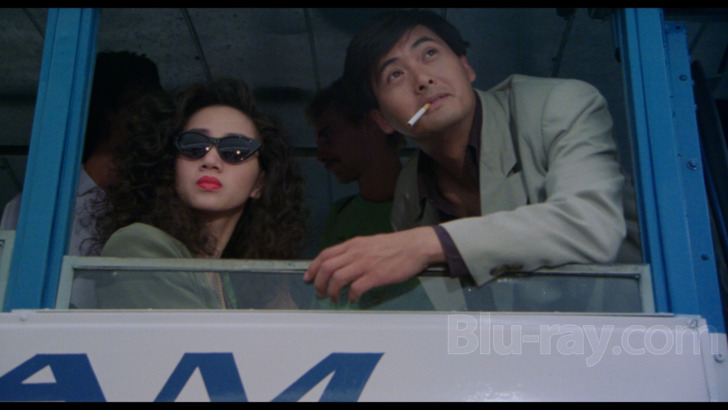
Kit and Mark.
A Better Tomorrow III is something of an origin story for Mark when he was a younger adult and hadn't yet joined the Triad. Kit serves as his mentor. She teaches him how to fight and use a machine gun with strong proficiency. One inkling we know this is a Tsui Hark film and not a John Woo film is the assertive role Hark has given a female character. But at the same time, Kit is a mystery woman. She's a black marketeer but I wonder why she has so much sway over Customs officials when they interrogate would-be passengers. (Customs officials are portrayed in a very negative light in this film.)
The movie is better when its showing scenes of government protestors. This had to reverberate loudly with Chinese audiences since the events of June 1989 at Tiananmen Square were still very fresh on their minds when ABTIII came out. The film is less successful, however, in the action scenes, which look pedestrian compared to those from the first two installments in the series. I understand that Hark has a different style in choreographing them than Woo does. He doesn't try to present them with the same "ballet of bullets." But Hark lacks Woo's creativity in the diversity of camera angles the latter chooses as well as editing patterns. Moreover, if Hark is making a prequel, why doesn't he include Sung Tse-Ho as well, and how he got to know Mark? ABTIII isn't as tightly paced as its predecessors and feels overlong.
A Better Tomorrow III: Love and Death in Saigon 4K Blu-ray Movie, Video Quality
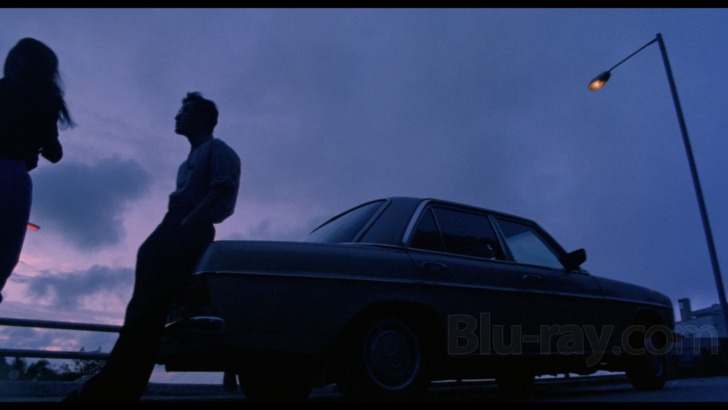
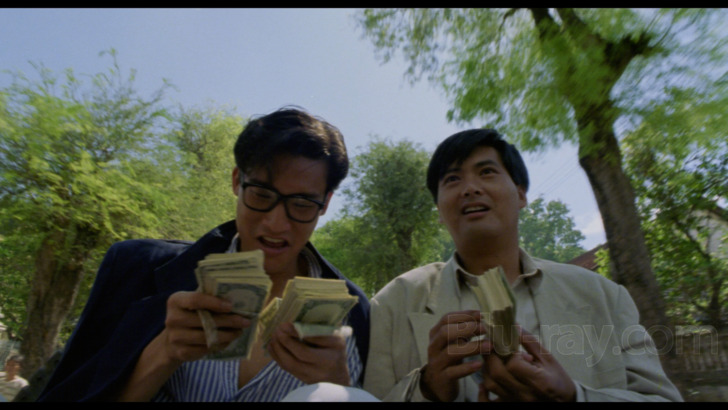
The 4K Ultra HD Blu-ray and standard Blu-ray are based on a 4K restoration from the original camera negative. The UHD appears in Dolby Vision (HDR10 compatible). A Better Tomorrow III is presented in its original theatrical exhibition ratio of 1.85:1. The transfers look as good, if not better, as the prior films in the franchise. Skin tones look completely natural. A thick texture and organic grain structure (without standing out as too chunky) suffuses the image. The bright red lipstick on Kit has a nice pop (see Screenshot #s 1, 6, and 13). Cinematographer Wing-Hang Wong favors a midnight blue for the late-evening scenes (see capture #s 15-19). He also employs a smoke machine (e.g., see #18) to give certain shots a palpable atmosphere. Look at how beautiful the lavender and dark blue sky appears on the 4K in #2. Tree foliage and vegetation are exquisite (see frame grab #s 4 and 14). Facial detail is abundant (see #s 7, 9, 11, and 12). Wing-Hang Wong got light to bounce off a green sign and on to Mark. (See how it looks on the Blu-ray in #31 and downsampled 4K in #32.)
The transfer has some dirt and debris in a few spots, although their presence is few and far between. The beach scene where Mark, Cheung, and Kit take part in target practice looks the roughest. You'll notice a white tramline in #25. (I saw another one in a different scene.) The UHD sports a mean video bitrate of 89.5 Mbps and total bitrate of 98.8 Mbps for the full disc. The MPEG-4 AVC-encoded BD-50 video delivers a rough average bitrate of 32000 kbps. My video scores for the UHD and Blu-ray are 4.75/5.00 apiece.
Screenshot #s 1-30, 32, 34, 36, 38, & 40 = Shout! Studios 2025 4K Ultra HD (downscaled to 1080p)
Screenshot #s 31, 33, 35, 37, & 39 = Shout! Studios 2025 Blu-ray BD-50 (from a 4K restoration)
Shout! has given the 119-minute feature eight chapter stops, which you can only skip to via remote since there's no menu shortcut.
A Better Tomorrow III: Love and Death in Saigon 4K Blu-ray Movie, Audio Quality
The default sound track is a DTS-HD Master Audio Dual Mono mix (1584 kbps, 24-bit), which is primarily in Cantonese along with a little English spoken by Chow Yan Fat's character. In addition, there's an alternate English dub, also encoded in DTS-HD MA 2.0 mono (1595 kbps, 24-bit). The native track is mixed a bit too high but there's isn't much distortion in the upper ranges. Spoken words are discernible. Bullets spraying from Uzis are clear and distinct. There's also some powerful bass from a firing tank and explosions.
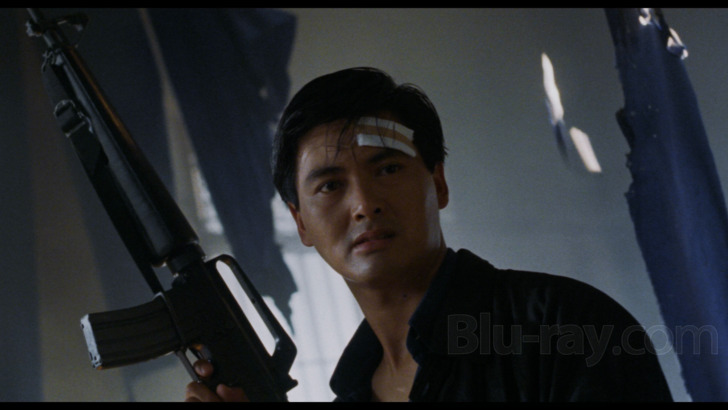
Lowell Lo's synth-heavy score works well and serves as effective accompaniment. He also employs bass and guitar. When Mark reappears with a long machine gun, Lo performs a cue similar to what Morricone would compose for a spaghetti Western. Lo reprises Joseph Koo's main theme from A Better Tomorrow and "Birdy's Flight" by Peter Gabriel one time each. My audio score is 4.75/5.00.
The English subtitles are optional. (See Screenshot #s 27-30 for some samples.)
A Better Tomorrow III: Love and Death in Saigon 4K Blu-ray Movie, Special Features and Extras
DISC ONE: 4K Ultra HD
- NEW Audio Commentary with Critic and Author David West - West discusses the influence that Story of a Discharged Prisoner (1967) had on the A Better Tomorrow films. He also talks about recurring motifs that run through Love and Death in Saigon. West compares and contrasts how John Woo and Tsui Hark portray their characters in the respective films that they've directed. In addition, the author/critic delves into how Confucianism and feudalism pertains to Hong Kong films, particularly this one. West also gives detailed filmographies of the major players and crew members. He speaks about Anita Mui's contributions as an actress, singer, and activist. West devotes special attention to her legacy. In English, not subtitled.
DISC TWO: Blu-ray
- NEW Audio Commentary with Critic and Author David West - West discusses the influence that Story of a Discharged Prisoner (1967) had on the A Better Tomorrow films. He also talks about recurring motifs that run through Love and Death in Saigon. West compares and contrasts how John Woo and Tsui Hark portray their characters in the respective films that they've directed. In addition, the author/critic delves into how Confucianism and feudalism pertains to Hong Kong films, particularly this one. West also gives detailed filmographies of the major players and crew members. He speaks about Anita Mui's contributions as an actress, singer, and activist. West devotes special attention to her legacy. In English, not subtitled.
- NEW Third Time Lucky – An Interview with Screenwriters Jason Kee-To Lam and Damu Liu (24:33, 1080p) - the scribes look back at the Film Workshop and the "idea group" that was formed. They disclose what John Woo told them about ABTIII and who should appear in it. The scenarists also reveal Tsui Hark's instructions to them before they wrote the script. They go over the group read that took place between Chow Yun Fat and Anita Mui. They additionally discuss Tony Ka Fai Leung and Saburô Tokitô. The writers have interesting comments about Chow's views of dubbing his own lines. They recollect writing the tank battle and what the last scenes represent as well as their meaning to Hong Kong audiences. They talk about an unrealized project Hark had for them after ABTIII. Both speak in Cantonese, subtitled in English.
- NEW Hong Kong Confidential: Inside A Better Tomorrow III with Grady Hendrix (10:23, 1080p) - Hendrix discusses the oft-fraught relationship between Tsui Hark and John Woo for films they worked together in the '80s. Hendrix unpacks the story ideas each filmmaker contributed in their various projects. He also talks about how the actors in ABTIII felt about the dubbing process. Hendrix critiques the performances of Shih Kien and Anita Mui. He specifies which genre ABTIII belongs in. In English, not subtitled.
- NEW All Our Tomorrows: THE A BETTER TOMORROW Franchise and Its Remakes – An Interview with Hong Kong Filmmaker and Academic Gilbert Po (23:18, 1080p) - Po talks about A Better Tomorrow (1986) as a cultural phenomena, the influence film noir of the '50s and '60s had on John Woo, how Hong Kong cinema changed after the A Better Tomorrow movies, and the star power of both Ti Lung (Shaw brothers fame) and Chow Yun Fat. Po says the ABT films brought out a different side to Leslie Cheung. He briefly addresses the audience popularity and mixed critical reception of A Better Tomorrow II (1987). He describes the cinematic style and dialogue of A Better Tomorrow II (1989), which he compares to Casablanca (1942). Moreover, Po touches on Return to a Better Tomorrow (1994), the three leads, and Wong Jing's style. He also covers the Korean remake A Better Tomorrow (2010) and the 2018 Chinese remake of the same. In English, not subtitled.
- NEW Nam Flashbacks: How A BETTER TOMORROW III Represents the Conflict – An Interview with Vietnam War Researcher Dr. Aurélie Basha i Novosejt (16:55, 1080p) - Novosejt talks about ABTIII's representation of the Chinese community in the north and south, Vietnam beginning in the 1950s, the mood of Saigon in the film, the signification of Vietnamese flags, and protestors' signs. She also compares how American films about Vietnam are different from ABTIII. Finally, Novosejt supplies historical context with the goings-on in both China and Vietnam. In English, not subtitled.
- Theatrical Trailer (5:11, upconverted to 1080p) - a telecined original trailer for ABTIII presented in about 1.85:1 anamorphic widescreen. It hasn't been restored as its sports numerous film artifacts and tramlines. The sound, however, has been restored. Its quality ranges from very good to excellent. In Cantonese, subtitled in English.
- Image Gallery (1:46, 1080p) - a slide show comprising 21 still images related to the promotion and publicity of ABTIII. These consist of adverts, posters, and lobby cards.
A Better Tomorrow III: Love and Death in Saigon 4K Blu-ray Movie, Overall Score and Recommendation
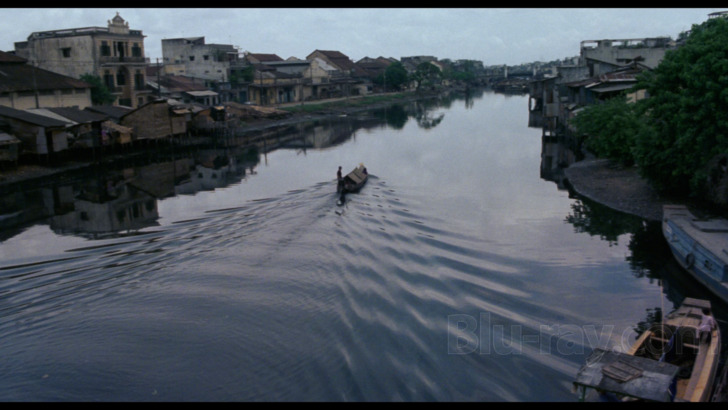
A Better Tomorrow III features excellent cinematography and atmospheric lighting but Hark's direction of the actors isn't as sharp as Woo's from this period. Love and Death in Saigon is a good film on its own terms but still a disappointing final entry in the ABT trilogy. Shout! has served up a marvelous 4K transfer and very fine mono mix in lossless. The extras are all worthwhile but not as plentiful as others for the first two films. RECOMMENDED but with some qualifiers.
Similar titles
Similar titles you might also like
(Still not reliable for this title)

A Better Tomorrow II 4K
Ying hung boon sik II / Ying xiong ben se II / 英雄本色II / Hong Kong Cinema Classics #20
1987

A Better Tomorrow 4K
Ying hung boon sik / Ying xiong ben se / 英雄本色 / Hong Kong Cinema Classics #19
1986

Long Arm of the Law: Part 2
省港旗兵續集
1987

Nightfall
Da Zhui Bu
2012

Righting Wrongs
Above the Law / 執法先鋒 / Zhí fǎ xiān fēng / Slipcover in Original Pressing
1986

Bangkok Dangerous
บางกอกแดนเจอรัส: เพชฌฆาตเงียบ อันตราย
1999

The Bodyguard from Beijing 4K
Chung Nam Hoi bo biu / Zhong Nan Hai bao biao / 中南海保鑣 / Hong Kong Cinema Classics #5
1994

In the Line of Duty IV
Huáng jiā shī jiě IV: Zhí jī zhèng rén | Wong ga si je IV: Jik gik jing yan | 皇家師姐IV 直擊證人 | 2K Remastered
1989

Tiger Cage II
Sai hak chin / Xi hei qian / 洗黑錢
1990

Golgo 13: Assignment Kowloon
ゴルゴ13:九竜の首 / Gorugo 13: Kûron no kubi
1977

The Brink
狂獸 / Kwong Sau
2017

The Street Fighter
Gekitotsu! Satsujin ken / 激突!殺人拳
1974

Long Arm of the Law
省港旗兵 / Shěng gǎng qí bīng
1984
Iron Angels
Tian shi xing dong / 天使行動
1987

Special ID
2013

The Killer 4K
Dip huet seung hung / Die xue shuang xiong / 喋血雙雄 / Hong Kong Cinema Classics #18
1989

Violent Cop
その男、凶暴につき
1989
The Killing Game
Satsujin yugi / 殺人遊戯 / The Murder Game
1978

Let the Corpses Tan
Laissez bronzer les cadavres
2017

Drug War
毒戰
2012