A Better Tomorrow 4K Blu-ray Movie
HomeA Better Tomorrow 4K Blu-ray Movie 
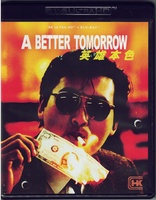
Ying hung boon sik / Ying xiong ben se / 英雄本色 / Hong Kong Cinema Classics #19 / 4K Ultra HD + Blu-rayShout Factory | 1986 | 95 min | Not rated | Nov 18, 2025
Price
Movie rating
7.7 | / 10 |
Blu-ray rating
| Users |  | 0.0 |
| Reviewer |  | 5.0 |
| Overall | | 5.0 |
Overview
A Better Tomorrow 4K (1986)
A death-hardened cop battles the Hong Kong underworld, including his own brother, who joins the bad guys and his former partner in crime. This progenitor of Woo's "heroic violence" films introduces the theme of loyalties between men shattered by a violent world that forces them apart. Only through sacrifice can honor be attained.
Starring: Chow Yun-Fat, Leslie Cheung, Lung Ti, Waise Lee, Kenneth TsangDirector: John Woo
| Foreign | Uncertain |
| Crime | Uncertain |
| Melodrama | Uncertain |
| Thriller | Uncertain |
| Action | Uncertain |
Specifications
Video
Video codec: HEVC / H.265
Video resolution: 4K (2160p)
Aspect ratio: 1.85:1
Original aspect ratio: 1.85:1
Audio
Cantonese: DTS-HD Master Audio Mono
English: DTS-HD Master Audio Mono
Subtitles
English
Discs
Blu-ray Disc
Two-disc set (2 BDs)
4K Ultra HD
Playback
Region A (B, C untested)
Review
Rating summary
| Movie | | 5.0 |
| Video |  | 4.5 |
| Audio | | 5.0 |
| Extras | | 4.5 |
| Overall | | 5.0 |
A Better Tomorrow 4K Blu-ray Movie Review
Reviewed by Dr. Stephen Larson November 15, 2025John Woo's A Better Tomorrow (original title: Ying hung boon sik, 1986) is being released as part of Shout! Studios' seven-disc box set, A Better Tomorrow Trilogy.
John Woo found himself in a quandary and at a crossroads in his directing career during the mid Eighties. After directing a string of comedies and action pictures, he was looked down upon by Cinema City probably because the then-new studio didn't think he could adapt well to audiences' tastes and respond effectively to how those two genres were evolving. Film scholar Kenneth E. Hall, author of John Woo: The Films (McFarland, 2012, 2nd edition), interviewed Woo’s business partner Terence Chang about that period. Chang recollected that the heads of Cinema City sent Woo to Taiwan for "administrative work." That assignment didn't go as smoothly as planned. Woo became short of funds. The studio permitted him to direct two features there, The Time You Need a Friend (1986) and Run Tiger Run (1986). They were not popular with audiences and Woo returned to Hong Kong in disconsolation. Enter Tsui Hark, Woo's friend. Hark was fully supportive of Woo and a creative partner for the next project they would work together on. Woo and Hark imagined remaking the Cantonese classic The Story of a Discharged Prisoner (1967) in a contemporary setting with a modern story. The result was A Better Tomorrow.
Woo and his co-writers construct the film's narrative around biological brothers and surrogate brothers. For example, there's Ho Sung-tse (Ti Lung) and his younger sibling, Kit (Leslie Cheung). Ho works pretty high up in a Triad group that operates a counterfeit money distribution outfit. Kit is a recent graduate of the local police academy and new officer for the Hong Kong Police Force. He doesn't know his brother works for a criminal syndicate. Mark Lee (Chow Yun-Fat) is also employed by this Triad. He and Ho are close friends and almost like brothers. They are loyal to each other. On the surface, Shing (Waise Lee Chi-hung) is one of Ho and Mark's fellow "brothers" but has bigger plans for himself in the Triad's operation. His personal ambition transcends brotherhood. A Better Tomorrow also features two important paternal figures. The ailing Father Sung (Feng Tien) is dad to Ho and Kit, who love him very much. The father's fate will alter the siblings' relationship. There is also Mr. Yiu (Yanzi Shi), head of the Triad and a surrogate father to Ho, Mark, and Shing. While he operates a criminal enterprise, he is not a bad person per se and later earns the audience's sympathy.
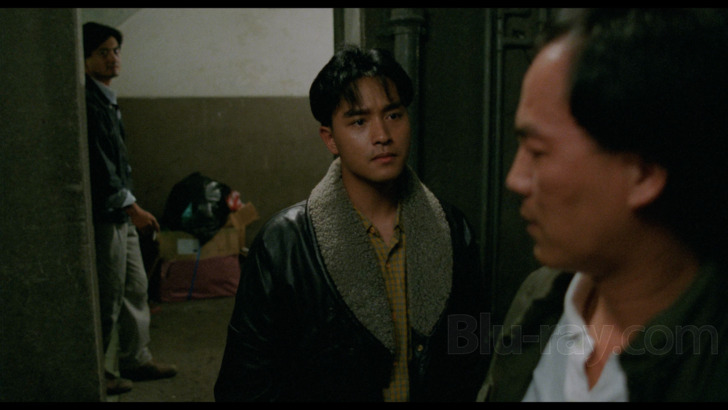
A Better Tomorrow features at least three magnificently staged and executed action scenes as well as several good ones. The action sequences are not that long because Woo wants to spend the most screen time on the characters and their interrelationships. The film isn't all serious drama. Woo also demonstrates his deft touch for comedy. For instance, there's a funny scene with Kit chatting with observers inside an auditorium while his girlfriend Jackie (Emily Chu) practices her cello. A humorous scene follows with Jackie's cello case and the window of a taxicab.
It's nearly impossible to believe that Chow Yun-Fat was once considered box-office poison by studios in Hong Kong. He was labeled that way prior to ABT but when he co-starred in the Woo picture, he was instrumental in shattering box-office records with his charisma and mastery of "Gun Fu." Ti Lung, a veteran of Shaw Brothers pictures whose career was floundering at the time, has just the right personality for Ho. Leslie Cheung is perfectly cast as Kit. His character is a bit of jokester but also petulant and not understanding of Ho's predicament. The sensitivity Cheung brings to the role is what makes his character so compelling. A Better Tomorrow is captivating and exhilarating from beginning to end.
A Better Tomorrow 4K Blu-ray Movie, Video Quality
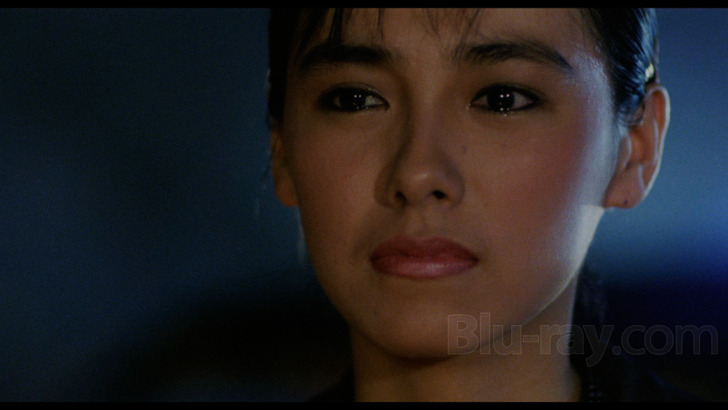
The transfers on Shout!'s 4K Ultra HD Blu-ray and 1080p Blu-ray are each sourced from a 4K scan of the original camera negative. The UHD is presented in Dolby Vision (HDR10 compatible). A Better Tomorrow previously received a 4K remaster in the mid-2010s. That older 4K scan was released on standard Blu-ray in various Asian countries by Kam & Ronson Enterprises, Nova Media, and later in the early 2020s by Deltamac. It seems that the UHD released in Japan by TWIN Co. is based on the first 4K master. The more recent 4K scan of the OCN has been issued on UHD in China by Disk Kino (re-released here in a standard edition).
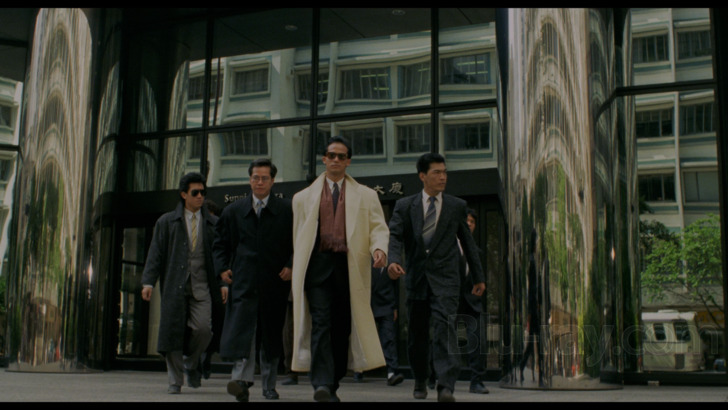
The film appears in its native exhibition ratio of 1.85:1. ABT was filmed in Hong Kong and Taiwan with exterior scenes that often feature overcast skies. Colors are still strong. Check out the reds in Screenshot #s 25 and 28 as well as the greens in #s 39-40. The interiors feature a lot of overhead lights for scenes set in the Triad headquarters and neon lights for nightclub scenes. On the 4K, I could pick out details in the framed photograph of Marilyn Monroe, which is impressive considering it's hanging in the back middle of a wall seen in a long wide shot (see frame grab #20). (I couldn't pick out details as well when viewing identical shot on the Blu-ray.) The 4K renders highlights well (e.g., see capture #14 and HK cityscapes at night).
Some of the more darker scenes on the 4K are a bit more difficult to see vestiges of light compared to the Blu-ray, which is a notch brighter. I immediately noticed the difference for a shootout in a dwelling. For example, notice how darkened the man's face is with the shotgun in #36 compared to the same shot in #35. (I did my very best to locate an identical frame match from each transfer.) Naturally, the grain is more heavily accented in the darkest scenes on the 4K but it never becomes clumpy. I am glad that Shout! continues to include a standard Blu-ray based off the same restoration for many of its releases because I feel both are worth examining. (They each have their individual strengths and occasional drawbacks.)
The restoration of the OCN is clean without any conspicuous filtering that would hinder the image's organic qualities. I did spot some age-related damage marks on the edge of the frame while watching both discs in motion on my QLED. When I examined the 4K transfer shot by shot on a monitor, I caught some photochemical spots. For instance, a couple popped up to the right of the father's bed pillow in #6 and one on a white tile in #10. In addition, there's a slight tear in the emulsion in #27 (on the right side). My video score for the UHD and Blu-ray is 4.75/5.00 apiece.
Because the amount of space used on the UHD slightly exceeds 66 GB, the disc is technically a BD-100. Shout!'s encoding is phenomenal. The feature boasts a mean video bitrate of 90.6 Mbps and an overall bitrate of 99.9 Mbps for the whole disc. The Blu-ray employs the MPEG-4 AVC encode and carries a standard video bitrate of 32000 kbps.
Screenshot #s 1-30, 32, 34, 36, 38, & 40 = Shout! Studios 2025 4K Ultra HD (downscaled to 1080p)
Screenshot #s 31, 33, 35, 37, & 39 = Shout! Studios 2025 Blu-ray BD-50 (from a 4K restoration)
Shout! has given the 95-minute film eight chapter breaks.
A Better Tomorrow 4K Blu-ray Movie, Audio Quality
Shout! has supplied a DTS-HD Master Audio Dual Mono mix (1598 kbps, 24-bit), which is primarily in Cantonese but also features some spoken Mandarin and English. There's also an alternate DTS-HD MA 2.0 Mono track (1577 kbps, 24-bit) dubbed in English. It is great to have the original monaural track back after so many physical media releases omitted it. The repressing of the 2001 Anchor Bay US DVD has it along with a few Asian and Scandinavian SD editions. It has been glaringly absent on a majority of Blu-ray versions, though. It should be pointed out that when ABT was issued on DVD with stereo and surround remixes, new foley effects were added along with different musical cue inserts. For example, on the Cantonese stereo remix on the Optimum DVD, I could hear Silvestri's theme from Forrest Gump!
The mono track isn't mixed as high as other mixes I've heard for releases in the Hong Kong Cinema Classics line. I played it for the full runtime at regular volume on my calibrated receiver and it didn't sound too loud. I played it again at least three decibels lower and I could still pick out dialogue, music, and sound f/x. There are no scratches, dropouts, or audible hiss. Composer Joseph Koo penned two themes. One features harpsichord, synths, bass, and percussive effects. The other theme, which is played far more often, contains harmonica, strings, and some synth accompaniment. Emily also plays this theme on her cello. Woo also incorporates Peter Gabriel's piece, "Birdy's Flight," from Alan Parker's Birdy (1984). He must love the track because it's excerpted four times in the film. The synthetic flute has a pan-flute sound to it that works well in how its synced with on-screen action in ABT.
The optional English subtitles are clear and legible to read. (The ballad Leslie Cheung sings during the end titles is subtitled.) When there is a sound bridge connecting one of the character's voices who's shown in the next scene, subs appear in italics (see Screenshot #29).
A Better Tomorrow 4K Blu-ray Movie, Special Features and Extras
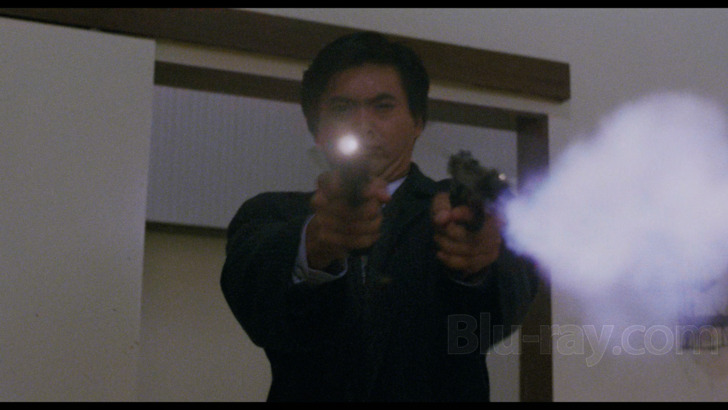
Shout! has produced a slew of exclusive extras for this two-disc set. There have been some bonus features included on prior disc releases that haven't been ported over here, though. For example, UK label Optimum Releasing recorded a feature-length commentary with Bey Logan, which initially appeared in the UK on Optimum's single- and double-disc releases and later on a Chinese Blu-ray released by Hualu Publishng & Media Co.. I have listened to Logan's track and regard it very highly. His commentary is more screen specific than James Mudge's on the Shout! discs. It is also more lucid, clearly presented, and measured in pace. It contains several anecdotes about Leslie Cheung and his legacy. Also missing is a 1993 interview (in English) with Chow Yun-Fat that UK label Missing in Action put on its 1999 DVD.
DISC ONE: 4K Ultra HD
- NEW Audio Commentary with James Mudge - Mudge is a film producer, festival programmer, and the Hong Kong film critic at easternKicks. He delves into many topics related to A Better Tomorrow across the 90-minute runtime. The representation of Hong Kong identity in the film is a major talking point. Mudge also discusses Cinema City, Film Workshop, John Woo, Tsui Hark, and all of the major performers, including Emily Chu. Mudge hardly lets up and tries to pack too much information into this track. He interjects his opinions, which are interesting to hear, but zigzags between his views and fact-based discussions of the HK film industry, ABT, its production, and the cast/crew. Mudge is prepared but his presentation could use better organization and transitions. Still, the commentary is well worth listening to. In English, not subtitled.
DISC TWO: Blu-ray
- NEW Audio Commentary with James Mudge - Mudge is a film producer, festival programmer, and the Hong Kong film critic at easternKicks. He delves into many topics related to A Better Tomorrow across the 90-minute runtime. The representation of Hong Kong identity in the film is a major talking point. Mudge also discusses Cinema City, Film Workshop, John Woo, Tsui Hark, and all of the major performers, including Emily Chu. Mudge hardly lets up and tries to pack too much information into this track. He interjects his opinions, which are interesting to hear, but zigzags between his views and fact-based discussions of the HK film industry, ABT, its production, and the cast/crew. Mudge is prepared but his presentation could use better organization and transitions. Still, the commentary is well worth listening to. In English, not subtitled.
- NEW Better Than the Best: An Interview with Director John Woo (34:26, 1080p) - Woo regards A Better Tomorrow as "his first auteur movie." He acknowledges the valuable support he received from Tsui Hark, who was indispensable in helping to make the picture with him. Woo also thinks back to his comedy-theme work and handling criticism about where he was in his directing career. He also recalls his desire to make a picture akin to Le Samouraï (1967) and as a broader homage to French films. He also describes his admiration for Alain Delon and Ken Takakura. In another section of the interview, he discusses the casting of Chow Yun-Fat, Leslie Cheung, and Ti Lung. Additionally, he explains how he directed an action sequence and what went into it. Woo also explains his attempt to make the film original and unusual. The final parts of the interview delve into releasing the film, its reception, and an audience's reaction. Woo speaks in English but his voice is raspy and hard to understand at times so I would recommend having the volume up on your receivers. Entirely in English, not subtitled.
- NEW Between Friends: Remembering A BETTER TOMORROW: An Interview with Producer Terence Chang (7:34, 1080p) - Chang gives an overview of Hong Kong cinema in the 1980s, his film school background in New York City, and returning to Hong Kong where he worked at Golden Harvest. He also talks about his stints at D & B Films (foreign sales) and Film Workshop (with Tsui Hark and his wife). Chang mentions working with John Woo on a few occasions before A Better Tomorrow. He also describes the influence of American westerns had on ABT and combining genres into the film. In English, not subtitled.
- NEW When Tomorrow Comes: An Interview with Screenwriter Chan Hing-ka (20:48, 1080p) - Hing-ka was the primary writer on A Better Tomorrow. He explains how he got involved with the film, penning a screenplay about the triads (which evolved into ABT), and a TV series he scripted starring Chow Yun-Fat. Hing-ka details his initial meetings with John Woo, what he's like as a collaborator, his personality as a man and a filmmaker. The writer also states that The Story of a Discharged Prisoner (1967) was a basis for ABT. (Hopefully, this classic Cantonese film will become available on physical media at some point.) Hing-ka describes the character themes of triad brotherhood and blood brotherhood, an actors' group read of the script, his personal reminiscences of Leslie Cheung, and his memories of seeing A Better Tomorrow at least two screenings after it was finished. Hing-ka also offers his opinions of the film's two sequels. In Cantonese or Mandarin, with English subtitles.
- NEW Thoughts on the Future: An Interview with Gordon Chan (8:15, 1080p) - Chan was an uncredited writer on A Better Tomorrow. Chan breaks down Woo's method of handling gunfights and explains why he doesn't ear earplugs. He also talks about Wuxia, The Final Option (1984), A Better Tomorrow II (1987), and the mutual admiration Woo and Tsui Hark had for each other. In Cantonese or Mandarin, with English subtitles.
- Better and Bombastic: Gareth Evans on A Better Tomorrow and John Woo (23:00, 1080p) - this interview is an appreciation of Woo and his work by filmmaker Gareth Evans. He begins with when he first discovered John Woo (i.e., Hard Boiled) and his reaction to seeing it with his father. Evans also has lots to say about A Better Tomorrow, which he acknowledges significantly influenced his own movies. He also discusses Chow Yun-Fat, The Killer (1989), Bullet in the Head (1990), Hard Target (1993), Face/Off (1997), and the two parts of Red Cliff (2008/09). In another part of the interview, Evans examines the films that he has directed in Indonesia and who influenced his style (Woo and others). He explains how ABT is autobiographical for Woo and how it differs from prior Hong Kong action films. A nice anecdote occurs towards the end when he unpacks details of a preview screening attended by Chow Yun-Fat. In English, not subtitled.
- NEW Hong Kong Confidential – Inside A Better Tomorrow with Grady Hendrix (17:48, 1080p) - Hendrix opens his piece with info on the different types of budding filmmakers who made movies in Hong Kong but often started elsewhere. He provides details on the comedy and action pictures Tsui Hark and John Woo made throughout the '80s. Hendrix discusses the casting of Leslie Cheung, Ti Lung, and Chow Yun-Fat. More, he covers some aspects of A Better Tomorrow's production and the different visions Hark and Woo had for the picture. In English, not subtitled.
- Trailers (6:24 altogether) - Trailer #1 (4:27, 1080p) is Cinema City's official theatrical trailer for A Better Tomorrow. It has been restored. Trailer #2 (1:57, upconverted to 1080p) was produced after the movie was a critical and commercial success. It is sourced from an analog master and hasn't been restored. In Cantonese, subtitled in English.
- Image Gallery (3:55, 1080p) - a slide show comprising 47 images that covers the productions and marketing campaigns of A Better Tomorrow and, to a lesser extent, A Better Tomorrow II. Stills consist of various posters, lobby cards, and a Japanese press booklet.
A Better Tomorrow 4K Blu-ray Movie, Overall Score and Recommendation
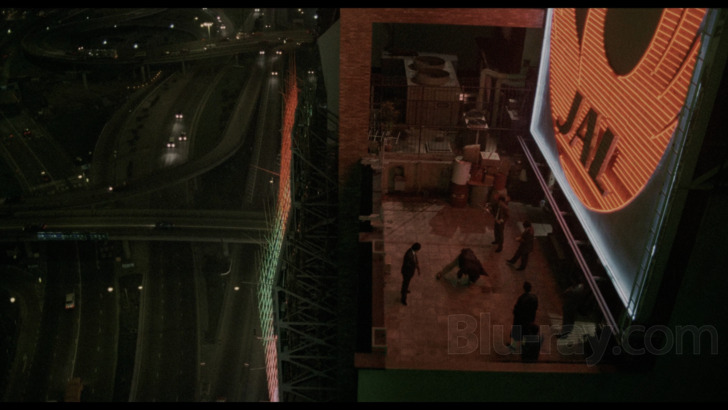
A Better Tomorrow is a strong candidate for John Woo's best film. It is an exemplar for the heroic bloodshed subgenre. It still feels fresh, groundbreaking, and innovative. The 4K is close to perfection. The supplementary contents deliver a lot of in-depth info on Woo, the film's production, and actors. MY HIGHEST RECOMMENDATION.
Similar titles
Similar titles you might also like
(Still not reliable for this title)

A Better Tomorrow II 4K
Ying hung boon sik II / Ying xiong ben se II / 英雄本色II / Hong Kong Cinema Classics #20
1987

A Better Tomorrow III: Love and Death in Saigon 4K
Ying hung boon sik III zik yeung ji gor / Ying xiong ben se III xi yang zhi ge / 英雄本色III夕陽之歌 / Hong Kong Cinema Classics #21
1989

The Killer 4K
Dip huet seung hung / Die xue shuang xiong / 喋血雙雄 / Hong Kong Cinema Classics #18
1989
Hard Boiled 4K
Lat sau san taam / La shou shen tan / 辣手神探 / Hong Kong Cinema Classics #17 / Includes Bonus BD
1992

The Raid 2
The Raid 2: Berandal
2014

Drug War
毒戰
2012

The Man from Nowhere 4K
아저씨
2010

A Bittersweet Life
2005

Le Doulos 4K
1962

Exiled
Fong juk / 放‧逐
2006

Syndicate Sadists
Il giustiziere sfida la città
1975

Bangkok Dangerous
บางกอกแดนเจอรัส: เพชฌฆาตเงียบ อันตราย
1999

The Street Fighter
Gekitotsu! Satsujin ken / 激突!殺人拳
1974

Beyond Outrage
アウトレイジ ビヨンド / Outrage Beyond
2012
Triad Underworld
Gong wu
2004

Outrage
アウトレイジ / Way of the Yakuza
2010

Violent Cop
その男、凶暴につき
1989

Dead or Alive 2
2000

The Raid: Redemption 4K
Serbuan Maut
2011

The Professional
Le professionnel
1981