A Ballerina's Tale Blu-ray Movie
HomeA Ballerina's Tale Blu-ray Movie 
MPI Media Group | 2015 | 84 min | Not rated | Feb 02, 2016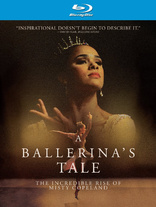

Movie rating
6.5 | / 10 |
Blu-ray rating
| Users |  | 0.0 |
| Reviewer |  | 3.5 |
| Overall | | 3.5 |
Overview
A Ballerina's Tale (2015)
Misty Copeland didn't start ballet dancing until age 13, yet quickly became a prodigy, and a mere five years after first lacing up toe shoes she joined American Ballet Theater. In June 2015, Copeland was promoted to principal dancer at ABT in June 2015, making her the very first female African-American principal in the company's 75-year history.
Starring: Misty Copeland, Deirdre Kelly (III), Susan Fales-Hill, Leyla Fayyaz, Brenda Dixon GottschildDirector: Nelson George
| Documentary | Insignificant |
| Biography | Insignificant |
Specifications
Video
Video codec: MPEG-4 AVC
Video resolution: 1080p
Aspect ratio: 1.78:1
Original aspect ratio: 1.85:1
Audio
English: DTS-HD Master Audio 5.1 (48kHz, 24-bit)
English: LPCM 2.0 (48kHz, 24-bit)
Subtitles
English SDH, Spanish
Discs
25GB Blu-ray Disc
Single disc (1 BD)
Playback
Region A (B, C untested)
Review
Rating summary
| Movie | | 3.5 |
| Video |  | 4.0 |
| Audio | | 4.0 |
| Extras |  | 1.5 |
| Overall | | 3.5 |
A Ballerina's Tale Blu-ray Movie Review
Swans of Many Colors
Reviewed by Michael Reuben February 3, 2016One doesn't need to be interested in ballet to appreciate A Ballerina's Tale, the biographical
sketch of dancer Misty Copeland by filmmaker Nelson George.The story of a young artist's
struggle for success and self-definition is the classic stuff of bio-pics, and George shrewdly taps
into that narrative tradition while avoiding many of its cliches. The achievement is even more
remarkable considering that, when George first began the project with a Kickstarter campaign in
2013, Copeland's dancing had been abruptly halted by injuries that threatened to end her
dazzling ascent. As George and a camera crew followed the former child prodigy through surgery
and rehabilitation, the filmmaker could not have been sure whether he was documenting a
triumphant tale of recovery or a tragedy about a promising career cut short.
A Ballerina's Tale premiered at the Tribeca Film Festival in April 2015. After a limited theatrical
run and release on VOD in October, the film is now being issued on Blu-ray by MPI Media
Group.
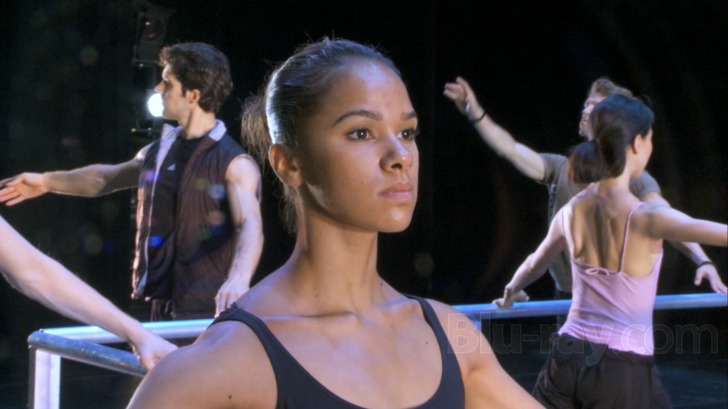
A Ballerina's Tale focuses less on biographical detail than on Copeland's distinctive role as a trail-blazing African-American star in an art form traditionally dominated by white Americans and Europeans. As with so many achievements, timing is a crucial factor. Though Copeland was not the first black ballerina to attract notice, she came along at a time when the conventional notion of a lead dancer was being examined with a critical eye. As one of the film's interviewees notes, the pale, waifish figures that dominate the ballet stage were largely the creation of choreographer George Balanchine in the 1950s, but the art form itself has a far more extensive and varied history since it first appeared in the 15th Century. When the New York Times published a 2005 feature entitled "Where Are All the Black Swans?", it was asking a question that was already in the air.
Copeland was the logical answer to the question. After a precocious career in California, where she was raised, she moved to New York in 1999 at the age of 17 to dance with the American Ballet Theater (or "ABT"), one of the world's leading companies. As reflected in numerous interviews, Copeland was quickly adopted by a squad of mentors, who sensed in the young prodigy a historic potential to redefine the conventional notion of how a ballerina should look and move. With encouragement from all sides, Copeland rose through the ranks at ABT, resulting in her selection as the lead in a 2012 production of Igor Stravinsky's masterpiece, The Firebird, at the Metropolitan Opera House. Multiple interviewees attest to the historic importance of Copeland's performance, which, according to director George, left much of the audience in tears.
But this is where A Ballerina's Tale takes a dark turn. The excellence of Copeland's Firebird performance was achieved through a haze of pain caused by multiple stress fractures in the dancer's left leg. Even with the high tolerance for discomfort that is a job requirement for a ballet dancer, Copeland was forced to withdraw from the stage altogether, lest she suffer permanent and irreversible damage. George interviews the surgeon who reconstructed the dancer's tibia with a metal rod and the dance teacher who oversaw her physical therapy. Then he chronicles Copeland's re-emergence on the stage in 2013 in a performance of The Dying Swan, a piece carefully chosen not to overtax her newly fortified bone. Embarking on a world tour, Copeland resumes regular performances and finds that her ability to connect with audiences is undiminished. In September 2015, she is promoted to principal ballerina of ABT--the first African-American woman to hold that position in the company's history.
Ballerinas are as much athletes as artists, and Copeland's success leads to the kind of publicity, endorsement contracts and public appearances that are a familiar staple among major sporting figures. Still, with all of the attention and scrutiny, what's most notable about the young woman whom George follows around New York is how quiet and unassuming she is, blending easily into the pedestrian throng on busy Manhattan streets. A Ballerina's Tale is filled with colleagues, friends and dance experts extolling Copeland's virtues, but the ballerina herself seems most comfortable when out of the limelight: giving George and his camera crew a tour of ABT's backstage areas, pointing out her favorite rehearsal spot or reminiscing about frequent trips to Red Lobster in Brooklyn when she first arrived in New York. Although she is graceful in managing the pressure of having so many people's hopes and expectations riding upon her, she also seems fully aware of belonging to a tradition of minority ballerinas on whose shoulders she stands. In a poignant sequence, Copeland visits with retired ballerina Raven Wilkinson, then 74 years old, and another African-American who succeeded against type, dancing with the Ballet Russe de Monte Carlo in the 1950s. As the two dancers trade notes on pieces they have both performed, and even rehearse some of the movements, they seem to share a special connection born of common experience, one that reaches across the generations and unites them as chapters of a continuing story.
A Ballerina's Tale Blu-ray Movie, Video Quality
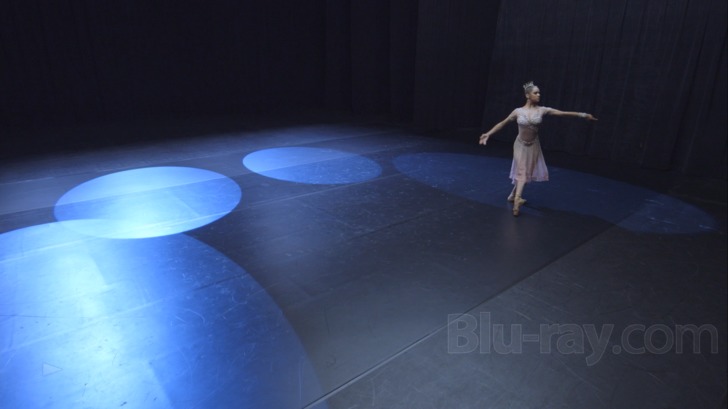
MPI Media Group's 1080p, AVC-encoded Blu-ray of A Ballerina's Tale effectively captures the HD camerawork of director George and his crew, reproducing both interviews and performances with naturalistic color and as much clarity as lighting conditions will allow. The New York street scenes look like the actual places, without stylization, and all of the new dance sequences are bright and fresh. The archival tapes of a young Copeland vary in quality according to the source, while the many photographs from Copeland's career and others' are reproduced with perfect clarity. The average bitrate for the 84-minute film is 27.43 Mbps, and no compression issues appeared.
A Ballerina's Tale Blu-ray Movie, Audio Quality
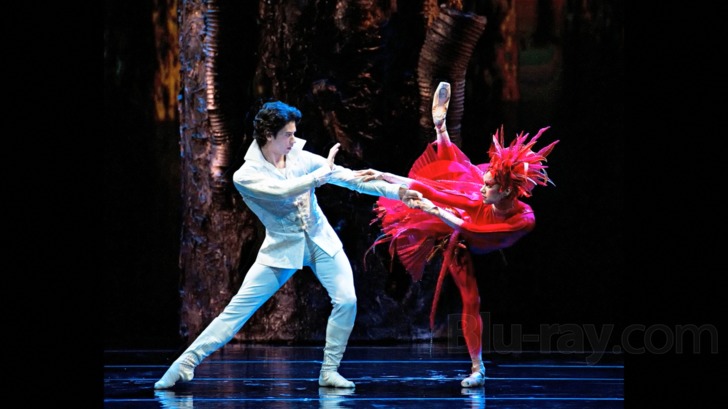
The film's 5.1 soundtrack, encoded on Blu-ray in lossless DTS-HD MA, features clearly
reproduced voices and well-recorded musical accompaniment to the dance performances. The
track is also effective in supplying background sound suited to the environment, so that, for
example, scenes shot on the streets of New York are accompanied by the immersive hum of
traffic, people and machinery that any city dweller will immediately recognize.
As usual with MPI Media Group's Blu-ray releases, an alternative PCM 2.0 track is included.
A Ballerina's Tale Blu-ray Movie, Special Features and Extras
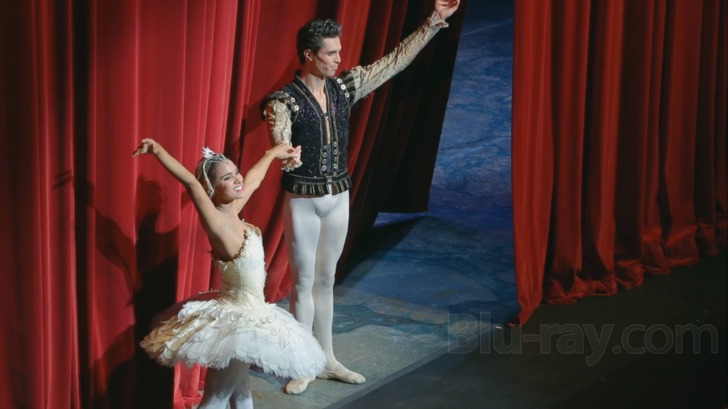
- Deleted Scenes (1080p; 1.78:1; 6:13): These consist entirely of additional interviews with Copeland and her publicist and manager, Gilda Squire.
- Theatrical Trailer (1080p; 1.78:1; 1:36).
- Additional Trailers: At startup, the disc plays trailers for Time Out of Mind, Seymour: An Introduction, Do I Sound Gay? and Killing Them Safely, which can be skipped with the chapter forward button and are not otherwise available once the disc loads.
A Ballerina's Tale Blu-ray Movie, Overall Score and Recommendation

As one of the film's interviewees observes, a ballet star must have "stage presence", which can
neither be learned nor taught. It may be impossible to capture that elusive quality on film, and A
Ballerina's Tale doesn't try. It does convey, however, a sense of the effort, discipline and self-sacrifice that are required to translate that
natural gift into a successful career. It also suggests,
through scenes like the adoring crowd greeting Copeland at the stage door, how important it is
for audience members to see people who look like them on stage and screen. Recommended.