1945 Blu-ray Movie
Home1945 Blu-ray Movie 
Menemsha Films | 2017 | 91 min | Not rated | Nov 06, 2018
Price
List price:Listed on Amazon marketplace

Movie rating
7.4 | / 10 |
Blu-ray rating
| Users |  | 0.0 |
| Reviewer |  | 3.5 |
| Overall | | 3.5 |
Overview
1945 (2017)
Two mysterious strangers dressed in black appear at the railway station of a Hungarian village. In the shadow of Russian occupation, the people of the village are preparing for the wedding of the son of the clerk, but the bride's former fiance returns from captivity. Within a few hours, everything changes.
Starring: Péter Rudolf, Bence Tasnádi, Tamás Szabó Kimmel, Dóra Sztarenki, Ági SzirtesDirector: Ferenc Török
| Foreign | 100% |
| Drama | Insignificant |
Specifications
Video
Video codec: MPEG-4 AVC
Video resolution: 1080p
Aspect ratio: 1.85:1
Original aspect ratio: 1.85:1
Audio
Hungarian: Dolby Digital 2.0
Subtitles
English
Discs
Blu-ray Disc
Single disc (1 BD)
Playback
Region A (B, C untested)
Review
Rating summary
| Movie |  | 4.0 |
| Video |  | 4.5 |
| Audio |  | 2.5 |
| Extras |  | 1.0 |
| Overall | | 3.5 |
1945 Blu-ray Movie Review
Men in black.
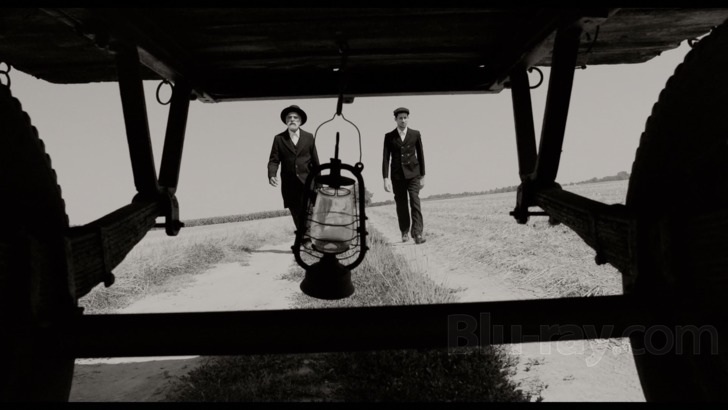
Reviewed by Jeffrey Kauffman November 16, 2018Woman in Gold was a fairly high profile film documenting the real life struggle of an elderly Jewish woman attempting to reclaim property that was rightly hers but which had been taken from her family by the Germans during World War II. 1945 doesn’t have the marquee value of a Helen Mirren or a Ryan Reynolds to effectively promote it, but in some ways it’s an even more devastating indictment of the opportunism of people (in this case, Hungarians) in the face of war, and how that opportunism creates a very real karmic resonance that comes back to haunt them in various ways. The film takes place entirely within the confines of an isolated Hungarian village shortly after hostilities in Europe had ended (but before the actual surrender of Japan, as evidenced by an early radio broadcast utilized in the film). Though there is very little real violence in the film, there is an absolutely unsettling feeling of menace and dread that suffuses the story virtually from the get go when two strangers who happen to be Jewish show up on the daily train with a couple of crates full of what is supposedly perfume and other makeup accessories. It might seem perfectly banal in one way, but in the hands of co-writer and director Ferenc Török, the mere arrival of this laconic duo creates immediate ripples which ultimately threaten to sink an entire village’s way of life. In fact the opening several minutes of 1945 are probably intentionally chaotic, something that adds to the general feeling of unease, as Török intercuts between several unfolding stories involving a number of characters who live in the village. Among these are town clerk István (Péter Rudolf), the "big kahuna" (or perhaps more appropriately given the film's subtextual milieu, the "big makher") of the region who is both a martinet and glad hander in about equal measure. While István wanders to and fro throughout the village in an "official" capacity, he's actually more concerned with the impending nuptials of his son Árpád (Bence Tasnádi), scheduled for later that day.
1945's screenplay is a model of elision and compact exposition, and even in just a few seconds of introductory material, a number of things become evident. Anna (Eszter Nagy-Kálózy), István's wife and Árpád's mother, is a drug addicted woman struggling to maintain emotional equilibrium under the domineering hand of her husband. She's also none too happy about Árpád's marriage, in a throwaway comment mentioning how Árpád's fiancée Rózsi (Dóra Sztarenki) was recently engaged to another village man. Rózsi is in fact soon seen in the amorous embrace of that other man, a glowering guy named Jancsi (Tamás Szabó Kimmel) who is otherwise inviting the umbrage of villagers due to his palling around with Russians. There is a veritable slew of subtext going on in this film which includes Hungary’s fractious political climate in the wake of World War II, though the political angle is played here mostly as a sidebar. What informs the story more consistently is the seemingly strange panic that the arrival of the two Jews almost instantly engenders in everyone in the town, even as wedding festivities are getting underway.
It soon becomes apparent that this is a town full of secrets, and that a conspiracy of silence has ensued after the “removal” of the village’s Jews during the war. Unsurprisingly, Jewish property was simply transferred to the (non Jewish) Hungarians, though István is in possession of certain paperwork that supposedly makes it all “legal”. But a number of intervening vignettes start to detail the rather fast unraveling of the town’s “best laid plans”, with a number of supporting characters starting to feel the heat in various ways, since they all become convinced, in a kind of psychological St. Vitus’ Dance, that the two Jews arriving in town are simply the “forward scouting party” for a number of other Jews with ties to the community who (the townspeople fear) will be coming back to claim what is theirs.
The two Jews slowly make their way through town with their cargo, creating just slightly masked havoc as they pass, with Török repeatedly framing shots through interstitial items like curtains or fenceposts, as if to suggest everyone in this place is spying on everyone else (a symptom which is actually overtly depicted a couple of times). A kind of collective conscience starts to take hold, leading to one devastating development with regard to a hard drinking man who is especially prone to pangs of guilt. But there’s also the emotional disarray of the father-son dynamic between István and Árpád, one that ultimately spills into the planned wedding. In fact the entire film might be seen as an apt cinematic treatment of William Butler Yeats’ famous pronouncement that “the center will not hold”, with events spiraling increasingly out of control.
The real emotional content, however, is probably most forceful (appropriately so, it must be added) with regard to the mysterious Jewish characters. Are they in fact a “scouting party”, or are they simply merchants starting to bring their wares into this region? The answer is actually considerably more crushing, and in fact points up the sheer inanity of the reactions of the Hungarian townspeople. There’s a quiet dignity to these two Jewish men that completely subverts the village’s paranoia in a rather intriguing way. By the end of the film it’s clear that while lasting lessons may indeed not have been learned, a certain “woke” quality has begun to seep into the village’s collective consciousness, perhaps despite the unwillingness of the townspeople to want to wake up.
1945 Blu-ray Movie, Video Quality
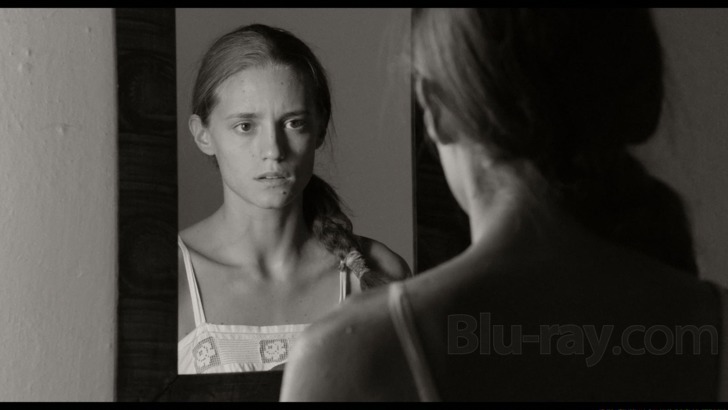
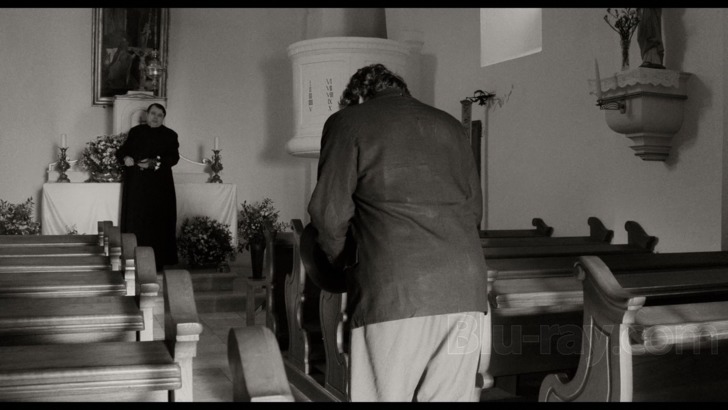
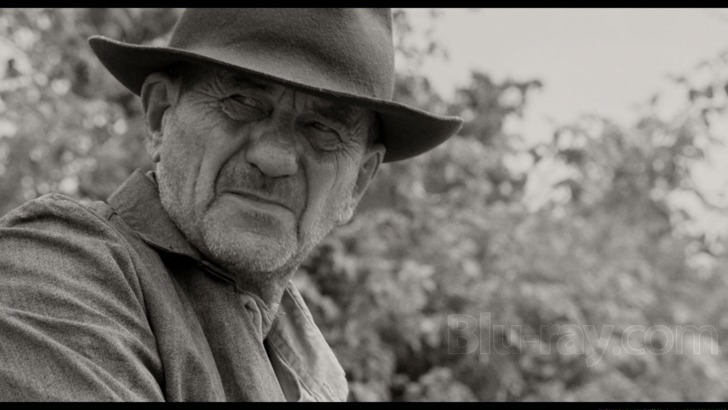
1945 is presented on Blu-ray courtesy of Menemsha Films with an AVC encoded 1080p transfer in 1.85:1. This film offers some really lustrous black and white cinematography courtesy of Elemér Ragályi. Detail levels are routinely excellent throughout this presentation, offering precise looks at the crags in several elders' faces or some of the stunning vistas that almost look like 19th century paintings at times. Ragályi does opt for some "arty" framings at times, as can perhaps be gleaned by parsing the screenshots accompanying this review, and there is a penchant for shooting "through" masking devices like curtains (as mentioned above in the main body of the review), an approach which understandably dampens detail levels. Contrast and black levels are both superb. There are a couple of very minor instances of image instability during lateral pans, but otherwise this is a fantastic looking presentation.
1945 Blu-ray Movie, Audio Quality
Unfortunately the audio presentation here is only a lossy Dolby Digital 2.0 track. It's especially unfortunate since 1945's sound design is so remarkable — so remarkable in fact that I could see some people not really liking it. The track is filled with weird, often near hallucinatory, effects like constant birdsong or what sounds like crystal singing bowls, with good separation. While the Jewish characters hardly utter a word, a lot of the rest of the film is filled with little dialogue skirmishes between various characters, and those are always presented with decent clarity. What's here doesn't offer any real problems, but I'm sure a lot of fans would have been more pleased with some kind of lossless audio on this release.
1945 Blu-ray Movie, Special Features and Extras
- Interview Q & A with Director Ferenc Török (1080p; 19:05) is moderated by Michael Berenbaum, Director of the Sigi Ziering Institute at American Jewish University and stems from late 2017. Torok gives some insight into the project, in fairly heavily accented English which subtitles might have helped to clarify.
- Trailers includes 1945 (1080p; 2:10) along with trailers for several other Menemsha Films releases.
1945 Blu-ray Movie, Overall Score and Recommendation
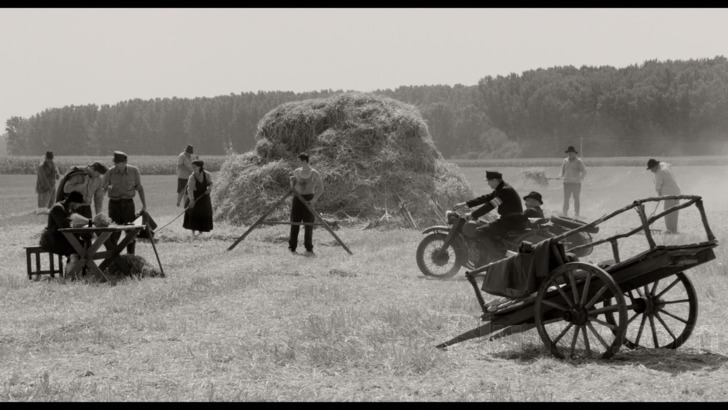
There are a few dangling plot threads (tzitzit?) in this story which I wish would have been developed just a bit more. The Russian soldiers just kind of waft in and out without much rhyme or reason, and what exactly are they doing with/to Rózsi toward the end of the film? Why is Anna so upset at the sight of a sewing machine and seamstress during wedding preparations? Who is the girl seen with Jancsi, one who seems to be a "replacement" for Rózsi? What exactly set the Pollak family (Jews from the village who are alluded to frequently) apart from the rest of the Jewish population? And if the Hermans (the mysterious Jews in the piece) aren't from the village, how do they have a village-specific "mission" to accomplish there? All of that said, this film gets so much information about so many characters delivered so effortlessly that these and a few other niggling qualms fall by the wayside. The film is also filled with memorable imagery (I was especially struck by the almost lunatic shots of the stationmaster madly bicycling through the countryside like a male Edna Gulch). Menemsha has stated this film is inspired by "alternative westerns" like High Noon and Bad Day at Black Rock, and it's certainly possible to see parallels with 1945 offering two "strangers in town" who in this case are the good guys. But the film is really a surprisingly wide ranging look at collective guilt, small town subterfuges, unhappy marriages, parent child relationships and, just in case that isn't enough, the Holocaust. This strikingly photographed feature receives a nice looking high definition presentation here, but Menemsha would serve fans better by including lossless audio on their releases. Recommended.
Similar titles
Similar titles you might also like
(Still not reliable for this title)

The Marriage of Maria Braun
Die Ehe der Maria Braun
1978

Coming Home
归来 / Gui Lai
2014

Never Look Away
Werk ohne Autor
2018

Omar
2013

Maborosi
幻の光 / Maboroshi no hikari
1995

Phoenix
2014

The Rocket
2013

La Pointe Courte
1955

Sarah's Key
Elle s'appelait Sarah
2010

Apur Sansar 4K
অপুর সংসার / The World of Apu
1959

The Forgiveness of Blood
2011

The Club
El Club
2015

Transit
2018

Tom of Finland
2017

The Conformist
Il Conformista | 4K Restoration
1970

The Daughter
2015

The Last of the Unjust
Le dernier des injustes
2013

Salon Kitty
Uncensored Director's Cut | Madam Kitty
1976

The Cranes Are Flying
Летят журавли / Letyat zhuravli
1957

Man with a Movie Camera
Человек с киноаппаратом / Chelovek s kino-apparatom
1929