11 Samurai Blu-ray Movie
Home11 Samurai Blu-ray Movie 
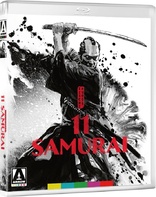
十一人の侍 / Jūichinin no samuraiArrow | 1967 | 101 min | Not rated | No Release Date
Price
Movie rating
6.7 | / 10 |
Blu-ray rating
| Users |  | 0.0 |
| Reviewer |  | 4.0 |
| Overall | | 4.0 |
Overview
11 Samurai (1967)
The final film in the "Samurai Revolution" trilogy tells the tale of 11 samurai who seek to avenge the death of their warlord that was subsequently covered up by the corrupt government. They will go to any lengths to reinstate the clan honor, even if it means killing innocents in their path.
Starring: Kô Nishimura, Isao Natsuyagi, Kôtarô Satomi, Kôji Nanbara, Kei SatôDirector: Eiichi Kudo
| Foreign | Uncertain |
| Adventure | Uncertain |
| Action | Uncertain |
Specifications
Video
Video codec: MPEG-4 AVC
Video resolution: 1080p
Aspect ratio: 2.35:1
Original aspect ratio: 2.35:1
Audio
Japanese: LPCM Mono
Subtitles
English
Discs
Blu-ray Disc
Single disc (1 BD)
Playback
Region A (B, C untested)
Review
Rating summary
| Movie | | 4.0 |
| Video |  | 3.5 |
| Audio | | 3.5 |
| Extras |  | 3.0 |
| Overall | | 4.0 |
11 Samurai Blu-ray Movie Review
Reviewed by Jeffrey Kauffman March 31, 2026 Note: This film is available on Blu-ray as part of Arrow's Eiichi Kudo's Samurai Revolution Trilogy set.
The "evolution" of portrayals of samurai in Japanese cinema is a subject worthy of considerable attention, but for those particularly interested in
so-called zankoku jidaigeki films, home theater aficionados have been getting the chance over the past couple of years to build their
collections, at least if they have
access
to either region free or various region coded players. This new Region A release of Eicchi Kudo's Samurai Revolution Trilogy is also being
offered by Arrow in Region B, adding to
a
growing list of titles in both regions, including Cruel Tale of
Bushido (available in both regions), The Betrayal
(available in both regions) and Revenge (available in Region B
only as of the writing of this review). Kudo's trilogy may nonetheless offer a kind of "one stop shopping" opportunity for those intrigued in this
subgenre, as the three films, released from 1963 to 1967, offer an often visceral deconstruction of samurai culture, at least insofar as the very term
samurai may suggest noble intent and that aforementioned term bushido supposedly indicating a code of honor and a secure
moral compass. While the Takashi Miike remake of 13
Assassins
was released on Blu-ray almost 15 years ago (!), these look like the first Region A and Region B releases of the three films in this set.
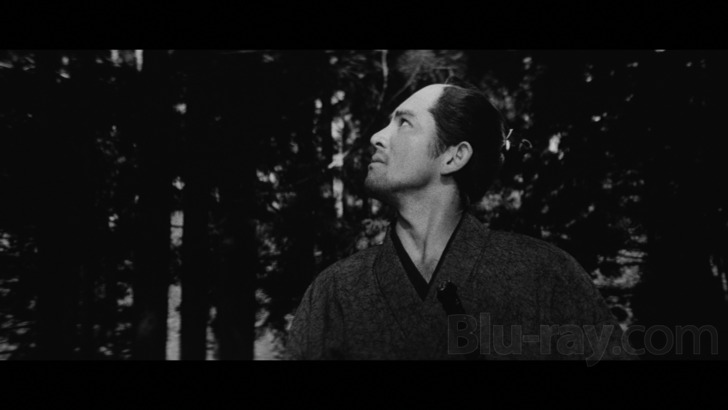
As kind of inherently sad as both 13 Assassins and The Great Killing are, 11 Samurai offers a whole new layer of grief since the corruption of the powers that be so directly affects completely innocent bystanders who have already been victimized. Some contextual background on "how things worked" back during this film's timeframe (roughly five years prior to events in 13 Assassins), but basically an entitled patrician takes out both a deer and a human on land officially not belonging to him. Instead of a normal course of justice occurring, it's the clan of the (human) victim who ends up suffering even more.
There's an almost 1984-adjacent rewriting of history to suit those in power which then leads to the central conflict of the film, as the followers of the victim band together on what, much like the formulation in the previous films, is probably a suicide mission. Kind of interestingly, then, despite the inarguably nihilistic tone running through this film, there may be slightly less of a fatalistic feeling here, though any survivors of the battle are obviously seriously scarred by the entire experience.
11 Samurai Blu-ray Movie, Video Quality
11 Samurai is presented on Blu-ray courtesy of Arrow Video with an AVC encoded 1080p transfer in 2.35:1. Arrow's insert booklet lumps fairly minimal information about the transfers of all three films in this set together on one page:
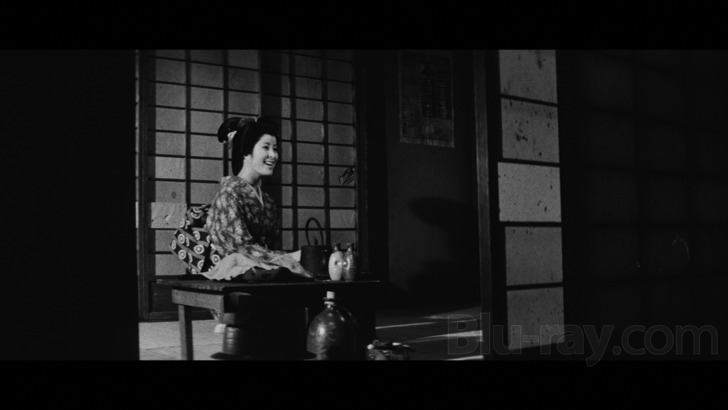
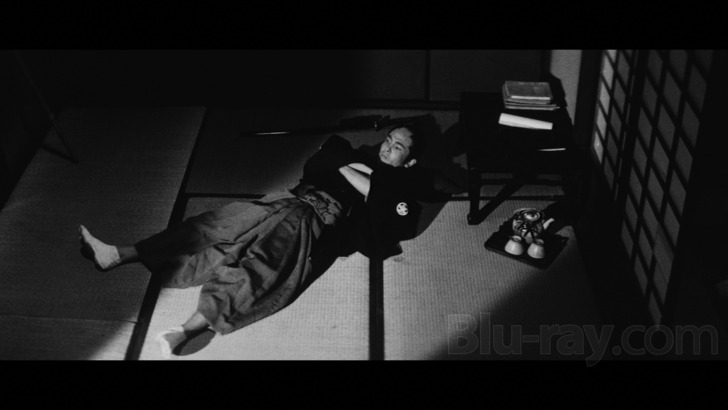
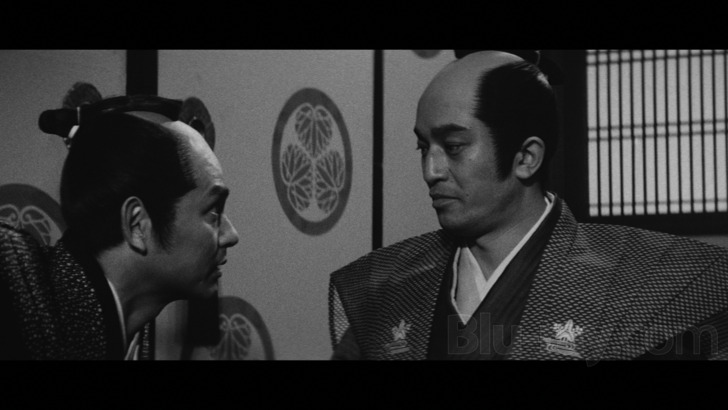
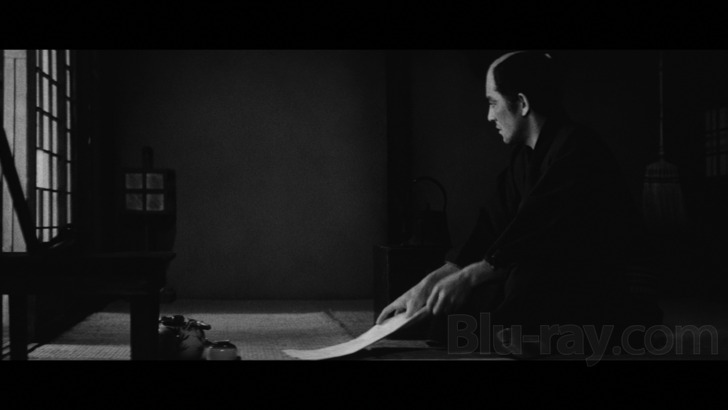
13 Assassins / Jusannin no shikaku, The Great Killing / Dai satsujin and 11 Samurai / Juinichin no samurai are presented in their original 2.35:1 aspect ratio with mono Japanese audio.Perhaps surprisingly, at least given the fact that this is the "newest" of the three films in this set, I'd rate the video quality here as the least pleasing overall. While detailing can still be impressive, especially in close-ups, this entire transfer struck me as too dark quite a bit of the time, though what's really noticeable is the recurrent variability of overall brightness, which ends up giving a quasi-flicker look throughout. The darkness can contribute to crush at times (look at the right side of the frame in screenshot 5 for one example). The same chiaroscuro sensibility that pervades the other two films in this set is still very much in play here, and despite some of the above observances there are nonetheless some really expressive looking moments here, where even with some impending shadows, detail levels still are commendable (look at the textures on the tatami in screenshot 3). too dark quasi-flicker
Additional picture restoration work was completed by Arrow Films at R3Store Studios, London.
11 Samurai Blu-ray Movie, Audio Quality
11 Samurai features an LPCM Mono track in the original Japanese. Once again a really arresting score captures immediate attention with weird swooping vocals, koto and percussion. There's arguably a bit more of a thin quality in the midrange and high end on this track, something that can be most noticeable during scoring moments or sequences with a lot of sound effects, as well as occasionally in dialogue with regard to exaggerated sibilance, but it's really probably a relatively minor difference. As with the two other films in this set, background hiss can be heard, along with occasional pops and cracks. Dialogue is rendered cleanly and clearly throughout. Optional English subtitles.
11 Samurai Blu-ray Movie, Special Features and Extras
- Commentary by David West
- Fighting the Poison (HD; 20:17) is a video essay by Jonathan Clements that offers a great overview of the entire trilogy, including some valuable historical context.
- Samurai Guerrilla Part 3 (HD; 26:59) completes the conversation begun on 13 Assassins and continued on The Great Killing between Eiichi Kudo's assistant director Misao Arai and Dirty Kudo (Kudo fils) about Eiichi Kudo's contributions to Japanese cinema in the 1960s. Subtitled in English, though this was evidently originally a French production, so the English subtitles are in a blurred section of the frame that I'm assuming originally had French subtitles.
- Eiichi Kudo: The Art of Realism (HD; 14:03) is an interview with Fabrice Arduini. Subtitled in English (without the blurring since I'm assuming this was a French production for actual French audiences).
11 Samurai Blu-ray Movie, Overall Score and Recommendation
Eiichi Kudo's trilogy ends on arguably the saddest, almost overwhelmingly nihilistic, ambience of the entire set (which is really saying something), though there may be the slightest glint of (seriously wounded) hope as well. This has the least pleasing video and audio of the set, but the supplements are great, and overall 11 Samurai comes Recommended.