The Pusher Blu-ray Movie
HomeThe Pusher Blu-ray Movie 
Metro-Goldwyn-Mayer | 1960 | 82 min | Not rated | Jun 10, 2025

Movie rating
7.1 | / 10 |
Blu-ray rating
| Users |  | 0.0 |
| Reviewer |  | 3.5 |
| Overall | | 3.5 |
Overview
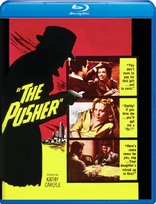
The Pusher (1960)
A detective investigating the murder of a heroin addict discovers that there is a connection between the junkie and his fiancee, who is his boss' daughter.
Starring: Kathy Carlyle, Robert Lansing (I), Felice Orlandi, Douglas Rodgers, Sloan SimpsonDirector: Gene Milford
| Crime | Uncertain |
| Drama | Uncertain |
Specifications
Video
Video codec: MPEG-4 AVC
Video resolution: 1080p
Aspect ratio: 1.33:1
Original aspect ratio: 1.37:1
Audio
English: DTS-HD Master Audio 2.0 Mono (48kHz, 24-bit)
Subtitles
English SDH
Discs
Blu-ray Disc
Single disc (1 BD)
Playback
Region A (B, C untested)
Review
Rating summary
| Movie | | 3.5 |
| Video | | 3.5 |
| Audio | | 3.5 |
| Extras | | 0.0 |
| Overall | | 3.5 |
The Pusher Blu-ray Movie Review
Reviewed by Justin Dekker August 6, 2025Based on the novel of the same name written by Ed McBain, 1960's 'The Pusher' arrives on Blu-ray disc courtesy of MGM. After discovering the
body of a young overdose victim, an investigation into the death seeks to find the pusher before other lives are compromised. The film stars Kathy
Carlyle as Laurie Byrnes in one of her few film roles, television mainstay Robert Lansing as her fiancé and police officer, Steve, Douglas Rodgers as
Laura's father, Lt. Byrnes, and Beatrice Pons as Maria, Laurie's friend and the victim's sister. 'The Pusher' features a jazzy score and numerous location
shots
around late 1950s New York City. The release is not accompanied by any on-disc supplemental material, nor is a slipcover or a Digital Code included.
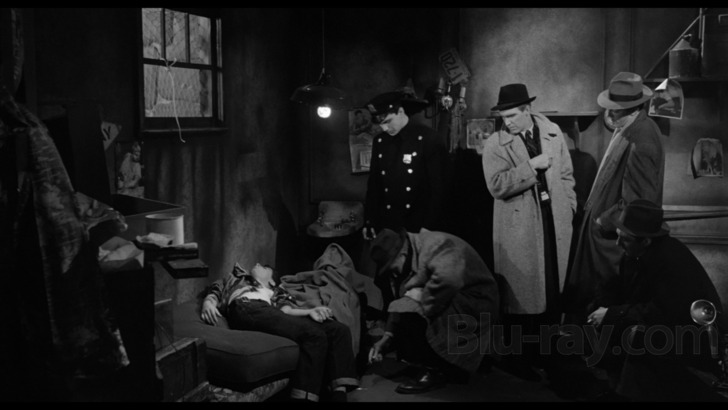
When a beat cop finds the body of Anibal Hernandez, what first appears to be a simple heroin overdose is soon discovered to be murder. Laurie
(Kathy Carlyle), who is a good friend of the victim's sister, Maria (Beatrice Pons), learns of the death from her father, a police lieutenant at the
local precinct. Unbeknownst to her family, Laurie is also hooked on the drug, something that her police detective fiancé, Steve (Robert Lansing), learns
before an encounter with her pusher, Gonzo (Felice Orlandi). Now, Lt. Byrnes will need to help his daughter kick the habit as he works to apprehend
the pusher.
At the time that The Pusher arrived in theaters, films pertaining to drug addiction weren't exactly common, nor were they as gritty and realistic as this film tried to be (despite the melodrama). The most famous early film pertaining to drug addiction that springs to mind is 1936's Reefer Madness, a film which attempted to educate the public at large to the dangers of marijuana. Shockingly, it depicted those under the sweet leaf's thrall as addicts, prone to all sorts of unsavory behaviors. In the film, those who indulged in marijuana engaged in hit and runs, manslaughter, and attempted rape, before succumbing to hallucinations and, inevitably, insanity. Viewed through today's lens, where the drug has seen a complete about-face as states move to legalize it, dispensaries are propagating, and THC gummies and beverages are seemingly everywhere, the film seems like a harmless bit of hokum. No doubt terrifying to some subset of parents, religious and community leaders at the time, today, while some deleterious health impacts are being researched and documented relative to marijuana's frequent usage, none of the consequences laid out in Reefer Madness are among them. 1955 would see Frank Sinatra star in the Oscar-nominated " The Man With the Golden Arm", which focuses on his Frankie, a man recently released from prison, who was struggling to stay clean and avoid falling back into a heroin habit, which caused his incarceration. Directed by Otto Preminger and also starring Kim Novak, it's easy to see why the film attracted the attention and publicity it did at the time. It almost goes without saying that this film was much more gritty and realistic than the modern cult hit from the 1930s, and The Pusher borrows some of this realism mixed with a healthy dose of pulpy noir to work its magic.
While the pusher Gonzo oversimplifies things a bit when he remarks that it's easy to hook young girls on heroin because they're always nervous and getting headaches, Felice Orlandi does inject him with a delicious amount of menace. While he can be quite suave and charming, aided, no doubt, by his dapper attire and gentlemanly presence, he can become dangerous in an instant. As a way in which to develop his character, he's shown as being concerned for his customers' welfare - well, the attractive female ones, at least. He offers soothing words when Laurie shows up out of cash and needing a fix. He intones that there's no need to worry about money, not when there are other ways that she can pay. He's quite clearly deadly as well, and he uses a gun, knife, and other methods of murder with equal ease. Further establishing his intelligence and therefore his threat level is the process he's devised to move his heroin. While other films over the intervening years and more modern television offerings such as Weeds (2005-2012) and Breaking Bad (2008-2013) have documented methods of dealing that prevented one from holding both the drugs and the money, at the time, Gonzo's system must have seen ingenious. As he berates an underperforming dealer late in the film, it further establishes he has a mind for the business and a ruthless focus on the bottom line.
Other elements are, perhaps, not treated with as much realism. Take, for instance, The Green Dragons, the street gang to which the ill-fated Anibal Hernandez belongs. While there are quite a few of them, it's not clear exactly what they do other than wear matching satin jackets and hang out in a scruffy basement-level "clubhouse" where a cheesecake calendar serves as the only real decoration. When they meet with the police regarding Anibal's death, they appear relatively clean-cut and mostly well-mannered despite a few of their number falling prey to addiction. Later, when Laurie's father finally realizes she's a heroin addict, something, he says, he's suspected for some time, rather than seek out professional help for his daughter and deal with any related repercussions, he strangely and somewhat comically takes matters into his own hands. Based on Lt. Byrnes' actions The Pusher would have the viewer believe that helping someone kick heroin is as simple as boarding up the windows and handcuffing them to the bed. After a pipe or two (of tobacco, naturally) and a chat with the wife, the problem is solved. But this last sin is easier to forgive. Addiction wasn't as well understood all those decades ago as it is today, and modern methods and resources just weren't available at the time. Even more to the point, dealing with the lengthy process of getting Laurie clean and sober does little to help The Pusher expeditiously advance the primary plot of having Lt. Byrnes bring Gonzo to justice. It's simply a matter of economy in storytelling.
More seriously, when looking at the film through a modern lens, immigration also comes into focus. When Mrs. Hernandez, her husband, and her two children, Maria and Anibal, came to the US from Puerto Rico, she explains how hard the family worked to fit in and make a positive impact. She tells the police she made sure they spoke perfect English, went to church, and were respectful. But in her eyes, it wasn't enough. It didn't matter to the "native" New Yorkers. With a considerable amount of anguish, she cries, "We are new. We are strange. Is always so with the new people, is that. It doesn't matter that they are good. They are bad because they are new." As many around the world continue to flee from poverty, war, and famine in search of a better life, her words still ring true.
While Ed McBain wrote a considerable number of 87th Precinct novels, 1956's "The Pusher" was the first to be adapted as a film. Despite some narrative shortcuts, the film works well. Laurie and Maria are quickly established as sympathetic victims of the pusher, the villainous Gonzo. The film does what it can to effectively paint a dirty and dangerous world that is home to alluring clubs, drug dens, and beautiful dancers, where pushers, dealers, prostitutes, and murderers lurk just a step into the shadows. The film's laser-focus and brisk pace eliminates any unneeded scene or scrap of dialogue, crafting a taut and suspenseful tale with plenty of vintage New York locations on tap for audiences to enjoy. Also eagle-eyed viewers should keep an eye out for the big screen debut of John Astin (The Addams Family), who plays a small role as a detective in one of the film's early scenes.
The Pusher Blu-ray Movie, Video Quality
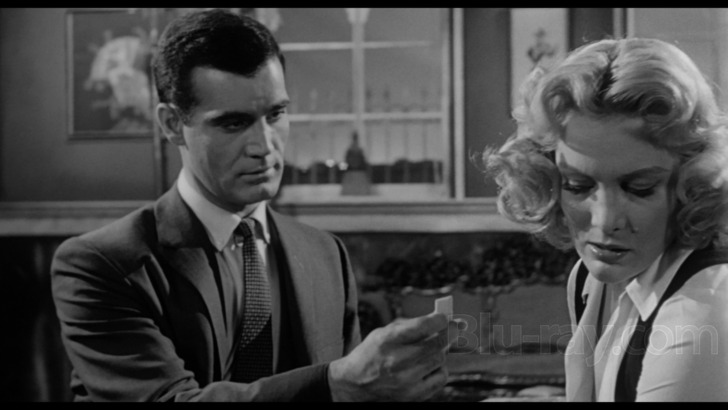
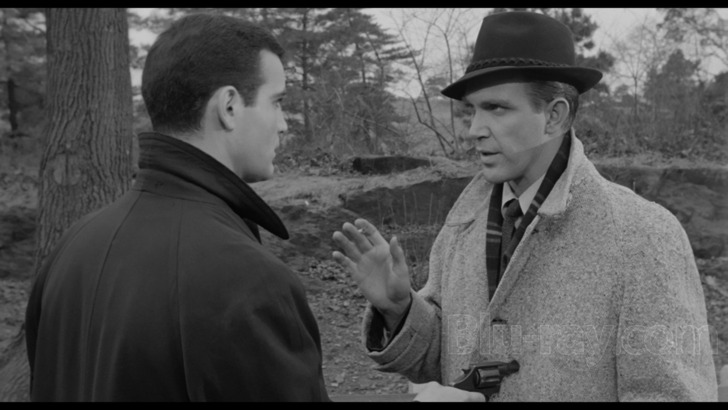
Regarding the film's 1080p transfer, the source is in good condition, and there doesn't appear to be any real significant damage on display or restoration work done for that matter, either. Exterior location shots at the film's start exhibit a softness and crush that is problematic, but isn't a frequent or substantial issue. It does recur, though, from time to time, with other outdoor shots exhibiting similar softness and crush. Occasional white specks and vertical lines are visible from time to time, with the former being more commonplace than the latter. Set-bound shots are typically much sharper and offer a more pleasing level of detail. Only Gonzo's lavishly furnished apartment offers viewers much of a chance to delve into interesting bits of set dressing. Even so, the camera doesn't linger on such details as the dragon statue or the feathery plumes sprouting from vases for very long, instead zooming in on Gonzo and Laurie's faces. Facial and hairstyle particulars offer acceptable levels of detail. The omnipresent herringbone tweed coats present with pleasing tactile realism in midrange shots, but especially in close-ups. It's a solid transfer.
The Pusher Blu-ray Movie, Audio Quality
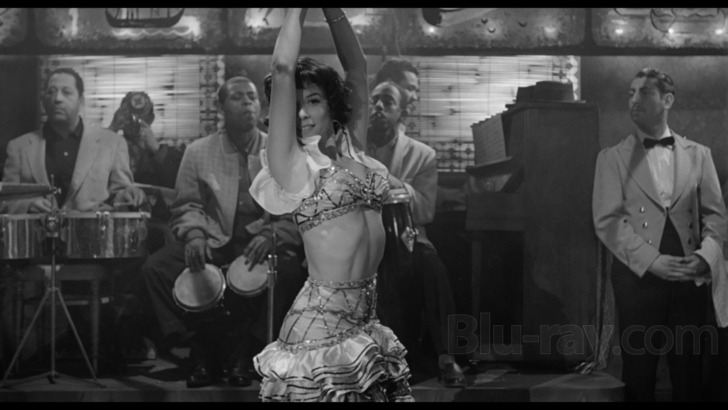
The Pusher's DTS-HD Master 2.0 track offers viewers a reasonable and competent companion to the film. Dialogue is clean and precise. It's devoid of defect or distortion, and sibilance issues are rare and minor. Environmental sounds of horns, traffic, chatter at the Baby Doll, and other places enhance the realism of the scenes but never overwhelm what the characters are saying. Vintage sound effects such as punches, kicks, hammering, and gunshots are appropriate for their era if a bit thin. From an audio perspective, the most impressive moments are musical, with the atmospheric jazz soundtrack being well-rendered. When allowed to rise to the forefront, the horns, keys, and percussion are even more enjoyable, displaying a surprising crispness and precision. There are some quirks in the subtitles, though. For example, when we meet Mrs. Hernandez, who is from Puerto Rico, for the first time, before she switches to English, the SDH subtitles for her words read "[speaking italian](sic)" though she is obviously speaking Spanish. Laurie and the lieutenant's surname is alternately displayed as "Burns" and "Byrnes" though the latter is correct.
The Pusher Blu-ray Movie, Special Features and Extras
The Pusher does not include any on-disc supplemental material.
The Pusher Blu-ray Movie, Overall Score and Recommendation
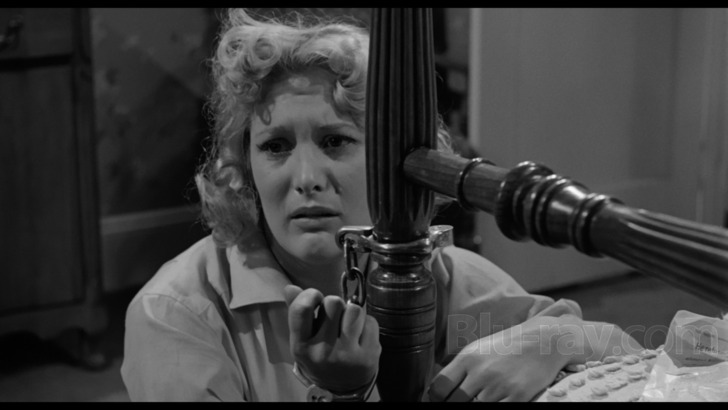
Beatrice Pons' Maria and Robert Lansing's Steve are two of the more engaging and interesting characters in The Pusher and the film could have benefited from giving them more screen time. Ultimately, though, their fates fall victim to the needs of the plot and Laurie's story, and the actions of she and her father do, in fact, drive much of the action. Luckily, Felice Orlandi has screen presence to spare and easily serves not only as the film's connective tissue, but also as the focal point of every scene he's in. His is a smooth and seductive evil that leaves the viewer rooting for him a little more than they should. Not as grim and gritty as similar films from the modern era, but considering its vintage, it does depict some pretty seedy locations and actions. Some manner of supplemental material would have been appreciated, but most importantly, it's a taut crime thriller that provides numerous looks at New York City from days gone by. For fans of the genre, The Pusher is solidly recommended.