Nymphomaniac: Volumes I and II Blu-ray Movie
HomeNymphomaniac: Volumes I and II Blu-ray Movie 
Magnolia Pictures | 2013 | 2 Movies | 241 min | Not rated | Jul 08, 2014


Movie rating
Movie has not been rated yetBlu-ray rating
| Users |  | 5.0 |
| Reviewer |  | 3.0 |
| Overall |  | 3.6 |
Overview
Nymphomaniac: Volumes I and II (2013)
A self-diagnosed nymphomaniac recounts her erotic experiences to the man who saved her after a beating.
| Drama | 100% |
| Erotic | 44% |
Specifications
Video
Video codec: MPEG-4 AVC
Video resolution: 1080p
Aspect ratio: 2.35:1
Original aspect ratio: 2.39:1
Audio
See individual releases
Subtitles
English SDH
Discs
50GB Blu-ray Disc
Two-disc set (2 BDs)
Playback
Region A (locked)
Review
Rating summary
| Movie |  | 2.5 |
| Video |  | 4.5 |
| Audio |  | 4.0 |
| Extras |  | 2.0 |
| Overall | | 3.0 |
Nymphomaniac: Volumes I and II Blu-ray Movie Review
I Am Curious (Lars)
Reviewed by Michael Reuben July 7, 2014The most important fact for prospective purchasers to know about Magnolia Home Entertainment's two-disc edition of Danish writer/director Lars von Trier's Nymphomaniac is that it isn't the last word on the subject. At just over four hours total running time, this so-called "international cut" of von Trier's latest work is the only version so far seen in its entirety, but von Trier's preferred cut runs 90 minutes longer. Magnolia has committed to releasing that version after the premiere of Volume II at the 2014 Toronto International Film Festival. So know at the outset that you may be buying this again. This assumes, of course, that you're interested in acquiring still more of Nymphomaniac. Despite the provocative title and explicit subject matter, Nymphomaniac is an alienating film. It uses the enticement of explicit sex between legitimate actors (achieved through digital trickery) as a Trojan horse to introduce an array of themes about cruelty, power, emotional manipulation and depression, all perennial von Trier obsessions and all of them presented with a dreary monotony that is only fitfully enlivened by some of the film's performances. The title character's sexual exploits certainly don't energize the film. Better quality porn has been available since VHS players first appeared in the home. And by Volume II, sex has become secondary to a kind of chastisement, almost a revenge for the physical pleasure experienced in Volume I. Exactly how and why these things go together is open to interpretation, but the real question is whether there's anything here worth interpreting. Artists who are driven by their obsessions are often at risk of self-parody, and von Trier is particularly so. For every Dogville, there is a Manderlay. For every The Kingdom (the Danish original, not the Stephen King remake), there is The Idiots. For every Breaking the Waves, there is a Dancer in the Dark. And now, for Melancholia, which flirted with laughable excess, we have Nymphomaniac, which replaces the former's hypnotically mysterious visuals with droning voiceover, as Charlotte Gainsbourg's Joe reflects on her life and Stellan Skarsgård's Seligman tries to participate with erudite digressions. Prodigious learning and cinematic technique are displayed in the process, but to what end?

See individual volumes for additional screenshots.
For further discussion of Volume I, please see the Nymphomaniac: Volume I Blu-ray review. For further discussion of Volume II, please see the Nymphomaniac: Volume II Blu-ray review.
Nymphomaniac: Volumes I and II Blu-ray Movie, Video Quality
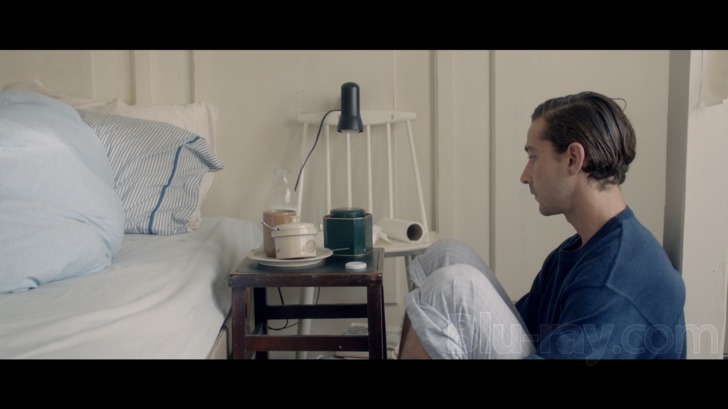
For additional screenshots from Volume I, please go here. For additional screenshots from Volume II, please go here. Chilean cinematographer Manuel Alberto Claro, who shot Melancholia for von Trier, returned for Nymphomaniac, which was photographed digitally, primarily on the Arri Alexa Plus, with some inserts shot on a Canon EOS 5D Mark II. Post-production was completed on a digital intermediate, and Magnolia Home Entertainment's 1080p, AVC-encoded Blu-ray was presumably sourced from digital files. However, at least for Nymphomaniac: Volume I, the master is not identical to that used by Artificial Eye for the Region B-locked edition released earlier this year. A tell-tale sign is that Chapter 3, "Mrs. H", is not framed at 1.85:1, as it was on the Artificial Eye Blu-ray (and, as far as I know, on the European theatrical release; I did not see the U.S. theatrical version). Except for a few brief shots, the chapter is framed, like the rest of the film, at 2.35:1. In general, however, the color grading is precisely detailed to establish a particular style for different portions of Joe's life. The examples can be obvious, such as the black-and-white Chapter 4 in Volume I, or much subtler, as in the changes in texture in Volume II between Joe's conversations with Seligman in the present and her account of her work with Willem Dafoe's L, where the latter has been given a slightly grainy texture almost like 16mm film. Magnolia Home Entertainment's two 1080p, AVC-encoded Blu-rays deliver a fine rendition of Nymphomaniac, which is only to be expected in a project that has been digitally acquired and processed at every stage, with no analog conversion. The image is sharp, detailed and, except for deliberate texturing, free of noise or interference. The blacks are solid, and the colors range from the drab interiors of Seligman's abode to the clear but sterile blues and whites of the home that Joe shares with Jerôme to the occasional eruptions of bright red, often associated with pain or pleasure (or both). Magnolia has followed its usual practice of delivering a high average bitrate at 34.93 for Volume I and 34.98 Mbps for Volume II, ensuring a superior image without artifacts.
Nymphomaniac: Volumes I and II Blu-ray Movie, Audio Quality

The sound design of Nymphomaniac, presented on both discs in lossless DTS-HD MA 5.1. is precise but straightforward. Joe's narration in the present, sometimes interrupted by one of Seligman's questions, comments or, as Joe calls them, digressions, weaves in and around the dialogue and basic sounds of the scenes she is describing. Dialogue sometimes abruptly contrasts with sounds of sexual activity (or, in Volume II, sounds of physical abuse), but interruption by silence can be equally effective. The film has no original score, but von Trier prefers a mix of portentous classical music (e.g., an excerpt from Palestrina's "Mass Hodie Christus Natus Est" or Mozart's "Requiem") and portentous contemporary rock (e.g., Rammstein's "Führe mich", which is also used in the trailer, and an arrangement of "Hey Joe" sung by Charlotte Gainsbourg over the closing titles). Even that standard played by every piano student, Beethoven's "Für Elise", is given a sinister arrangement and context.
Nymphomaniac: Volumes I and II Blu-ray Movie, Special Features and Extras
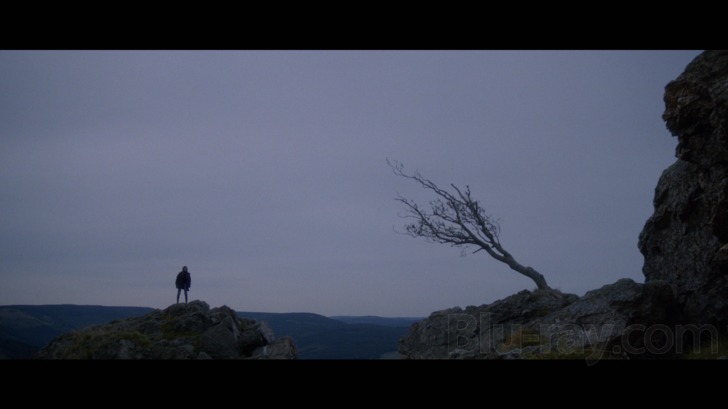
Please see the reviews of Volume I and Volume II for a listing of the extras on each disc.
Nymphomaniac: Volumes I and II Blu-ray Movie, Overall Score and Recommendation
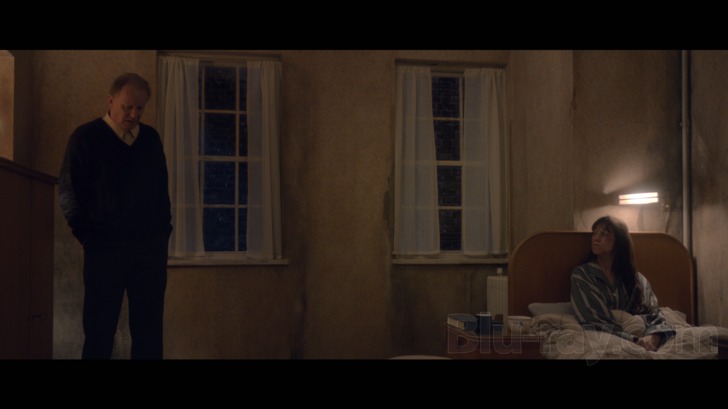
In one of the interviews included in the extras, Stellan Skarsgård recalls seeing von Trier's film, The Element of Crime, and thinking, "I'd like to work with this director when he gets interested in people." Both as a subject of cinema and as aesthetic objects, people often seem both to fascinate and repel von Trier, himself included. One often gets the sense that, if he had the choice, he would exist as pure spirit, as impervious to physical sensation as the frozen trunks of dead trees that Joe's father finds so compelling. Unfortunately for this fastidious depressive, humans exist as flesh, subject to needs, desires and the "thousands natural shocks" of which Hamlet complained. Nymphomaniac is about many things, but one of them is the curse of living a fleshly existence. Von Trier grudgingly accepts being a spirit encased in flesh, but that doesn't stop him from kicking up a fuss about it—and misery loves company. When von Trier was making The Idiots, he famously stripped on set to encourage his reluctant cast to do nude scenes; the finished film contains a few stray shots where the disrobed director can be seen in the background. Sixteen years later, it's tempting to say that the auteur still has no clothes, and I don't think von Trier would argue. Everything he has done, from the quickly abandoned Dogma "vow of chastity", to the eruptions of religious faith in The Kingdom and Breaking the Waves, to the provocation of titling a film Nymphomaniac that is about so many other things, has been marked by a showman's determination to stand out from the crowd. Sometimes the effect is brilliant, like having the doors of perception opened so that, for a moment, you really do see things differently. At other times, though, von Trier creates the maddening sensation that you've been cornered by a lunatic who demands that you join him in his insanity. I put Nymphomaniac in the latter category, but judge for yourself.