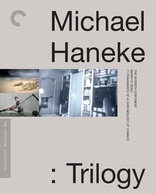
Michael Haneke: Trilogy Blu-ray Movie
HomeMichael Haneke: Trilogy Blu-ray Movie 
The Seventh Continent / Benny's Video / 71 Fragments of a Chronology of ChanceCriterion | 1989-1994 | 3 Movies | 317 min | Not rated | Dec 06, 2022


Movie rating
Movie has not been rated yetBlu-ray rating
| Users |  | 5.0 |
| Reviewer |  | 3.5 |
| Overall | | 3.5 |
Overview
Michael Haneke: Trilogy (1989-1994)
See individual titles for their synopses.
| Foreign | 100% |
| Drama | 81% |
| Crime | 1% |
Specifications
Video
Video codec: MPEG-4 AVC
Video resolution: 1080p
Aspect ratio: 1.66:1
Original aspect ratio: 1.66:1
Audio
German: LPCM Mono (48kHz, 24-bit)
Subtitles
English
Discs
Blu-ray Disc
Three-disc set (3 BDs)
Playback
Region A (locked)
Review
Rating summary
| Movie | | 3.5 |
| Video |  | 4.0 |
| Audio | | 4.0 |
| Extras | | 4.0 |
| Overall | | 3.5 |
Michael Haneke: Trilogy Blu-ray Movie Review
Don't cry because it happened, smile because it's over.
Reviewed by Randy Miller III July 10, 2023Austrian filmmaker Michael Haneke is perhaps best known on this side of the pond as the possibly imbalanced writer and director of Funny Games (the 1997 German original as well as a 2007 American remake), both of which introduced viewers to a deeply disturbing pair of antagonists who brutally torture a family on vacation. It turns out the director has always had it in for the white-bread upper middle class in Michael Haneke: Trilogy, a new collection from Criterion that presents his first three feature films -- 1989's The Seventh Continent, 1992's Benny's Video, and 1994's 71 Fragments of a Chronology of Chance -- in one handy package with a few assorted bonus features. As of this writing they're not available separately but, at its current price point, this is a pretty affordable set for interested parties.
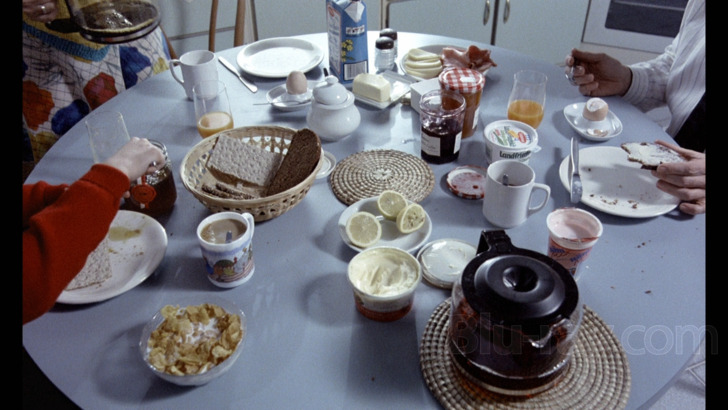
High artistic values intersect with often mind-melting sluggishness during all three films, which cover different subject matter but carry the transitive theme of modern existence -- at least by late 1980s and early 1990s standards -- and how aspects of technology and daily routines cripple our ability to connect with each other. It's an admirable topic for an emerging filmmaker who already established (and would continue) a fruitful career in TV movies, yet each requires a great deal of patience from first-time viewers whether or not they're familiar with Haneke's style of work.
The Seventh Continent is a slow-moving drama divided into three parts ("1987", "1988", and "1989") that follows nuclear family Anna (Birgit Doll), Georg (Dieter Berner), and Eva (Leni Tanzer) during their day-to-day lives at home, in school, and at work; specifically, many of the more uncomfortable parts of each one. The film's coldly detached visual aesthetic favors abstract, unconventional compositions; for example, material goods are often shown instead of faces, and dialogue is rarely spoken on-screen. Its first two parts are almost tonally identical, regurgitating most of the same fragments with subtle changes, such as a new pair of shoes being tied or more responsibility given to the growing Eva. Both "1987" and "1988" are purposefully dull, occasionally comforting, and numbingly similar endeavors -- which, like it or not, eat up a combined 51 minutes of the film's 108-minute runtime -- but they're turned upside down later in the final chapter, a dirge-like and disturbing account of their almost inevitable self-destruction. It all adds up to a mostly engaging and eventually intense experience, but one that feels self-indulgent and padded. Rating: 3.5/5.
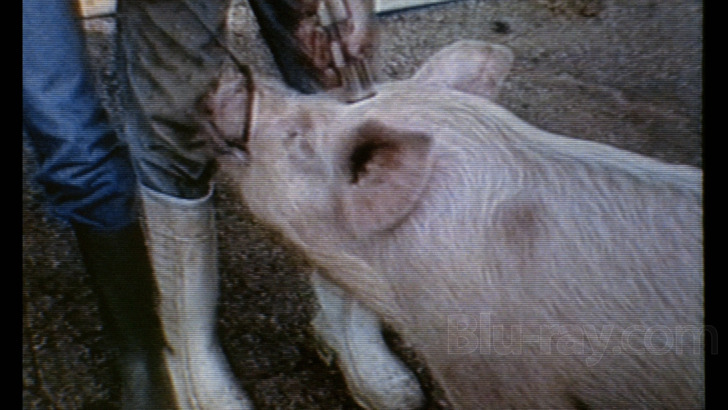
Benny's Video, no less disturbing than The Seventh Continent, makes audiences immediately aware of its intentions by beginning with the filmed death of a pig (below); it's even repeated and slowed down by our main character Benny (Arno Frisch, who would also appear in the original Funny Games five years later), a deeply troubled 14 year-old boy with rich and mostly inattentive parents. Surrounded by media -- most of it violent in nature -- and with a keen interest in filmmaking, Benny soon develops an interest in teenage Mädchen (Ingrid Stassner) and invites her over when mom and dad aren't home. But while Benny is showing off his prized possessions, including the bolt gun used to murder that pig, Mädchen is accidentally (?) killed while his camcorder is running. After Benny gets his head shaved and reluctantly comes clean to his parents, Benny's Video shifts gears into vaguely satirical territory when, rather than involving the authorities, he and his mom take a vacation to Egypt while dad cleans up the apartment. Almost the structural opposite of The Seventh Continent but with a few clear-cut connections, this is a more narratively accessible film that, while it fizzles out in the home stretch, threads its story beats together in a smoother way. Rating: 3.5/5.
71 Fragments of a Chronology of Chance is the black sheep of the bunch, and that's certainly saying something. Routinely listed
near the bottom of critically ranked lists of the director's films, 71 Fragments is just that: a series of seemingly separate but loosely
interconnected scenes that occur in Vienna during a three-month period in late 1993 before a mass killing incident. Perhaps even more challenging
than The Seventh Continent and with obvious visual and structural nods to both that film and Benny's Video, it's the kind of story
you have to pick apart to make any real sense of rather than having most of it relayed to you in a sequential, easy-to-digest manner. I actually
found this film to be a bit more tonally satisfying than The Seventh Continent, which certainly had its moments but is often cited as one of
the most confident and successful movie debuts of its era which I can't fully agree with. In direct contrast, 71 Fragments is even further
from a perfect effort but I appreciated its particular structure and the fragmented scenes, while definitely a bit pretentious at times, are interesting
to piece together despite a much smaller payoff. Rating: 3/5.
Michael Haneke: Trilogy Blu-ray Movie, Video Quality
Criterion's included booklet details the masters used for all three films, indicating their source materials -- a 35mm interpositive for Seventh Continent, and the 35mm original negatives for both Benny's Video and 71 Fragments of a Chronology of Chance -- while also mentioning that they were restored separately at LISTO laboratory in Vienna as well as Hiventy in Boulogna-Billencourt, France with supervision and color grading by Michael Haneke. Nowhere is the age of these digital masters clearly specified, suggesting that they may be the exact same ones used for Kino's 2006 DVDs with additional cleanup and/or processing done... a hunch that I sadly can't confirm or refute, since I don't have access to those DVDs. I can say, however, that they look extremely similar in quality to the supportive clips seen during Yves Montmayeur's 2013 documentary Michael H. – Profession: Director, included as a supplement on disc 3.
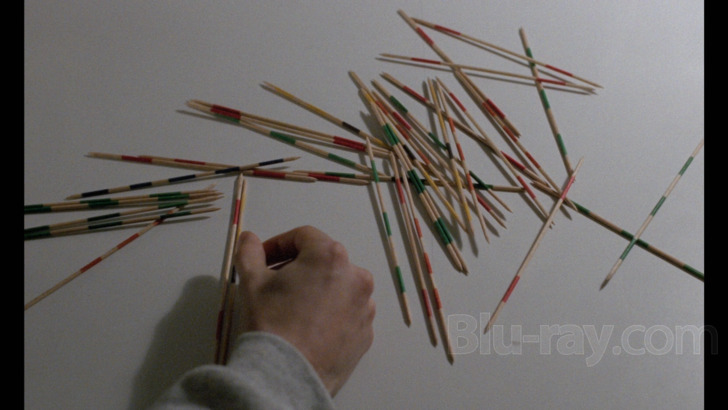
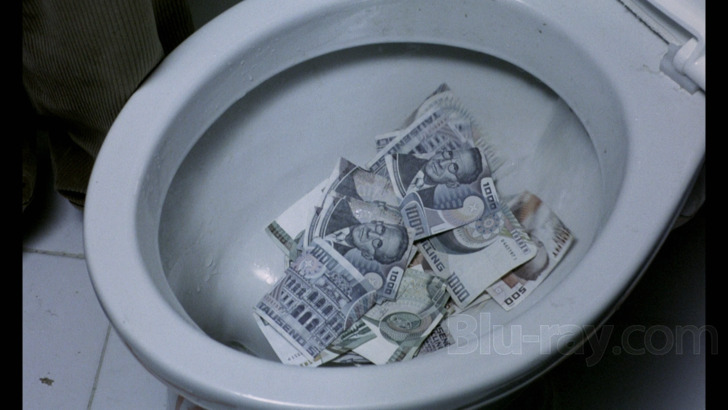
That said, these separate masters are of reasonably good quality, showcasing the chilly and largely understatured color palettes that give each of these films a similar but not necessarily identical appearance. It's not necessary to analyze these subtle differences due to the number of screenshots provided (ten for each film), but it's worth pointing out a few of the highlights and drawbacks present for those who might be interested in that sort of thing. In their favor, all three showcase good to very good amounts of fine detail and texture, with some of the product close-ups and other minutiae uniformly easy to read and scrutinize even without close inspection. Facial details including hair, skin, and make-up are rendered precisely with only occasional dips into softness. Depth and shadow details come and go depending on the subject matter and lighting levels, with some of the deepest blacks varying between "inky" territory and medium-grey with little variance at the darker end. Yet due to their uniform appearance (which may or may not include regrading, as again I have no earlier discs to compare these two), any perceived highlights and shortcomings tend to bleed together into an overall satisfactory presentation, one that snugly fits this trilogy's atmosphere well enough.
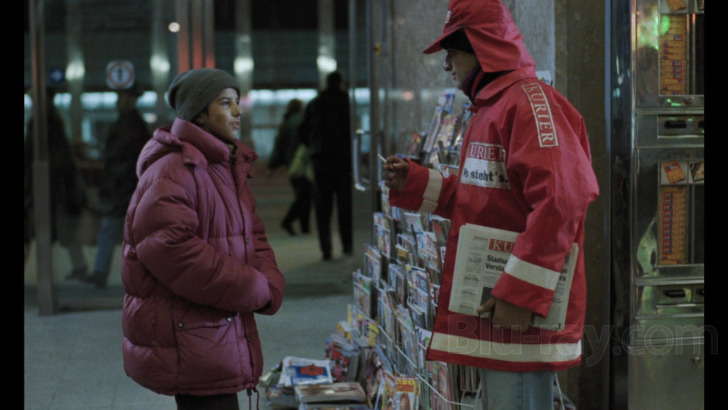
As seen in a few screenshots including the one above, Benny's Video -- and to a greater extent, 71 Fragments -- make use of sporadic lower-resolution video clips; the former is supposed to be Hi8 or a reasonable facsimile, while the latter is a collection of era-specific news broadcast clips intermixed with the standard hi-res film footage. These look as good as their source material will allow with crisp scan lines, unavoidable interlacing issues, and a scuzzy overall appearance that creates a clear visual contrast and makes everything else look that much better in comparison.
On the encoding side of things, there's some obvious macro blocking and crushed blacks here and there, but rarely to any kind of even mildly distracting degree. Overall, this is a fine and reasonably consistent set of presentations that, if I had to rank individually, would represent a slight improvement in their chronological release order.
Michael Haneke: Trilogy Blu-ray Movie, Audio Quality
The audio is uniformly similar on these LPCM 1.0 mixes that preserve the original German language tracks with English subtitles for translation only*. Criterion's booklet doesn't detail the restoration process, only saying that each one was sourced from the original 35mm magnetic tracks with (presumably) some sort of additional cleanup applied. Since the audio does not play as large a role as the visuals, these lossless tracks are up to the modest challenge of fragmented dialogue, stray diegetic music cues, and occasional outbursts that don't suffer from any perceivable thinness at the high end. Overall, a very solid effort that's only "hindered" by limitations of the source material.
* - This means that any English speech, such as dialogue heard in TV clips and songs, is not subtitled. Unfortunately during The Seventh Continent this also applies to German-language TV/radio clips, letters, and the credits (a personal pet peeve), which leaves a few small but possibly substantial context gaps for non-German speakers.
Michael Haneke: Trilogy Blu-ray Movie, Special Features and Extras
This three-disc set ships in a stocky keepcase, with The Seventh Continent in its own hub on the left side and both other films overlapping on the right. Tucked inside is a 24-page booklet with minimal design elements, cast/crew info, an essay by New York Times Magazine contributor John Wray, and information about the 1080p transfers.
The following bonus features are divided neatly between all three discs, with many repurposed from DVD editions released by Kino Video in 2006. All are presented in German with optional English subtitles.
The Seventh Continent
- Michael Haneke (16:42) - This DVD-era interview with the director was conducted by Cinémathèque Française director Serge Toubiana in 2005 and features comments about the making of The Seventh Continent.
- NEW! Alexander Horwath (27:43) - Produced for The Criterion Collection in 2018, this interview with film historian Alexander Horwath was recorded in Vienna. Among other topics, it focuses on director Michael Haneke's early career including several of his 1980s television films and, of course, The Seventh Continent.
- Theatrical Trailer (1:52)
Benny's Video
- Michael Haneke (20:45) - This DVD-era interview with the director was conducted by Cinémathèque Française director Serge Toubiana in 2005 and features comments about the making of Benny's Video.
- NEW! Arno Frisch (24:23) - Produced for The Criterion Collection and recorded in 2018, this interview with actor Arno Frisch -- who played the title character of Benny and later appeared in the original Funny Games as "Paul" -- speaks about his memories of the film, from the initial casting process to working with Haneke.
- Deleted Scenes (14:36) - Another DVD-era carryover, this collection of deleted scenes features introductions and comments by Michael Haneke and Cinémathèque Française director Serge Toubiana.
- Theatrical Trailer (1:07)
71 Fragments of a Chronology of Chance
- Michael Haneke (23:32) - This DVD-era interview with the director was conducted by Cinémathèque Française director Serge Toubiana in 2005 and features comments about the making of 71 Fragments.
- NEW-ISH! Michael H. – Profession: Director (92:10) - Easily the most substantial extra in this collection, Profession: Director is a full-length 2013 documentary film by Yves Montmayeur (The 1000 Eyes of Dr. Maddin) that loosely covers various portions of the director's filmography up until that point. There are more than a few film clips but it's mostly comprised of interview clips with Juliette Binoche, Isabelle Huppert, Emmanuelle Riva, Susanne Lothar, Béatrice Dalle, Jean-Louis Trintignant and, of course, Haneke himself.
- Theatrical Trailer (0:38)
Michael Haneke: Trilogy Blu-ray Movie, Overall Score and Recommendation
As its title suggests, Criterion's Michael Haneke: Trilogy celebrates the early work of the polarizing Austrian director, serving up three films that vary in subject matter but share similar themes. Those who have seen and enjoyed (or at least appreciated) any of his other films including Funny Games and The Piano Teacher should find this set to be of great interest and, despite the use of older masters and supplements, there's a solid amount of value here for the asking price. That said, it's not necessarily ideal blind buy material for those new to the director's work.