Focus on Louise Brooks Blu-ray Movie
HomeFocus on Louise Brooks Blu-ray Movie 
Flicker Alley | 1925 | 137 min | Not rated | Feb 13, 2026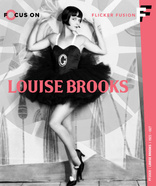

Movie rating
6.7 | / 10 |
Blu-ray rating
| Users |  | 0.0 |
| Reviewer |  | 4.0 |
| Overall | | 4.0 |
Overview
Focus on Louise Brooks (1925)
The Bowery's "Easy Money" Charlie is the best professional beggar there is, and he's also likely the most soft-hearted. When an acquaintance shares that she only has a short time left to live, he agrees to make her infant daughter his ward. Giving her a comfortable upbringing and status in society, her future is threatened when Charlie's past is revealed.
| Crime | 100% |
Specifications
Video
Video codec: MPEG-4 AVC
Video resolution: 1080p
Aspect ratio: 1.33:1
Original aspect ratio: 1.33:1
Audio
English: DTS-HD Master Audio 2.0
Subtitles
English, French, German, Spanish
Discs
Blu-ray Disc
Single disc (1 BD)
Packaging
Slipcover in original pressing
Playback
Region free
Review
Rating summary
| Movie | | 4.0 |
| Video | | 4.0 |
| Audio |  | 5.0 |
| Extras | | 4.0 |
| Overall | | 4.0 |
Focus on Louise Brooks Blu-ray Movie Review
Reviewed by Justin Dekker March 4, 2026A compilation of the early film work of from one of Hollywood's most recognizable female stars arrives on Blu-ray disc in 'Focus on Louise Brooks'
courtesy of Flicker Alley. It is the first entrant in the Flicker Fusion series which will present restored films, both complete and fragmentary, from
some of Hollywood's earliest big box-office draws. The four films found on this disc include Brooks' first on-screen appearance in 'The Street of
Forgotten Men (1925)' which is also the most complete. The other three titles, 'The American Venus' and 'Just Another Blonde' from 1926, and
1927's World War I comedy 'Now We're in the Air', are each comprised of all surviving material but do not represent complete films. The pleasingly
restored films feature excellent soundtracks, and engaging commentary tracks. A slipcover, booklet, and reversable cover art are also included.
Based on a Liberty Magazine story by George Kibbe Turner, The Street of Forgotten Men follows Easy Money Charley (Percy
Marmont, Four Sided Triangle (1953)), the Bowery's most accomplished, and most soft-hearted professional beggar, who, thanks to
carefully applied make-up and other effects is able to carve out a very comfortable living at the expense of the charitable nature of others. When a
terminally ill acquaintance asks him to adopt and care for her infant daughter Mary, he quickly consents, and raises her as his own. Now an adult,
Mary
(Mary Brian, The Virginian (1929)) develops an interest in suitor, and is blissfully unaware of her adoptive father's true occupation. With a
potential marriage on the horizon, Charley's double-life threatens to undo everything he's worked for, forcing him to take dramatic action before it's
too late.
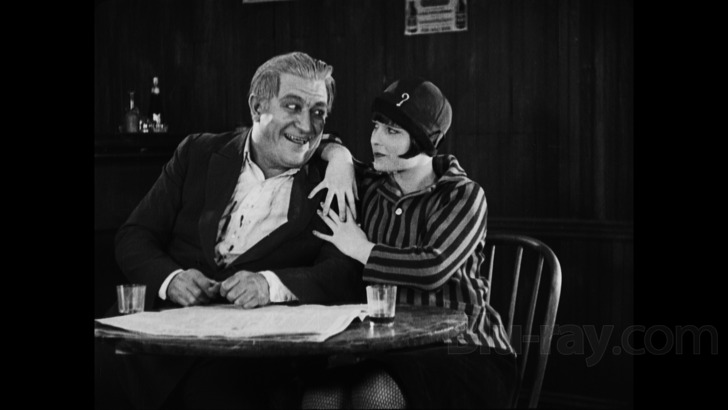
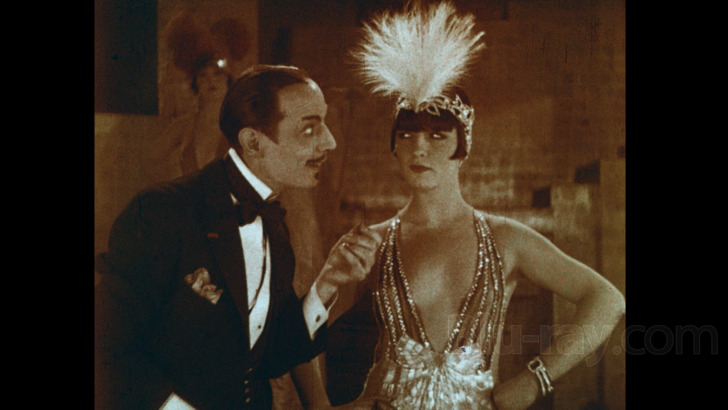
Before Louise Brooks would go on to star in her two most significant film roles Pandora's Box, and Diary of a Lost Girl, she would first find herself in The Street of Forgotten Men a 1925 tale of a professional beggar with a heart of gold. In it, she portrays the girlfriend of film's antagonist, another professional panhandler who seems to be absent scruples or limits. She's uncredited, but those familiar with her profile and trademark hairstyle should have no trouble spotting her near the film's end, as she spends time with her beau, sporting a glamorous costume that includes a spectacular hat embellished by an unmissable question mark. She's on the screen mere moments, but even here she displays an inherent magnetism and presence that far surpasses her experience.
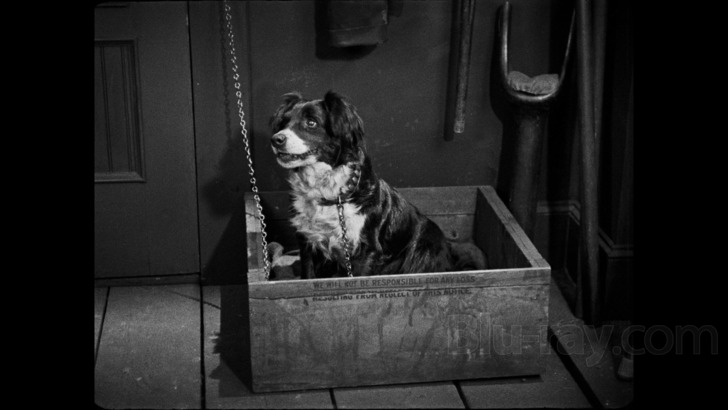
While the climax of the film is rather exciting, and made all the more so by Brooks' presence, the balance of the film is quite touching. This is largely the result of Charley's character arc, and the compassion and tenderness Percy Marmont brings to the role. Early in the film, the existence of his beloved dog sets him apart from the others who ply his swindling trade. After an arduous day as one of the world's untouchable unfortunates, his entire being is transformed when he's greeted by his beloved canine. That said, even with his loyal companion, his is a rather solitary existence, devoid of any meaningful human contact or relationship. Were he to vanish, he might initially be missed by some at the bar which serves as his base of operation, but he would not be long remembered.
His kind-heartedness, though, is ultimately his gateway to a more fulfilling life, for it's that trait that marks him as the ideal caretaker for the soon- to-be-orphaned Mary. The viewer is rapidly reassured the girl's dying mother made the right choice when we witness the care with which he tucks his young ward in for the first time. Later, we learn of the decisions he's made in the girl's upbringing; providing her with a well-appointed beautiful home, a good education, and respectable standing in society. It's a picturesque life that is far removed from what would have otherwise awaited her due the era in which the film is set and her rough and bleak beginnings. Her origin is practically Dickensian. Played by Mary Brian, once proclaimed "sweetest girl in pictures", the devotion her character displays to Charley provides further evidence to the fact that he has been a wonderful father to her. Even as she enters adulthood, Charley continues to prioritize her needs and happiness above all else, with the sacrifices and decisions he makes ensuring he won't be forgotten.
Once viewers have finished with The Street of Forgotten Men, the only essentially complete film included in this release, there are fragments from three other of Brook's films that are presented here. While none provide a complete viewing experience, they are nonetheless fascinating as they document the growth of both her skill and status within the early days of Hollywood. Each are found under the "Play Feature" section of the disc's main menu.
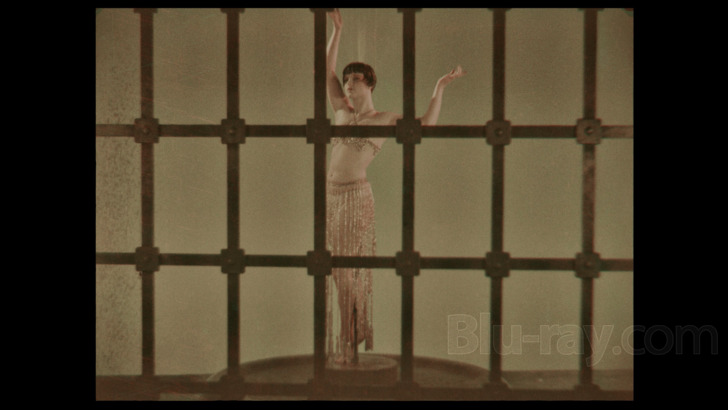
- 'The American Venus' (7.56) - The only known surviving material related to the film is found here, and consists of three trailers (a 35mm tinted nitrate print with two-color Technicolor insert, a 35mm black and white print, and a 16mm black and white print), two excerpts (one 35mm two-color Technicolor print, and one black and white), along with a Color Test (35mm two-color Technicolor print). Playable with an optional commentary from film historian Thomas Gladysz and film restorer Robert Byrne, the pair provide a significant amount of information in a short amount of time. The undeniable highlight here is the only existing color film footage of Louise Brooks in the form of a scant 91 frames from a color test. The American Venus was Brook's second film, and the first in which appears as one of the primary stars at just 18 years of age.
- 'Just Another Blonde' (32.22) - This 1926 film is sourced from a 35mm tinted nitrate print of the portions of the five (out of six) remaining reels of the film which were duplicated for preservation purposes in 1994. Restoration, carried out in 2025, included work to remove scratches, dust, and frame repair. The 35mm trailer survives as well. This selection can be viewed with an optional commentary from film historian Thomas Gladysz and film restorer Kathy Rose O'Regan. Keep an eye out for Brooks reading "Gentlemen Prefer Blondes" in an early scene.
- 'Now We're in the Air' (23.18) - While the film is one of a number of comedies that would see Wallace Beery partnered with Raymond Hatton, the 1927 film is of most importance here as it finds Brooks playing twins, one raised in France and the other in Germany, and was considered completely lost until portions of a 35mm tinted nitrate print consisting of sections of reels two, three, and six (out of six), were located in Prague, Czech Republic. While only the French half of her dual role is captured here, her energy and presence are riveting. Reproductions of the English intertitles were created based on an original continuity script and were crafted in a manner consistent with surviving Czech intertitles in terms of font and color. This selection can be viewed with an optional commentary from film historian Thomas Gladysz and film restorer Robert Byrne.
Focus on Louise Brooks Blu-ray Movie, Video Quality
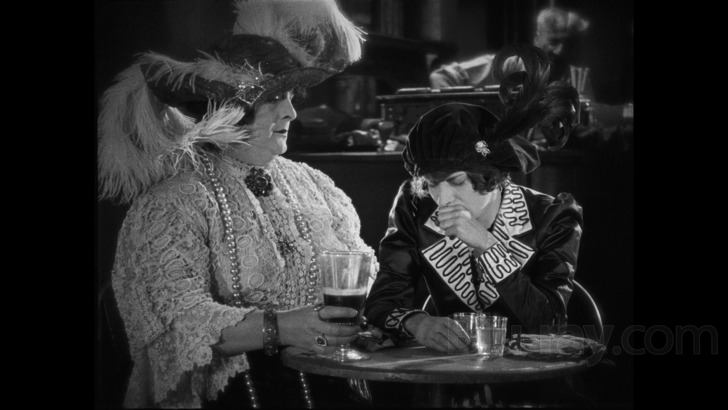
The Street of Forgotten Men's, as well as the other material's AVC-encoded 1080p presentations look remarkably good, considering the age
and condition of the film materials. Preceding each film (or selection), some brief information regarding the source material is provided, while the
booklet goes into greater depth. The deterioration and, sometimes, outright disintegration of the original film elements is consistently the the greatest
obstacle to overcome for the films included here. Regarding The Street of Forgotten Men as six of the seven reels of the film had survived,
the decision was made to reconstruct the missing second reel by leveraging the original script and a voluminous amount of stills. The end result is
surprisingly seamless and affords the viewer a complete viewing experience. Dust and scratches have been removed when possible, and image
stability and flickering have been addressed. These restorative measures have been judiciously and tastefully applied. Viewers will certainly notice
that there is some amount of each of these issues on display, so too is there occasional damage that is not completely resolved. This, per the
enclosed notes, is intentional and provides audiences with an undeniably improved but authentic viewing experience. The results are, in a word,
striking. Grain is present is is handled quite well. Fine detail levels can be rather high, especially in close up shots where details such as the icing on
Mary's birthday cake and flyaway hairs in the women's hairstyles are observable. So too, is the brickwork and the inscriptions at the cathedral Charley
and Mary visit when the film shoot goes on location. Environmental details are on display in Charley and Mary's cozy home, as are the rough
furnishings and the detritus that crowds the back room of the bar where Charley and the others get in and out of costume to ply their crooked trade.
The material present for the other films meets with largely similar results, with much of it roughly on par with The Street of Forgotten Men,
though for me, notable highlights would certainly be The American Venus's Excerpts #1 and the all-too-brief Color Test footage. Part 2 (Reel
3) of Now We're in the Air is likewise impressive with solid image depth and pleasingly defined costuming particulars of those attending and
performing in the carnival, even in spite of some damage that stubbornly recurs. On the whole, fans should be very happy with the restoration work
performed and the final image on display here.
Screenshots #1-3 and 6 - 13 are from The Street of Forgotten Men. Screenshot #11 displays an example of the solution for the missing
second reel.
Screenshot #4 is from American Venus Color Test.
Screenshots #5 and 14 are from American Venus Excerpts #1.
Screenshot #15 is from American Venus Color Trailer.
Screenshots #16 - 17 are from Just Another Blonde.
Screenshots #18 - 19 are from Now We're Up in the Air.
Focus on Louise Brooks Blu-ray Movie, Audio Quality
The films (or fragments thereof) found in Focus on Louise Brooks have been paired with a DTS-HD Master Audio 2.0 track that is more than up the task at hand. These being silent films, the bulk of what the track needs to do is handle the scores from Stephen Horne, whose work is heard on The Street of Forgotten Men and Now We're in the Air, and Wayne Barker, who is heard on Just Another Blonde and The American Venus. Horne's playful keys on Now We're up in the Air are delicate and precise, as are the lilting piano lines of Blonde's third reel, and the jazz inflected score to the dance scene in the fourth. Even in more dramatic and musically aggressive moments, instrumentation is clear, precise, and free from defect or distortion. The same holds true for the numerous commentary tracks, and the "Looking at Lulu" feature, where dialogue is consistently intelligible and free from defects or anomalies.
Focus on Louise Brooks Blu-ray Movie, Special Features and Extras
Focus on Louise Brooks includes an array of enlightening supplemental features for fans of the iconic star as detailed below.
- Restoration Demo (8.54) - This fascinating split-screen feature displays the differences between the surviving material of Now We're Up in the Air, on the left side of the screen with the restored version being found in the right. From there we move to material from Just Another Blonde and American Venus. The segment provides a sense of how dramatically the presentation of each has improved in terms of image stability, dirt and scratch removal, detail level, and other elements, while at the same time not overreaching with regard to damage repair. The focus of the restoration is an artful mix of preservation with an eye toward an authentic viewing experience.
- Looking at Lulu (34.35) - Film critic and historian Pamela Hutchinson shares her thoughts on Louise Brooks in this richly informative segment that also includes film clips and numerous stills, headshots, publicity photos, and the like. Hutchinson moves quickly to provide details on her early life, pre-film career, her time in Hollywood, abroad, and her return to the US. She provides context pertaining to Brooks' experiences both on and off the set, before she addresses Brooks falling into obscurity only to be rediscovered in the 1950s.
- Image Gallery - Viewers can manually advance through stills, publicity shots, posters, lobby cards, and advertising material from the films included in this release. In black-and-white and color without accompaniment.
- Audio Commentary for 'The Street of Forgotten Men' - Film critic and historian Pamela Hutchinson is on hand to provide viewers with a wealth of information about the film, beginning with comments about the film's source material and the bustling Bowery set. She quickly transitions to providing background on the film's director and his other output. She then covers the film's cast and the adorable canine actor, and other topics to numerous to recount. Hutchinson is rarely silent for more than a few seconds in this highly informative yet casual feeling track. It's a terrific listen.
- Booklet - The enclosed booklet provides information regarding the films, their source material, restoration work, and the artists whose music is heard here. A selection of color and black-and-white images are also included.
Focus on Louise Brooks Blu-ray Movie, Overall Score and Recommendation
Though her screentime is extremely limited in The Street of Forgotten Men, her presence in the film is palpable. Despite it's unusual setting, it's
a timeless tale of a parent willing to sacrifice anything for the happiness of their child. The portions of the other three films included here provide a
tantalizing glimpse into Brooks' all too short film career, with Now We're Up in the Air and her color test from American Venus being
particular stand-outs. While each of these films seem to include an impressive list of personages from Hollywood's silent era and beyond,
Forgotten Men's cinematographer Harold Rosson (as Hal Rosson here), grabbed my attention. He had a substantial number of films under his
belt by the time he lensed this picture, and he would go on to shoot a number of classic works including The Wizard of Oz, Singin' in the
Rain, and The Asphalt Jungle, and his framing and shot composition adds significantly to the film's melodrama and emotional pull. For fans
of the silent era and especially of Louise Brooks, Flicker Alley's Focus on Louise Brooks comes highly recommended.