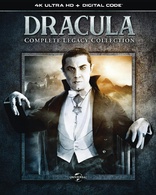
Dracula Complete Legacy Collection 4K Blu-ray Movie
HomeDracula Complete Legacy Collection 4K Blu-ray Movie 
Dracula / Drácula / Dracula's Daughter / Son of Dracula / House of Frankenstein / House of Dracula / Abbott and Costello Meet Frankenstein | 4K / 4K Ultra HD + Blu-ray + Digital CopyUniversal Studios | 1931-1948 | 7 Movies | 554 min | Not rated | Sep 30, 2025

Movie rating
Movie has not been rated yetBlu-ray rating
| Users |  | 0.0 |
| Reviewer |  | 4.5 |
| Overall | | 4.5 |
Overview
Dracula Complete Legacy Collection 4K (1931-1948)
The legendary bloodsucker stakes his claim on a British estate in search of new blood.
| Horror | 100% |
| Foreign | 13% |
| Sci-Fi | 11% |
| Drama | 2% |
| Fantasy | 2% |
| Comedy | Insignificant |
| Romance | Insignificant |
Specifications
Video
Video codec: HEVC / H.265
Video resolution: 4K (2160p)
Aspect ratio: 1.31:1
Original aspect ratio: 1.2:1
Audio
English: DTS-HD Master Audio 2.0 Mono (48kHz, 24-bit)
French: DTS 2.0
Spanish: DTS 2.0
German: DTS 2.0
Italian: DTS 2.0
Subtitles
English SDH, French, German, Italian, Japanese, Spanish, Danish, Dutch, Finnish, Mandarin (Simplified), Norwegian, Swedish
Discs
Blu-ray Disc
Four-disc set (4 BDs)
Digital copy
4K Ultra HD
Playback
Region A (B, C untested)
Review
Rating summary
| Movie | | 4.5 |
| Video | | 0.0 |
| Audio |  | 3.0 |
| Extras |  | 4.0 |
| Overall | | 4.5 |
Dracula Complete Legacy Collection 4K Blu-ray Movie Review
Reviewed by Justin Dekker October 17, 2025The entire cycle of the original 'Dracula' (and 'Dracula'-related) films which began with the Bela Lugosi classic in 1931 arrives on 4K UHD in the 'Dracula Complete Legacy Collection 4K' courtesy of Universal. All seven films (including the simultaneously shot Spanish version of 'Dracula') are included in this 4-disc set. All of the legacy on-disc supplemental material is brought forward to this set, which features solid technical merits. An embossed slipcase and a Digital Code redeemable via Movies Anywhere are also included.
For an appreciation of Dracula (1931), please follow this link.
Dracula's Daughter: 4.0/5.0
The first of several sequels to the film that introduced the world to the cinematic character of Dracula, and Bela Lugosi, the actor who brought him to horrifying and alluring life, 1935's Dracula's Daughter places Gloria Holden (The Life of Emile Zola) in the title role, giving a franchise a easily explained gender swap. Lugosi isn't part of this production, though Edward Van Sloan's Professor Van Helsing returns, offering the sequel a modicum of connective tissue and serving, once again, as a credible foe to the undead menace. Given that the film takes place soon after the events of the 1931 classic Dracula, somehow, inexplicably, the film has vaulted forward a great many years to a more modern London replete with electric lights and telephones. That the era of the sequel has changed so dramatically, and given that a virtually unchanged Van Helsing is the same man who fought Dracula in the first film, viewers are simply expected to ignore this continuity issue and accept the tale the film presents.
Given Holden's performance, this is easy to do. Where Lugosi's Dracula was possessed of a seductive but unmistakably malevolent evil, Holden's Countess Zaleska, as she introduces herself in polite society, is quite different. While she exudes a smoldering and entrancing sexuality, hers is coupled with a sense of vulnerability, softness, and a certain world-weariness. Her unassumingly elegant artist persona allows her to lure potential victims like the lovely and waifish Lili (Nan Grey) into her exanguinating clutches, making her seem almost gentle in comparison to Lugosi's more dramatic, threatening, and sweeping embrace.
Bringing the action almost back in time, the film transitions to Transylvania for its final act, and a love triangle of sorts comes into stark focus. While Countess Zaleska seeks to spend eternity with another man, she uses a woman dear to him as bait/leverage. Flooded with obvious disapproval, her faithful henchman Sandor (played perfectly by Irving Pichel) feels slighted. As is the case in gothic horror/drama, while Countess Zaleska remains optimistic about her plan's success, it sets events on an unfortunate and unavoidable trajectory. It's here that the film provides viewers with its greatest and only disappointment. While Van Helsing is ultimately on hand at her castle in the film's waning moments, his function is merely to explain, and not to square off against her in what would have been a more dramatic and thrilling final confrontation.
Son of Dracula: 3.0/5.0
Once again, in more modern times, Lon Chaney Jr. is on hand to perform the spooky blood-sucking duties as another of Dracula's cursed offspring as the titular character in 1943's Son of Dracula. After the death of her father, our heroine, Katherine, wants to keep the plantation and stay at Dark Oaks, as the house is known. Claire is skeptical of the newly-arrived Count Alucard, and it's quickly observed that Alucard is "Dracula" backward. Frank Craven's Dr. Brewster is Claire's co-conspirator, investigating Alucard and questioning what is going on with Katherine. Lon Cheney Jr.'s film career began in earnest in the early 1930's but it was his turn as the ill-fated Larry Talbot in 1941's The Wolf Man that finally provided him with notoriety. Cheney would go on to portray a mummy and Frankenstein's monster, creating a creepy trifecta of sorts. As he didn't play Dracula, but rather his son, he's denied membership to the unofficial club of which Christopher Lee is a member, being one of the few to have played Dracula, Frankenstein's monster, and the Mummy. While Lugosi's Count was suave and seductive, and Lee's mixed an imposing physical presence with sex appeal, Cheney's Count Alucard is direct, almost brutish. He doesn't suggest, he bullies. He doesn't seduce, he demands. And rather than a timeless elegance which informed Lugosi's portrayal, Cheney's mannerisms and pattern of speech are of a much more modern rather than antiquated, and far more American than Eastern European.
House of Frankenstein: 3.5/5.0
There are certain actors who elevate any film they are in simply by virtue of their presence. Boris Karloff is one such actor. While the film boasts Frankenstein's monster, Dracula, and the Wolf Man among its menacing roster of characters, Karloff stays out of such grueling makeup and elaborate costumes. Here, he's the much-maligned and imprisoned Dr. Niemann, a man to whom the secrets and lessons of Dr. Frankenstein have been passed down. While he continues to fine-tune what he's learned while incarcerated, he promises his cellmate, a hunchback, to cure his ailment as soon as the pair are free. Escaping after the prison suffers catastrophic damage during a storm, the pair quickly assume the roles of traveling showmen, Professor Lampini and his assistant. After reviving Dracula, whose body the real Lampini recovered from his castle in Carpathia, the two make their way to Frankenstein's castle. While the film gets busier with monstrous action from there, Karloff's refined and restrained performance adds a certain gravity and importance to the sometimes silly on-screen action. For, through it all, Karloff is utterly committed and convincing.
Aside from Universal's stable of classic monsters, the film does its best to bring in shades of Victor Hugo's The Hunchback of Notre Dame. Niemann's assistant, Daniel, is a hunchback. Somewhat unlike Quasimodo, he's an affable fellow, able-bodied, strong, and articulate. He's quickly smitten with a beautiful young gypsy girl, Ilonka (Elana Verdugo), who he meets as soon as the two stop in the village of Frankenstein. While most recoil from the sight of him, the young woman shows him kindness and treats him like a person, rather than defining him by his physical disability. It quickly becomes clear, however, that her obvious affection for Larry Talbot is all but assured to be the source of future problems.
Cheney demonstrates that he has a unique connection to and understanding of the tragic Larry Talbot. The anguish on his face and in his performance is palpable. Despite Niemann's assurance of help and relief from the curse that plagues him, and the attentions of Ilonka, Talbot remains as hopeless as he is impatient. He goes through the motions of the plan to assist him, though he clearly believes that nothing can save him. It's an emotional performance that, for fans of The Wolf Man, will ring true and feel like the logical progression of the character.
House of Dracula: 2.5/5.0
House of Dracula, should, to some degree, be commended for trying to break the break the mold of the Universal monster movies that had come before. Residing and treating patients out of a remote castle outside the town of Visaria, the renowned Dr. Edelmann (Onslow Stevens) conducts his experiments and does his work with the help of two nurses, the beautiful Miliza (Martha O'Driscoll), and the hunchbacked Nina (Jane Adams). Within a very short period of time, both Count Dracula (John Carradine), and Lawrence Talbot (AKA The Wolf Man) (Lon Cheney Jr.) arrive looking for a cure to their respective conditions. Far from being a "mad scientist, Dr. Edelmann is a logical, rational man of science. He quickly finds a very terrestrial cause for both men's afflictions, and a similarly "real world" medical solution for each. He's even found a potential cure for Nina. While all of this sounds promising, experienced monster movie viewers know it's never that simple.
But with its novel and made-to-sound reasonable scientific explanations for both lycanthropy and vampirism, House of Dracula inadvertently robs itself of some of what makes monster movies fun - the supernatural. Medical causes and solutions to these conditions render them both less frightening. The presence of a parasite in the blood also does little to allow for a vampire to turn into a bat, something Carradine's Dracula does here, nor does it explain how a vampire could transform into mist, or why they have an aversion to crosses. The idea of a parasite being the root cause for vampirism would reappear from time to time, and was, perhaps, best handled in Guillermo del Toro and Chuck Hogan's "The Strain" book trilogy and the television series that it spawned. Similarly, a simple surgical cure for lycanthrope makes the disease no more terrifying than any other uncommon illness, which can be remedied by going under the knife. Part of what made Talbot's character interesting is the torment he endured and his powerlessness against the cyclical transformations. When a simple, easy-to-replicate procedure is the solution, no one has a reason to fear werewolves. Throughout it all, Frankenstein's monster is largely an afterthought, and his presence is wasted. An unfortunate casualty in a film that could have used some more "traditional" monster-related thrills.
Abbott and Costello Meet Frankenstein: 4.0/5.0
During their heyday of the 1940s and 1950s, the comedy duo of Bud Abbott and Lou Costello would make over thirty films. While a number of them had spooky overtones and plots, in my opinion, few surpassed Abbott and Costello Meet Frankenstein. Aside from a solid story that effectively lampoons the comparatively young monster movie genre, and the expected comedic stylings of the frantic and frightened Costello (Wilbur) and the grouchy and skeptical Abbott (Chick), the film is notable for Bela Lugosi reprising his role of Dracula for the first time since the 1931 film of the same name. While Lugosi had continued working since that classic film landed on the screen, none of his projects matched Dracula in terms of quality or success, though The Island of Lost Souls, Voodoo Man, and The Devil Bat are highlights. Though years removed from his first filmic performance of the Count, Lugosi seems incredibly comfortable in the cape and fangs. From his first appearance here, he quickly reasserts his supremacy in the role, leaving the viewer wishing he had more screen time.
While Boris Karloff does not return for the role of the Monster, those chores are handled by Glen Strange, Lon Chaney Jr. is back as the tragic Larry Talbot. However effective the cure may have appeared in House of Dracula, its efficacy seems to have abated, as, once again, the full moon brings about his horrific transformation. However sad as that may be, it's undeniable that an afflicted Larry Talbot is a more interesting character, and Chaney plays the role perfectly. He's pitiable in his condition and almost frantic in both his desire to stop the resuscitation of Frankenstein's monster, and his warning regarding Dracula. While he does have a moment or two where he uses his size to make Talbot menacing, for the most part, he leaves the scaring and intimidating moments to the monsters.
Dracula Complete Legacy Collection 4K Blu-ray Movie, Video Quality
For an assessment of Dracula (1931)'s 4K presentation, please follow this link.
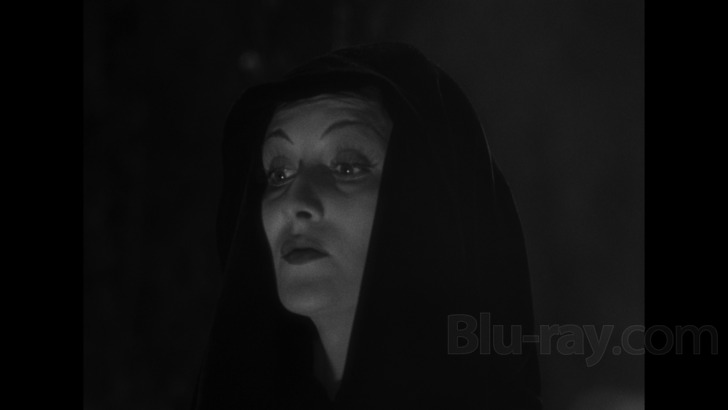
Dracula's Daughter 4.5/5.0: (Screenshots 1-4) The difference between the 2017 Blu-ray and this new 4K transfer is immediately noticeable,
starting from the
opening credits. Letters are sharp and crisp, and read a touch brighter than their duller and less precise Blu-ray counterparts. The opening scene, as
the two policemen descend the stairs, is still a bit soft, but once they reach the bottom and discover the body, the image becomes much more
defined, and remains that way for the rest of the film's runtime. There are still some softer, glamorous shots of star Gloria Holden and a few others as
well,
but those are stylistic choices and not a defect or inadequacy of the transfer. Grain is present and resolves naturally and without issue, giving
Dracula's Daughter a nicely filmic look. Facial particulars are open for inspection, from Edward Van Sloan's (Professor Van Helsing) deep
wrinkled chin, to Holden's eyes, lashes, and eyebrows, which are a frequent focus in scenes where she is attempting to exert her hypnotic influence.
Generally speaking, the contrast is improved in this black and white feature, offering deeper, inkier blacks which afford the picture greater depth. The
grey-scale is also expanded, allowing viewers a better look into character and environmental details in the film's numerous dark and moody scenes. I
did not detect any defects or other issues. It's a wonderful transfer.
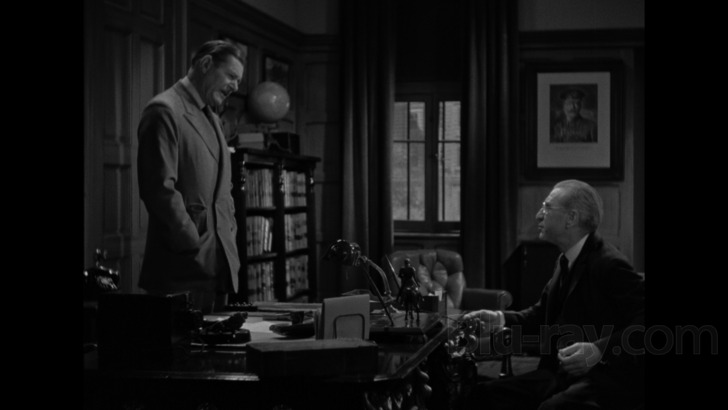
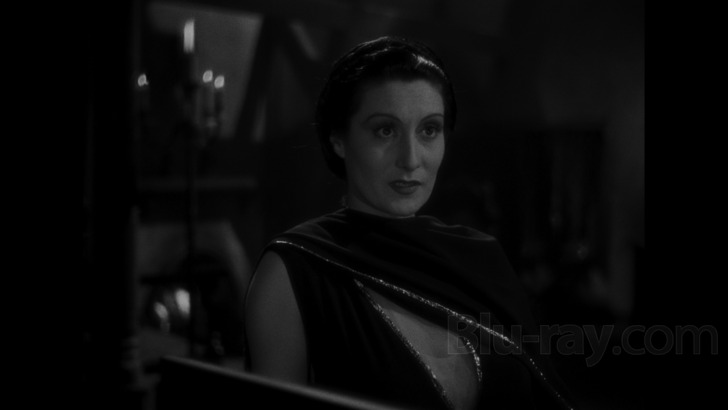
Son of Dracula 4.25/5.0: (Screenshots 5-8) As with Dracula's Daughter 4K the image on display here is improved over the 2017
Blu-
ray as well. Blacks are
inkier, providing greater depth to shadows and better dimensionality to the picture. Darker scenes still yield a great of detail in the shadows, such as
when Katherine (Louise Allbritton) flees from Queen Zimba's home through the dark and spooky woods. At the party, her sequined dress is alive with
reflected light, giving it an almost unearthly quality as she shares her interest in matters of the occult. Close-ups of Allbritton can still exhibit a moody
softness, as was the filmmakers' intent. Environmental particulars are frequently on display, from the crowded and cluttered contents of Queen
Zimba's squalid home and the more elegant and lavishly appointed Caldwell home. Fine grain is present, but resolves without issue. The film is free
from issues or defects, though certain scene transitions reveal source limitations.
House of Frankenstein 4.5/5.0: (Screenshots 9-12) As has been the case with the other sequels included in the collection, House of
Frankenstein 4K
has been given a healthy 2160p transfer, with a pleasing layer of fine film grain. Close-ups and midrange shots consistently fare the best, displaying a
heightened level of detail that enables viewers to see the exacting details in the fake bead Boris Karloff wears when imprisoned at the film's start. The
same holds true inside Lampini's carriage, where viewers can appreciate the facial and fabric particulars, as well as specifics of the objects contained
therein. Blacks are deeper here than on the previous Blu-ray, and whites are brighter, allowing for greater contrast, an improved greyscale, and more
detail visible in darker environs. On the whole, the film looks excellent in motion, and the print is free from damage, dirt, and debris. Fans of this
monster mash should be pleased.
House of Dracula 4.5/5.0: (Screenshots 13-16) House of Dracula has been given a nicely filmic 2160p transfer. Grain is present but
is never problematic.
Contrast is once again improved here, allowing for deeper blacks, brighter whites, and more subtle gradations in between. Shadowy depths are rarely
impenetrable, save for some instances when it appears to have been the filmmakers' choice to keep certain scenic or character elements bathed in
darkness. Some process shots retain a certain softness, but on the whole, the film looks sharper and better defined here than its previous Blu-ray
release. Fine detail in the cast's faces and costuming elements is pleasing, and many of the sets, such as Dr. Edelmann's castle and laboratory,
are open for inspection. While a simpler set, even the jail cell where Larry Talbot spends some time yields some pleasing detail, particularly the cell's
iron bars, which have an excellent tactile realism.
Abbott and Costello Meet Frankenstein 4.5/5.0: (Screenshots 17-20) Featuring a barely there layer of film grain, the image on display here
is typically very
sharp, particularly in midrange and close-up shots. Fine lines and wrinkles are typically easy to observe on Costello and Lugosi's faces, as are
hairstyle particulars on the female members of the cast. Blacks are pleasing deep, and the expanded palette of greys makes more complex
environments, such as the leafy set where Costello searches for Joan and Talbot transforms much more nuanced and defined. Lugosi's cape presents
with a pleasing silkiness, and the myriad fabrics seen at the costume party present with satisfying realism, especially lacey and sequined
elements of which there are many.
Screenshots are sourced from the 4K UHD discs and downscaled to 1080 and are in SDR.
Dracula Complete Legacy Collection 4K Blu-ray Movie, Audio Quality
For an understanding of the audio tracks for the films included here, please follow the links below.
Dracula
Dracula's Daughter
Son of Dracula
House of Frankenstein
House of Dracula
Abbott and Costello Meet
Frankenstein
Dracula Complete Legacy Collection 4K Blu-ray Movie, Special Features and Extras
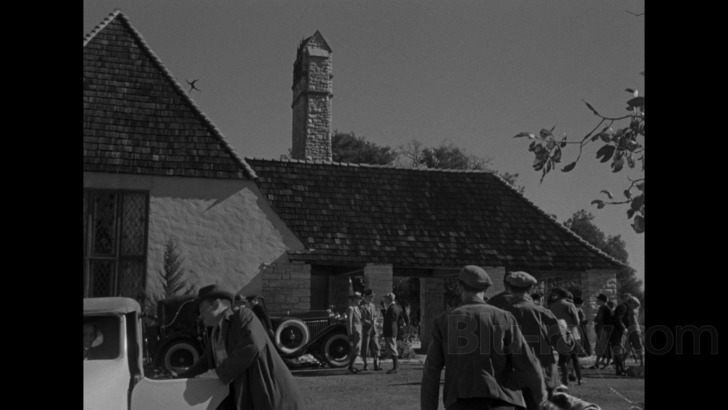
As there aren't any new features added to this release, please follow this link to learn about the legacy supplements brought forward to these discs. Information on the extras included on Abbott and Costello Meet Frankenstein can be found here.
Dracula Complete Legacy Collection 4K Blu-ray Movie, Overall Score and Recommendation
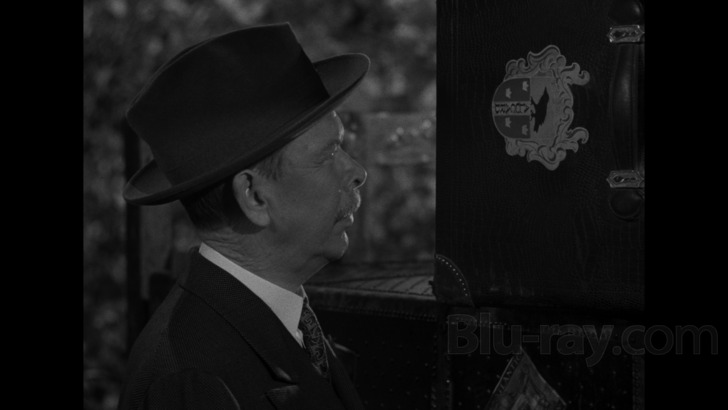
The importance of Dracula (1931) to both Universal and horror cinema in general cannot be overstated. The film concerning what would become the world's most famous undead monster saved the studio financially, codified what we understand about vampires, and informed every subsequent portrayal of the masters of the night across all forms of media. It also made Bela Lugosi one of the most well-known and enduring stars to ever grace the silver screen. Each of the direct sequels and the other associated films have received very appealing 4K transfers, and though the films vary in story quality, and preference will come down to a matter of individual taste, each is an enjoyable watch in their own right. The Dracula Complete Legacy Collection 4K comes highly recommended.