Beyond the Black Rainbow Blu-ray Movie
HomeBeyond the Black Rainbow Blu-ray Movie 
Magnolia Pictures | 2010 | 110 min | Rated R | Sep 11, 2012


Movie rating
7 | / 10 |
Blu-ray rating
| Users |  | 4.2 |
| Reviewer |  | 2.5 |
| Overall |  | 3.4 |
Overview
Beyond the Black Rainbow (2010)
Despite being under heavy sedation, Elena tries to make her way out of Arboria, a secluded, quasi-futuristic commune.
Starring: Michael J Rogers, Eva Bourne, Scott Hylands, Rondel Reynoldson, Marilyn NorryDirector: Panos Cosmatos
| Horror | 100% |
| Surreal | 34% |
| Psychological thriller | 33% |
| Period | Insignificant |
| Sci-Fi | Insignificant |
Specifications
Video
Video codec: MPEG-4 AVC
Video resolution: 1080p
Aspect ratio: 2.41:1
Original aspect ratio: 2.39:1
Audio
English: DTS-HD Master Audio 5.1 (48kHz, 16-bit)
Subtitles
English SDH, Spanish
Discs
25GB Blu-ray Disc
Single disc (1 BD)
Playback
Region A (C untested)
Review
Rating summary
| Movie | | 2.5 |
| Video |  | 4.0 |
| Audio | | 4.5 |
| Extras |  | 0.5 |
| Overall | | 2.5 |
Beyond the Black Rainbow Blu-ray Movie Review
A would-be cult classic that tries too hard and not enough.
Reviewed by Casey Broadwater September 14, 2012No, Beyond the Black Rainbow isn't the blaxsploitation version of The Wizard of Oz, but by the end you might
wish it were. From the
look and feel of it, this retrofied sci-fi thriller was clearly made by someone who loves Stanley Kubrick but doesn't realize
there's more to 2001: A
Space Odyssey than trippy colors and symmetry and unsettling quietness. That someone is Panos Cosmatos—son of the
late Tombstone
and Rambo: First Blood Part II director, George P. Cosmatos—and his stab at making an esoteric cult classic comes
up short. Spectacularly
short, maybe—in that Beyond the Black Rainbow is, if nothing else, an impressive visual spectacle—but the problem
here is that the film just
doesn't have the substance to match Cosmatos' keen sense of style.
The barrenness of content isn't for a lack of thematic touchstones. Drawing on his own 1980s childhood, Cosmatos fills the
film—which is set in a
future-past version of 1983—with nostalgically outdated tech, Cronenberg-like practical effects, and electric surges of Reagan-
era unease. Plus, a
killer synthesizer soundtrack. Black Rainbow is most definitely suffused with a distinct mood—think midnight
B-movie meets acid
freakout meets 16mm science class film strip—and at its best you might say it's a handy substitute for hallucinogenics. (But
not something
you'd want to watch while on them; that would be a seriously dark trip indeed.) Unfortunately, the film's highs are few,
squeezed out dropper-like into
an otherwise lackluster narrative.
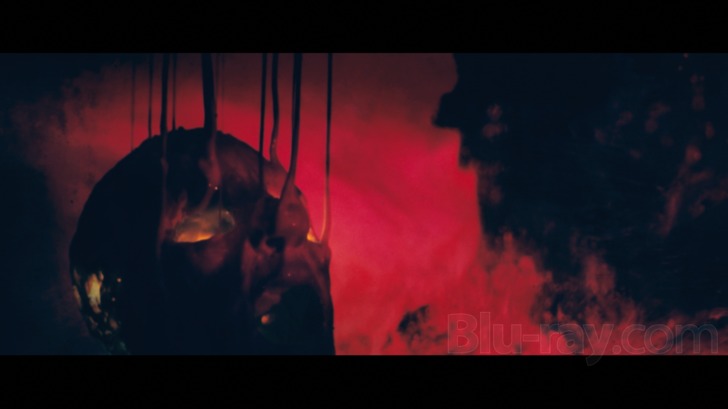
Somewhere, beyond the black rainbow...
Fans of ABC's LOST might get a Dharma Initiative vibe from the film's instructional video prologue, in which Dr. Mercurio Arboria (Scott Hylands) introduces us to the Arboria Institute, a cult-like think tank and clinic where "herbists, naturalists, and healers" have discovered new means of attaining happiness through "benign pharmacology" and "energy sculpting." Don't worry about the pseudoscientific details, because there aren't any; Beyond the Black Rainbow uses the institute as little more than an evocative setting.
It is evocative, though, and it's obvious that the fairly low budget movie blew its wad on sleek, minimalist production design. The interiors have an aesthetic that's like a darker, insidious version of 2001's spaceships, with reflective plastic and glass panelling everywhere and intense red lighting. It's very 1980's retro-futurist, all staticky tube TVs and front-projection screens, ancient computer terminals and big beige landline telephones. If films were judged by set design alone, this one would would net an easy five stars. Cosmatos employs "experimental" cinematography to match as well, using grainy, heavily color-manipulated 35mm footage—lots of red/blue duotone printing—and often intentionally throwing faces out of focus for effect. It's music video-ish in a mostly good way.
The plot, however, is music video-ish in a decidedly bad way. That is, there's barely a story here at all. We mainly follow the elderly Dr. Arboria's lab- running protege, Barry Nyle, a weasely-looking scientist who's unhealthily obsessed with—and exerts control over—what seems to be the institute's only patient, Elena (Eva Allen), an orphaned teenaged brunette with uncertain telekinetic powers. The heavily sedated girl is kept in a sparse room— the pen-tapping Nyle questions her from behind a glass wall, trying to elicit emotions—and she doesn't speak a single word until 26 minutes into the film, when she finally croaks out, "I want to see my father, please." There's apparently some question here about Elena's potential status as the hope for all mankind—that she may be "the dawning of a new era"—but this isn't developed enough to make much of an impact. In fact, it's not developed at all.
Instead, we watch the weird, jittery Nyle as he pops pills, goes home to a woman (his lover? his mother?) who's always meditating, and has a flashback to his acid-dropping induction into the Arboreal Institute. This particular sequence, shot in blown-out black and white, is the most memorable —Nyle sinks down into a kind of circular tar pit in the floor and later reemerges, covered in oozing black sludge. He looks like he just crawled out of the opening "Immigrant Song" credit sequence in David Fincher's The Girl with the Dragon Tattoo. Eventually, Elena escapes the facility, and Nyle —who has now removed his wig, revealing himself as an alopecia-afflicted cross between Voldemort and Arrested Development's Stan Sitwell— goes after her, toting a dagger he refers to as "The Devil's Teardrop." And that's essentially all that happens. If you don't get it, fret not— there's nothing to get. This bare minimum of a narrative is simply a meaningless framework over which Cosmatos drapes his druggy visuals.
The debut director cribs liberally from the artistic playbooks of Jodorowsky and Cronenberg, Kubrick and Kenneth Anger, but unlike these true geniuses —who use(d) their visionary styles to mirror the social and philosophical substance of their films—Cosmatos has little to nothing to say. Emotionally, the movie is as sterile and vacuous as its austere setting. We don't feel anything for Elena or Nyle because we don't know enough about them or their situation to care. And because we don't care about the characters, we quickly stop caring about the director's clever camera setups. It's one thing to be enigmatic and let audiences piece together a mystery on their own—David Lynch has made a career of this—but its something else entirely to give only the illusion of depth and leave viewers frustrated and bored. It's the very definition of pretentious. There's a scene in the film where a character stands inside a room made entirely of mirrors, and this seems like a good analogy for Beyond the Black Rainbow itself—it's visually dazzling, sure, but it only reflects its own emptiness.
Beyond the Black Rainbow Blu-ray Movie, Video Quality

There's not much use trying to write up a standard checklist-style evaluation of Beyond the Black Rainbow's picture quality on Blu-ray. The film has been pre-and-post-processed to oblivion, so the usual rules don't really apply. That said, I think the film looks fantastic in high definition, and I'm certain Magnolia's 1080p/AVC-encoded transfer—minus some negligible compression artifacts—is true to source. Shot on 2-perf 35mm, the movie has a very chunky grain structure, which naturally effects the clarity of the picture. The softness here isn't a bad thing, though, as it accentuates the simultaneously gritty/polished retro-futurist vibe. (Besides, Panatos is always throwing things intentionally out of focus anyway.) A big part of the film's aesthetic is the heavily stylized color palette, which involves lots of bright reds and blues. There's a bit of a cross- processed look here at times, with creamy yellowish highlights and raised black levels that are slightly tinted. It works. On the encode/authoring side of things, there's no edge enhancement, DNR, or other concerns, and the compression noise you might pick up while pixel peeping is completely unnoticeable from a normal viewing distance.
Beyond the Black Rainbow Blu-ray Movie, Audio Quality

Beyond the Black Rainbow's sound design—delivered here via lossless DTS-HD Master Audio 5.1 surround track—is all about the atmosphere. You won't hear many whiz-bang effects or notice much cross-channel directionality, but you will be immersed in the acoustic uneasiness of the Arboria Institute. Strange electronic thrummings. Flourescent buzzes. Wub-wub- wub subwoofer pulses. Mechanical hisses. Bleeps and bloops. Archaic modem lines grating and pinging. It's very effective and it all sounds great, with sufficient clarity and oomph. The minimal dialogue is clean and clear too, requiring no fiddling with your remote once you set a decent listening level. (English SDH and Spanish subs are available in bright yellowing lettering for those who need or want them.) The real kicker, however, is the menacing old-school synthesizer score by Jeremy Schmidt, which wobbles and drones throughout the film, oozing mood. Fans of Drive's soundtrack take note.
Beyond the Black Rainbow Blu-ray Movie, Special Features and Extras
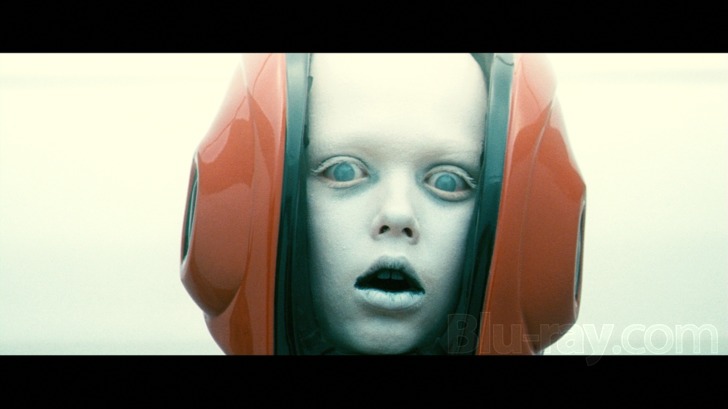
Bummer. Like the film, there's not much substance to be found in the special features. I would've loved a commentary from Cosmatos.
- Deleted Special Effect - Ballistic Head Dissolve (1080p, 3:21): Yep, a melting, dissolving head.
- Theatrical Trailer (1080p, 2:21)
- Also from Magnolia Home Entertainment (1080p, 4:30)
Beyond the Black Rainbow Blu-ray Movie, Overall Score and Recommendation

I was really impressed by the trailer for Beyond the Black Rainbow, which leads me to think the film would definitely work better in shorter form—it could stand to lose a good twenty minutes—or even as a music video concept. As a feature, though, it leaves a lot to be desired. Beyond the trippy throwback visuals and oppressive mood, there's not much of substance going on here. I have no doubt the film will find fans willing to overlook the empty story, but imagine how great Black Rainbow would be if it actually had anything to say! Ah well. Here's hoping Panos Cosmatos comes up with a more fleshed out script next time. He's definitely got the aesthetic side of things under control. Magnolia's Blu-ray release is short on special features—a commentary would've been appreciated here—but the film looks and sounds great. Proceed at your own caution.
Similar titles
Similar titles you might also like

We Are Still Here
2015

Mandy
2018

Censor
2021

The Blob 4K
1988

Hell's Highway
2002

Sorority House Massacre 4K
1986

The Mind's Eye
2016

Patrick: Evil Awakens
2013

Nightmare Weekend
1986

Rabid
2019

Slithis
Spawn of the Slithis
1978

Nightflyers: Season One
2018

Videodrome 4K
Unrated Version
1983

Baron Blood
Gli orrori del castello di Norimberga
1972

Trauma
Dario Argento's Trauma | Standard Edition
1993

From Beyond 4K
Slipcover in Original Pressing
1986

Stanley
1972

Death by Dialogue
1988

The Conjuring
2013
Video Violence
1987